Middle East conflict fuels stockpiling surge in Malaysia

The surge in stockpiling in Malaysia has come at a cost for both businesses and consumers. Input cost inflation climbed to a 45-month high as energy and raw material prices spiked.

Motorists ride past an anti-US billboard referring to President Donald Trump and the Strait of Hormuz at Valiasr Square in Tehran on May 2, 2026. ( Photo: AFP)

Kuala Lumpur (VNA) – Malaysia’s manufacturing sector recorded its strongest performance in four years in April, but economists have cautioned that the uptick was largely driven by precautionary stockpiling amid the ongoing Middle East conflict.

According to the latest S&P Global report on Malaysia’s Manufacturing Purchasing Managers’ Index (PMI), the seasonally adjusted PMI rose sharply to 51.6 in April from 50.7 in March. This marked the second consecutive month above the neutral 50.0 threshold, signalling an overall improvement in operating conditions. Output growth was the fastest since December 2021.

However, S&P Global noted that the rebound was not entirely demand-driven. Instead, manufacturers and their clients have been actively building “safety stocks”, purchasing large volumes to hedge against potential shortages and price increases linked to geopolitical tensions in the Middle East.

The surge in stockpiling has come at a cost for both businesses and consumers. Input cost inflation climbed to a 45-month high as energy and raw material prices spiked. Manufacturers have passed on these higher costs to customers, pushing selling prices to a record high in the survey’s history.

The conflict has also severely disrupted global logistics, with supplier delivery times lengthening to their worst level in nearly four years. While domestic demand strengthened as local customers increased purchases, external demand weakened. New export orders declined for a second consecutive month, reflecting subdued demand from overseas buyers amid geopolitical uncertainty.

To cope with the sharp rise in production demand, Malaysian manufacturers stepped up hiring, recording the strongest pace of job creation since the beginning of the year. Despite increased staffing, backlogs of work continued to rise slightly due to ongoing material shortages.

Even as output and employment expanded, business confidence remained fragile. Manufacturers’ optimism fell to its lowest level in eight months, weighed down by the unpredictable developments of the Middle East crisis.

Maryam Baluch, an economist at S&P Global Market Intelligence, said the latest data clearly show the conflict’s impact on local factories. Stockpiling has boosted output significantly, partly to build inventories of finished goods. Companies also reported similar behaviour among their customers, resulting in a rebound in new orders in April.

She added that the sector’s performance in the coming months will depend in part on developments in the Middle East, but the latest data highlight the measures manufacturers are taking to mitigate the impact of the crisis./.

VNA

See more

Portable solar panels charge a power station outside a suburban home at dusk (Photo: solarquarter.com)

Solar generator demand surges in Malaysia

According to solarquarter.com, prices have risen by about 20% since February, yet consumers continue to invest in these systems as reliable backup power sources against outages and rising energy costs.

Thailand: BOT warns SMEs and vulnerable groups face hardest economic shock (Photo: The Nation)

Thailand faces economic shock from Middle East tensions

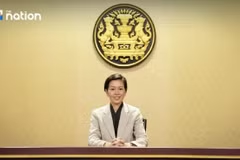
Bank of Thailand Governor Vitai Ratanakorn said the economy was likely to slow as many parties had assessed. The clear impact was higher inflation, affecting both businesses and households, which were beginning to face more pressure from rising costs, as well as effects on debt and liquidity.

Malaysia pursues balanced economic diplomacy

Malaysia pursues balanced economic diplomacy

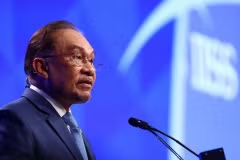
Malaysian Prime Minister Datuk Seri Anwar Ibrahim said Malaysia will continue to strengthen economic cooperation with key trading partners, including China and the US, despite differences in views on geopolitical issues.

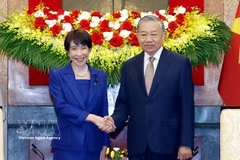
Party General Secretary and State President To Lam (R) receives Japanese Prime Minister Sanae Takaichi in Hanoi on May 2 (Photo: VNA)

Japanese PM highlights outcomes of visits to Vietnam, Australia

Speaking to the press in Canberra on May 4, the Japanese PM stressed that during her visits to Vietnam and Australia, in addition to deepening personal trust among leaders, she and the leaders were able to reach agreement on advancing concrete cooperation toward their shared objective of enhancing national resilience and autonomy, and becoming stronger and more prosperous together as a region.

Foreign investment in Thailand surges in Q1

Foreign investment in Thailand surges in Q1

According to Thailand's Board of Investment (BOI), the combined value of the 624 project applications submitted during the January-March period was roughly 2.4 times the value recorded in the same period last year, reflecting strong foreign interest despite global economic volatility.

Malaysia accelerates economic restructuring to tackle energy crisis (Photo: Straitstimes.com)

Malaysia steps up economic restructuring amid energy crisis

Participants agreed the crisis, though expected to last up to 18 months, offers a key opportunity for Malaysia and ASEAN to reshape their economic models through innovation, stronger public-private partnerships, and data-driven governance.

Singapore deploys AI to combat financial scams

Singapore deploys AI to combat financial scams

In its statement, the Monetary Authority of Singapore (MAS) said as part of broader efforts to harness AI/ML for industry-wide use cases, it is conducting a Proof-of-Value (POV) to explore AI/ML techniques for pre-emptive scam detection.

Heightened financial instability leads to ASEAN+3 leaders remaining vigilant over excessive volatility and disorderly movements in currency and financial markets. (Illustrative photo: thevibes.com)

ASEAN+3 agrees to cooperate in addressing crude oil supply challenges

In a joint statement approved at a meeting on the sidelines of the Asian Development Bank annual gathering in Samarkand, in southeastern Uzbekistan, ASEAN+3 finance ministers and central bank governors stressed that increasing conflicts in the Middle East have significantly heightened downside risks to the regional outlook.