Japanese PM highlights outcomes of visits to Vietnam, Australia

Speaking to the press in Canberra on May 4, the Japanese PM stressed that during her visits to Vietnam and Australia, in addition to deepening personal trust among leaders, she and the leaders were able to reach agreement on advancing concrete cooperation toward their shared objective of enhancing national resilience and autonomy, and becoming stronger and more prosperous together as a region.

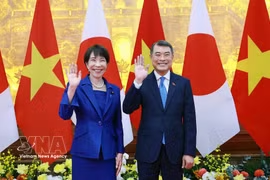
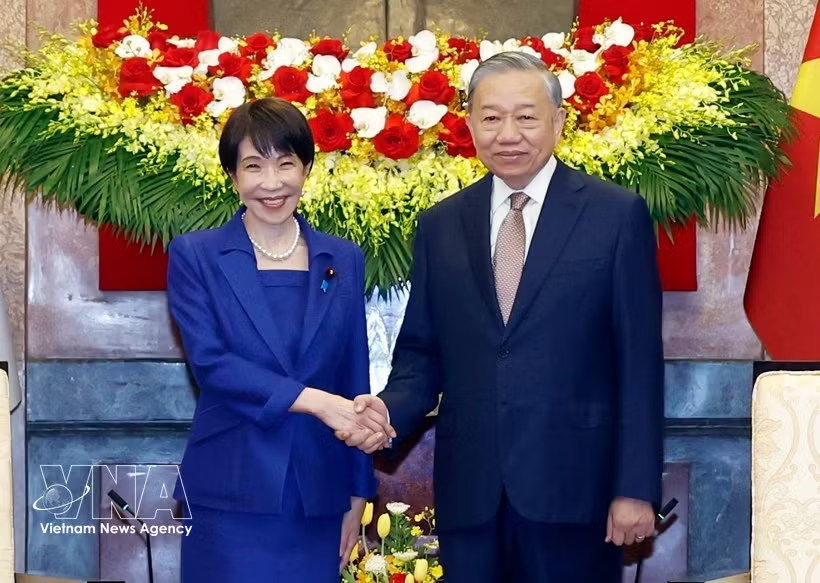
Party General Secretary and State President To Lam (R) receives Japanese Prime Minister Sanae Takaichi in Hanoi on May 2 (Photo: VNA)

Tokyo (VNA) – Japanese Prime Minister Sanae Takaichi has underscored the success of her recent visits to Vietnam and Australia, highlighting strengthened cooperation in economic security.

Speaking to the press in Canberra on May 4, the Japanese PM stressed that during her visits to Vietnam and Australia, in addition to deepening personal trust among leaders, she and the leaders were able to reach agreement on advancing concrete cooperation toward their shared objective of enhancing national resilience and autonomy, and becoming stronger and more prosperous together as a region.

In the field of economic security, the sides announced cooperation documents aimed at ensuring stable energy supplies, including liquefied natural gas (LNG), and strengthening the sustainability of supply chains for rare earths and other critical minerals, an important achievement amid ongoing instability in the Middle East.

Notably, in Vietnam, Japan introduced the first project under its “Power Asia” initiative, unveiled last month, to support the country’s crude oil supply. Medical supplies manufactured by Japanese firms in Vietnam are also set to be exported to Japan. Ensuring stable energy supplies for Vietnam - an important regional supply chain hub - is expected to contribute to economic stability and livelihoods in both countries.

The Prime Minister added that in-depth discussions were also held on regional developments and security cooperation. The sides agreed to step up coordination on strategic issues in the Indo-Pacific, including East Asia, and to further deepen security ties.

Regarding the “Free and Open Indo-Pacific” (FOIP) initiative, first advanced by late Prime Minister Shinzo Abe a decade ago, Takaichi said she highlighted its evolution in a keynote speech in Vietnam. She stressed the need for countries to enhance autonomy and resilience in response to global changes, while promoting practical cooperation to build a stronger, more prosperous Indo-Pacific.

Building on the outcomes of the visits, Japan will continue to work closely with regional partners to advance FOIP cooperation with the aim of jointly building a stronger and more prosperous Indo-Pacific region./.
VNA

See more

Portable solar panels charge a power station outside a suburban home at dusk (Photo: solarquarter.com)

Solar generator demand surges in Malaysia

According to solarquarter.com, prices have risen by about 20% since February, yet consumers continue to invest in these systems as reliable backup power sources against outages and rising energy costs.

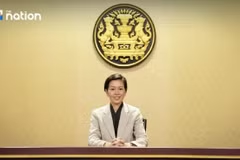
Thailand: BOT warns SMEs and vulnerable groups face hardest economic shock (Photo: The Nation)

Thailand faces economic shock from Middle East tensions

Bank of Thailand Governor Vitai Ratanakorn said the economy was likely to slow as many parties had assessed. The clear impact was higher inflation, affecting both businesses and households, which were beginning to face more pressure from rising costs, as well as effects on debt and liquidity.

Malaysia pursues balanced economic diplomacy

Malaysia pursues balanced economic diplomacy

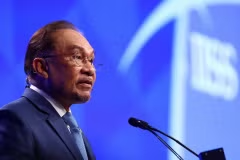
Malaysian Prime Minister Datuk Seri Anwar Ibrahim said Malaysia will continue to strengthen economic cooperation with key trading partners, including China and the US, despite differences in views on geopolitical issues.

Foreign investment in Thailand surges in Q1

Foreign investment in Thailand surges in Q1

According to Thailand's Board of Investment (BOI), the combined value of the 624 project applications submitted during the January-March period was roughly 2.4 times the value recorded in the same period last year, reflecting strong foreign interest despite global economic volatility.

Malaysia accelerates economic restructuring to tackle energy crisis (Photo: Straitstimes.com)

Malaysia steps up economic restructuring amid energy crisis

Participants agreed the crisis, though expected to last up to 18 months, offers a key opportunity for Malaysia and ASEAN to reshape their economic models through innovation, stronger public-private partnerships, and data-driven governance.

Singapore deploys AI to combat financial scams

Singapore deploys AI to combat financial scams

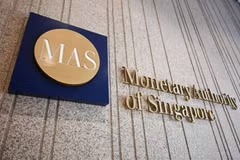
In its statement, the Monetary Authority of Singapore (MAS) said as part of broader efforts to harness AI/ML for industry-wide use cases, it is conducting a Proof-of-Value (POV) to explore AI/ML techniques for pre-emptive scam detection.

Heightened financial instability leads to ASEAN+3 leaders remaining vigilant over excessive volatility and disorderly movements in currency and financial markets. (Illustrative photo: thevibes.com)

ASEAN+3 agrees to cooperate in addressing crude oil supply challenges

In a joint statement approved at a meeting on the sidelines of the Asian Development Bank annual gathering in Samarkand, in southeastern Uzbekistan, ASEAN+3 finance ministers and central bank governors stressed that increasing conflicts in the Middle East have significantly heightened downside risks to the regional outlook.

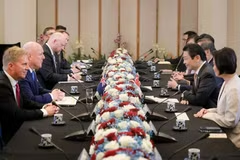
Singaporean Prime Minister Lawrence Wong (second from right) and New Zealand Prime Minister Christopher Luxon (second from left) witness the signing of the pact on May 4 (Photo: The Straits Times)

Singapore, New Zealand sign agreement to ensure essential goods supply

Once domestic procedures are completed, the agreement will take effect and be incorporated into the existing bilateral free trade agreement. It also establishes a framework for both countries to facilitate the movement of goods, share information, and consult each other before or during supply chain disruptions, providing businesses and consumers with greater confidence and stability, MTI said.