Indonesia, Malaysia step up cooperation to combat transnational drug trafficking

Indonesia and Malaysia also agreed to establish more responsive and sustainable communication channels to ensure swift and effective law enforcement in breaking the chain of narcotics trafficking in the region.

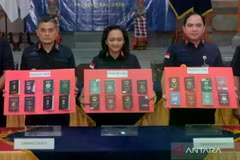
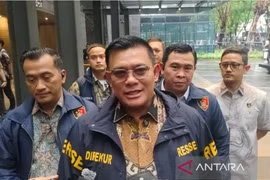
Jakarta (VNA) – Indonesia and Malaysia have agreed to strengthen cooperation in tackling transnational drug trafficking, following a bilateral meeting between Indonesia's National Narcotics Agency (BNN) and Malaysia’s Narcotics Crime Investigation Department (JSJN) in Bali.

BNN head commissioner General Suyudi Ario Seto emphasised that drug trafficking is a transnational crime requiring close cooperation. Strengthening coordination, rapid information exchange, and increasing surveillance in border areas, airports, and ports are important steps in joint handling, he said in a statement.

BNN highlighted the increasingly complex methods used by drug syndicates, noting the emergence of more than 1,400 new psychoactive substances worldwide. Among recent concerns is the abuse of etomidate, particularly in e‑cigarettes, uncovered in a clandestine laboratory case in Bali.

Suyudi stressed that the Golden Triangle remains a major route for narcotics entering Indonesia, with Malaysia serving as a transit hub in the regional distribution network.​

The meeting with Hussein Omar Khan, Director of JSJN Malaysia, was held on the sidelines of the Colombo Plan Drug Advisory Programme (CPDAP).

Both sides used this opportunity to strengthen synergy in combating transnational drug crimes.

Discussions also covered cooperation in backtracking, financial tracking, and the use of Mutual Legal Assistance (MLA) to confiscate assets derived from drug trafficking.

Indonesia and Malaysia also agreed to establish more responsive and sustainable communication channels to ensure swift and effective law enforcement in breaking the chain of narcotics trafficking in the region, Suyudi concluded./.
VNA

See more

Malaysia pursues balanced economic diplomacy

Malaysia pursues balanced economic diplomacy

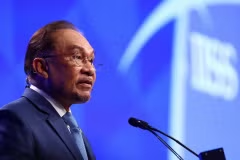
Malaysian Prime Minister Datuk Seri Anwar Ibrahim said Malaysia will continue to strengthen economic cooperation with key trading partners, including China and the US, despite differences in views on geopolitical issues.

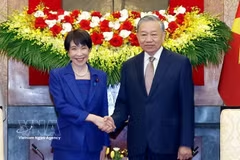
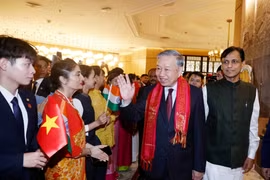
Party General Secretary and State President To Lam (R) receives Japanese Prime Minister Sanae Takaichi in Hanoi on May 2 (Photo: VNA)

Japanese PM highlights outcomes of visits to Vietnam, Australia

Speaking to the press in Canberra on May 4, the Japanese PM stressed that during her visits to Vietnam and Australia, in addition to deepening personal trust among leaders, she and the leaders were able to reach agreement on advancing concrete cooperation toward their shared objective of enhancing national resilience and autonomy, and becoming stronger and more prosperous together as a region.

Foreign investment in Thailand surges in Q1

Foreign investment in Thailand surges in Q1

According to Thailand's Board of Investment (BOI), the combined value of the 624 project applications submitted during the January-March period was roughly 2.4 times the value recorded in the same period last year, reflecting strong foreign interest despite global economic volatility.

Malaysia accelerates economic restructuring to tackle energy crisis (Photo: Straitstimes.com)

Malaysia steps up economic restructuring amid energy crisis

Participants agreed the crisis, though expected to last up to 18 months, offers a key opportunity for Malaysia and ASEAN to reshape their economic models through innovation, stronger public-private partnerships, and data-driven governance.

Singapore deploys AI to combat financial scams

Singapore deploys AI to combat financial scams

In its statement, the Monetary Authority of Singapore (MAS) said as part of broader efforts to harness AI/ML for industry-wide use cases, it is conducting a Proof-of-Value (POV) to explore AI/ML techniques for pre-emptive scam detection.

Heightened financial instability leads to ASEAN+3 leaders remaining vigilant over excessive volatility and disorderly movements in currency and financial markets. (Illustrative photo: thevibes.com)

ASEAN+3 agrees to cooperate in addressing crude oil supply challenges

In a joint statement approved at a meeting on the sidelines of the Asian Development Bank annual gathering in Samarkand, in southeastern Uzbekistan, ASEAN+3 finance ministers and central bank governors stressed that increasing conflicts in the Middle East have significantly heightened downside risks to the regional outlook.

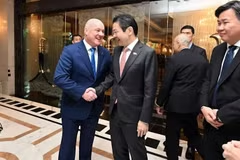
Singaporean Prime Minister Lawrence Wong (second from right) and New Zealand Prime Minister Christopher Luxon (second from left) witness the signing of the pact on May 4 (Photo: The Straits Times)

Singapore, New Zealand sign agreement to ensure essential goods supply

Once domestic procedures are completed, the agreement will take effect and be incorporated into the existing bilateral free trade agreement. It also establishes a framework for both countries to facilitate the movement of goods, share information, and consult each other before or during supply chain disruptions, providing businesses and consumers with greater confidence and stability, MTI said.