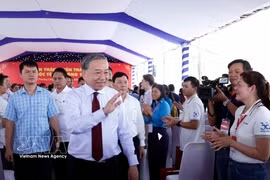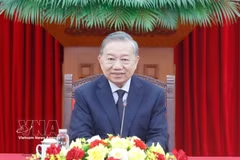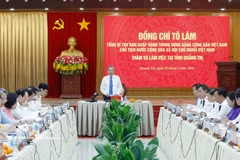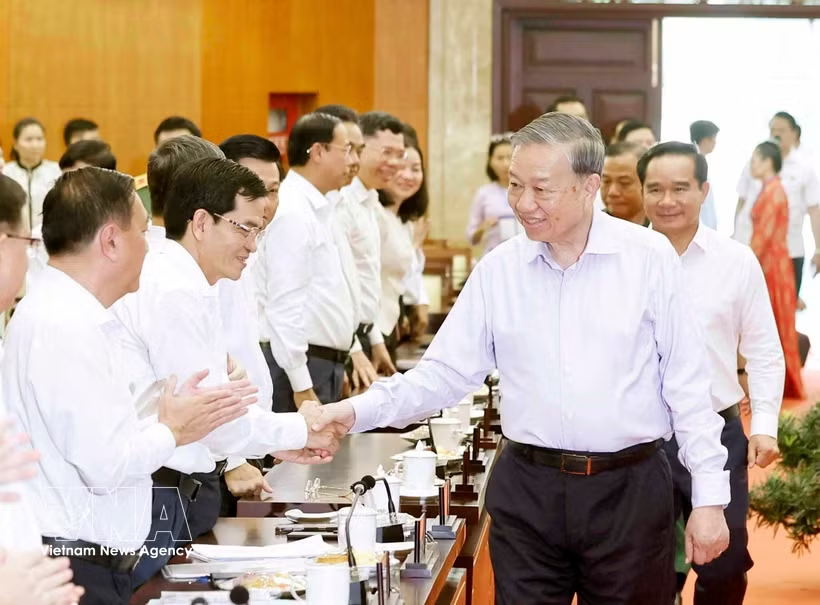
Ho Chi Minh City (VNA) – Party General Secretary and State President To Lam on April 27 urged Ho Chi Minh City to take the lead in translating the Party’s strategic resolutions into concrete, measurable results, stressing that the country’s largest economic hub must pioneer reforms and set the pace for national development.
At a working session with the Standing Board of the municipal Party Committee, the top leader and delegates reviewed preparations for the 50th anniversary of the city bearing the name of President Ho Chi Minh, the implementation of the 14th National Party Congress’s Resolution, urban planning orientations, socio-economic performance in the first four months of 2026, and a roadmap for achieving double-digit growth. Discussions also covered social welfare, the two-tier local administration model, and the city’s challenges and proposals.
After hearing reports and opinions, the top leader expressed broad agreement with the city’s assessments, while commending its strong efforts, sense of responsibility, and political resolve.
He noted that the city has initially stabilised the two-tier local administration model, but called for an early review to consolidate effective aspects and proactively propose adjustments where necessary. In particular, he highlighted the need to institutionalise a suitable urban governance model in the forthcoming special urban law.
Looking ahead, the leader stressed that Ho Chi Minh City must be more proactive, resilient, and forward-looking in mobilising internal resources, building a self-reliant, adaptive economy, and ensuring strategic autonomy.
He underlined that strategic autonomy is not only a central-level task. In the face of global uncertainties, the city must strengthen resilience with a long-term development security perspective. This includes preparing scenarios for oil price volatility, supply chain disruptions, inflationary pressures, and rising production costs, as well as adopting a broader approach to energy security by ensuring a safe, flexible, and sustainable energy structure with strategic reserves.
Initial steps such as diversifying energy sources, promoting renewables, and improving energy efficiency, he said, should be developed into a comprehensive strategy.
The leader also emphasised that the city’s double-digit growth target must be aligned with its role as a national growth engine, ensuring both quantity and quality. He urged authorities to avoid bottlenecks in capital, land, and projects, and to take decisive action in removing legal and planning obstacles while accelerating public investment disbursement.
Agreeing with proposals to issue a new Politburo resolution to replace Resolution 31 and to develop a special urban law, the top leader stressed that institutional reform must be at the core. Policies must reflect the city’s stature and mission, enabling breakthroughs in governance, fiscal autonomy, and modern financial tools. The city should be allowed to retain more revenue, mobilise resources proactively, pilot new mechanisms, and design policies suited to a mega-urban context, alongside adopting exceptional talent attraction policies.
He called for deeper concretisation of the Party’s strategic resolutions into practical development models. Resolutions on science and technology should translate into innovation ecosystems, high-tech industries, urban data systems, digital government, artificial intelligence, and semiconductors. International integration should be linked to building an international financial centre, free trade zones, and modern logistics systems. Legal and institutional reforms must be embedded in the special urban law, with genuine decentralisation and administrative reform. Meanwhile, private sector development policies should turn entrepreneurial aspirations into reality, encouraging business expansion and the emergence of more technology firms.
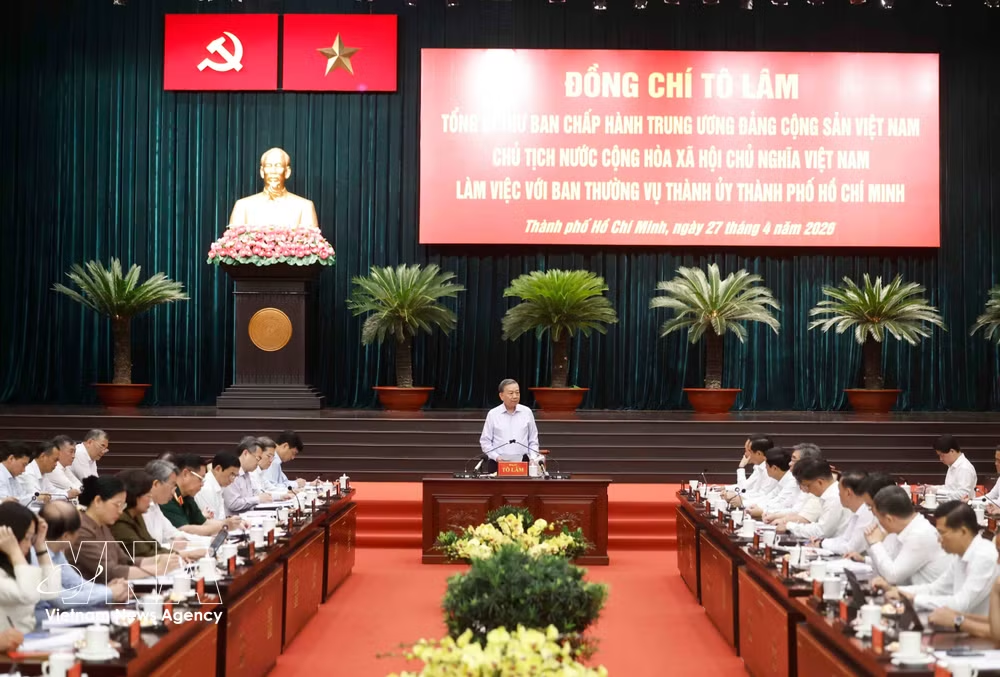
Ho Chi Minh City must take the lead in turning strategic resolutions into vivid realities, avoiding a situation where policies are well-written but poorly implemented, he stressed.
Towards a sustainable, innovative, and liveable mega-city
The Party General Secretary and State President urged the city to accelerate planning with a modern, integrated, and forward-looking approach, covering surface, underground, and digital infrastructure, as well as green corridors and urban connectivity. Planning must ensure coherence, future space reserves, and avoid becoming outdated soon after approval.
Urban planning, he said, must be people-centred, aiming to improve quality of life and build a smart, ecological, culturally rich, and secure city.
Under its development orientation for 2025–2050 with a 100-year vision, Ho Chi Minh City aims to become a sustainable, innovative, and liveable mega-city with a multi-centre model linked to international finance, free trade, and advanced logistics. The leader described this as a vision commensurate with the city’s stature, but cautioned against fragmented or arbitrary planning adjustments.
He highlighted the need to prioritise strategic infrastructure, digital infrastructure, and innovation ecosystems as foundations for a new growth model driven by productivity, science and technology, innovation, and efficient resource allocation. Wider application of artificial intelligence across sectors should be promoted to achieve breakthroughs in productivity and growth quality, alongside stronger incentives to attract private investment in science and technology.
Regional connectivity was also identified as a priority. The city should take a more proactive role in restructuring development space in southern Vietnam, coordinating with neighbouring localities to build a shared vision, clear functional roles, and effective linkages, thereby enhancing overall regional competitiveness.
At the same time, General Secretary and President Lam called for more decisive action to address persistent issues such as traffic congestion, flooding, and environmental pollution, as well as to accelerate urban renewal and canal-side housing relocation programmes in a way that balances interests and improves living standards.
He stressed that as the city grows and governance becomes more complex, it must uphold unity, discipline, and integrity, while strengthening personnel work, inspection, supervision, and anti-corruption efforts. Building a capable, ethical, and innovative public workforce – one that dares to think, act, and take responsibility – is essential, alongside mechanisms to replace underperforming officials.
Regarding the upcoming 50th anniversary of Ho Chi Minh City bearing the name of President Ho Chi Minh in 2026, the leader called for meaningful, practical, and cost-effective commemorative activities that inspire action, foster pride, and mobilise contributions from all sectors. These should be closely linked with social welfare, urban upgrading, and the implementation of key projects to deliver tangible and lasting outcomes.
He also urged central agencies, the Government, the National Assembly, and ministries to provide more timely and substantive support for the city’s development.
Expressing confidence in the city’s tradition of dynamism, creativity, and solidarity, General Secretary and President Lam said Ho Chi Minh City will continue to innovate, make breakthroughs, and successfully fulfil its goals, maintaining its role as the country’s economic locomotive and a leading growth pole in the region./.