Solving technology challenge through the “three-party linkage”

According to Pham Duc Nghiem, Deputy Director of the Department of Startups and Technology Enterprises under the Ministry of Science and Technology, the “three party” linkage model involving the State, research institutes/universities and enterprises is becoming essential for developing strategic technologies. Enterprises provide practical problems, universities and research institutes develop technological solutions, while the State creates support mechanisms and policies to accelerate commercialisation.

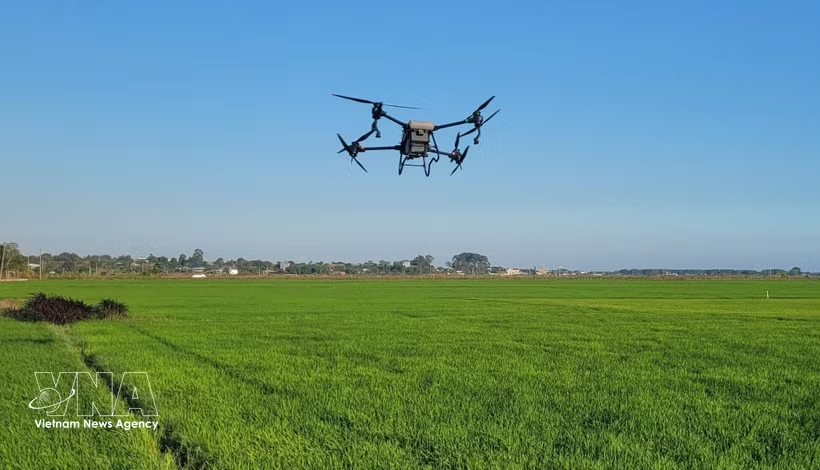
Using drones to spray pesticides in the An Nhut rice fields in Long Dien commune of Ho Chi Minh City. (Photo: VNA)

Hanoi (VNA) – Building mechanisms that enable the State, universities, research institutes and businesses to jointly participate in the science and technology development chain is becoming increasingly important as Vietnam identifies science and technology as a major driver of future economic growth.

Linking the “three parties” to commercialise research

According to Pham Duc Nghiem, Deputy Director of the Department of Startups and Technology Enterprises under the Ministry of Science and Technology, the current orientation is no longer limited to generating scientific results but aims to create technologies, products and Vietnamese technology enterprises.

He said the “three party” linkage model involving the State, research institutes/universities and enterprises is becoming essential for developing strategic technologies. Enterprises provide practical problems, universities and research institutes develop technological solutions, while the State creates support mechanisms and policies to accelerate commercialisation.

Nghiem stressed that the linkage should go beyond isolated technology transfers and become a foundation for a modern science and technology market in Vietnam. In a knowledge-based economy, research outcomes, inventions and intellectual property assets must become tradable commodities capable of commercialisation.

He also pointed to several bottlenecks, particularly rigid management thinking. Innovation, he noted, always involves risks, while existing mechanisms remain heavily focused on administrative control. He called for more flexible legal frameworks, policy sandboxes and output-based funding mechanisms to support startups, spin-offs and innovative research groups.

Weak connections between universities, businesses and investors have also prevented many research results from becoming commercial products, while scientists often lack market development experience.

Regarding spin-off enterprises originating from universities and research institutes, Nghiem described them as one of the most effective ways to bring technologies from laboratories to market. He noted that many global technology corporations began as university research projects.
vnanet-potal-tang-cuong-lien-ket-hop-tac-dao-tao-nhan-luc-nganh-ban-dan-8515427.jpg
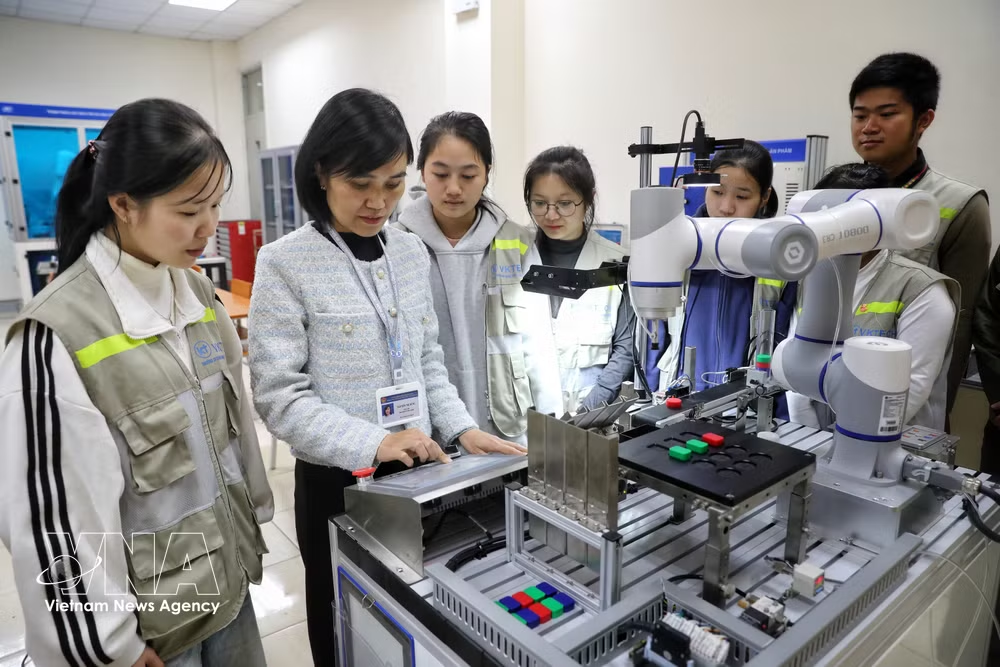
Students doing internships in microcontroller programming at the Vietnam-Korea College of Technology in Bac Giang. (Photo: VNA)

Vietnam’s legal framework for spin-offs has gradually taken shape through laws on enterprises, higher education, technology transfer and intellectual property. In particular, the revised Capital Law 2026 and Decree 271/2025 have created clearer mechanisms for universities in Hanoi to establish and invest in enterprises commercialising research outcomes.

Businesses seek more flexible mechanisms

Dao Ngoc Chien, Director of the National Foundation for Science and Technology Development (NAFOSTED), said the “three-party” model is the most suitable approach for developing strategic technology products because such technologies require high scientific content and competitive advantages.

According to Chien, most enterprises still need cooperation with universities and research institutes to solve core scientific challenges, while the State should play a facilitating role through policies and support resources.

He said research institutes and universities need more flexible funding mechanisms that allow for scientific risks, while businesses are more interested in tax incentives, technical standards and intellectual property protection than direct budget support.

Chien added that NAFOSTED could serve as a bridge connecting scientists, businesses and management agencies. A draft decree currently under government consideration would formally assign the fund a matchmaking role in the science, technology and innovation ecosystem.

Experts said the requirements outlined by To Lam demonstrate the need to establish mechanisms enabling the State, research institutes, universities and businesses to participate in a complete technology development chain, from research and testing to commercialisation.

They stressed that Vietnam’s technology challenge is not only about capital, equipment or policies, but also about trust and national aspiration in the knowledge economy era. When young people dare to innovate, scientists pursue new technologies, businesses invest in Vietnamese knowledge and the State acts as a facilitator, science and technology can become the core driver of Vietnam’s development ambitions in the 21st century./.
VNA

See more

Visitors explore agricultural production equipment on display at Agri & Biotech Vietnam 2026 in Ho Chi Minh City. (Photo: VNA)

Agri-biotech exhibition series underway in Ho Chi Minh City

In addition to the exhibition activities, Agri & Biotech Vietnam 2026, lasting until June 12, is set to host a series of specialised forums and seminars. Topics of particular interest to businesses include farming exports, sustainable development of the pepper and spice industries, low-emission agriculture, carbon credits, the circular economy, biotechnology and innovative start-ups.

At Expo Tel Aviv in Israel (Photo: VNA)

Digital transformation fuels demand for cybersecurity talent

According to the National Cybersecurity Association (NCA), cyberattacks are rising in both frequency and severity. Attackers are targeting critical infrastructure, personal data, and public services with increasingly advanced methods. This isn't just a technical glitch, but a systemic vulnerability requiring a workforce that can analyse and respond in real time.

Billionaire Eric Schmidt, former Chairman and CEO of Google and former Chairman of the US National Security Commission on Artificial Intelligence (NSCAI) (Photo: NIC/VietnamPlus)

Vietnam well-positioned to become global AI hub: Eric Schmidt

Vietnam possesses significant advantages and strong potential to emerge as a global centre for artificial intelligence (AI), according to billionaire Eric Schmidt, former Chairman and CEO of Google and former Chairman of the US National Security Commission on Artificial Intelligence (NSCAI).

Vietnamese Ambassador to Austria Vu Le Thai Hoang speaks at the event. (Photo: VNA)

Vietnam shows off homegrown humanoid robots in Austria

The event paired a robotics showcase with an innovation networking session, spotlighting Vietnamese companies’ research, development and technological mastery in robotics, automation and artificial intelligence.

Vietnamese delegates at the 2026 IEEE International Conference on Robotics and Automation (ICRA 2026). (Photo: VNA)

Vietnamese tech draws attention at Austria robotics forum

Representing Vietnam were VinRobotics and VinDynamics, two tech subsidiaries of Vingroup. They showcased "Make in Vietnam" humanoid robots, demonstrating the country’s growing capacity to integrate into the global robotics value chain.

Deputy Prime Minister Ho Quoc Dung speaks at the meeting of the Government task force on strategic technology development on June 4. (Photo; VNA)

Deputy PM demands tangible results in strategic tech development

Deputy PM Ho Quoc Dung pressed ministries and agencies to rapidly convert their assigned tasks into concrete action plans with clearly defined responsibilities, and effectively launch projects that create strategic technology products capable of sharpening national competitiveness.

A panel discussion on “Digital trust in the AI era: Security starts with the users” at the Digital Trust in Finance 2026 forum (Photo: nhandan.vn)

Protecting users crucial in building digital trust: Experts

In Vietnam, digital transformation in the finance and banking sector is accelerating cashless payments, expanding access to financial services, improving market transparency and supporting economic growth and macroeconomic management.

Illustrative image

Proactive cybersecurity essential in age of AI-powered crime: experts

According to Dr. Le Minh Nghia, Chairman of the Vietnam Financial Consulting Association (VFCA), AI has become a key driver reshaping the global financial industry. In Vietnam, the technology is already widely used in banking and finance for credit analysis, electronic customer identification (eKYC), risk management, service personalisation and real-time transaction processing.