Hanoi (VNS/VNA) - Experts have welcomed the Ministry of Education and Training’s proposal to offer scholarships for undergraduate and postgraduate students across 15 STEM-related disciplines, saying the policy could help attract talented students and strengthen Vietnam’s pool of high-quality human resources in strategically important fields, particularly as demand for science and technology skills continues to rise.
Professor Nguyen Tien Thao, Director of the ministry’s Department of Higher Education, said the ministry is preparing to submit a draft decree to the Government on scholarship policies for students pursuing studies in basic sciences, key engineering fields and strategic technologies.
If approved, the policy is expected to take effect on September 1, 2026.
The proposed programme would cover 15 disciplines, including biology, applied biology, physical sciences, earth sciences, mathematics, statistics, computer science, information technology, mechanical engineering, electrical-electronics and telecommunications engineering, chemical-materials-metallurgical and environmental engineering, engineering physics, geological-geophysical and surveying engineering, mining engineering and construction.
Scholarship levels would vary depending on academic level and field of study, with the aim of covering minimum study and living expenses while also providing incentives for students.
Under the proposal, undergraduate students could receive between 3.7 million VND and 5.5 million VND (140–210 USD) per month while master’s and doctoral students could receive up to 8.4 million VND (318 USD) per month.
Eligible applicants would be divided into two groups. The first group includes students who won first, second or third prizes at national or international academic competitions within the past three years.
The second group includes students whose university entrance examination scores reach at least 22.5 points in combinations including mathematics and two of the following subjects: physics, chemistry, biology and English. Applicants must also rank among the top 30% of admitted students nationwide within their respective disciplines.
To retain the scholarship throughout their studies, recipients would need to meet requirements on academic performance, credit accumulation progress and disciplinary conduct. Postgraduate students would also be assessed on scientific research capacity.
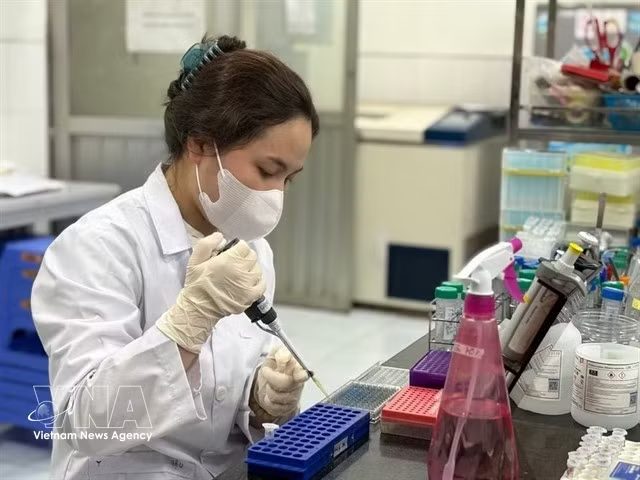
Nguyen Nhat Ly, a master’s student in biotechnology at the University of Science under Vietnam National University, Hanoi, said the programme would significantly ease financial pressure on students.
According to Ly, postgraduate students in basic sciences are required to spend most of their time working in laboratories, leaving little opportunity for outside employment.
“To cover tuition and living expenses, many students have to work part-time after class, which can be very stressful,” Ly said. “If scholarships are available, we can focus more fully on studying and improving research quality. It would also motivate students to achieve the best academic results possible.”
Professor Nguyen Dinh Duc from the VNU University of Engineering and Technology said the Politburo’s Resolution No. 57-NQ/TW identifies science, technology, innovation and digital transformation as the leading breakthrough driving national development and prosperity in the new era.
Meanwhile, the Politburo’s Resolution No. 71-NQ/TW sets the goal of transforming universities into national centres for research, innovation and entrepreneurship.
Duc said the proposed STEM scholarship policy is one of several measures aimed at achieving those strategic goals.
“The policy serves both as guidance and encouragement for learners while also attracting talented students,” he said. “It will help train a high-quality workforce for STEM fields, especially at a time when these sectors face labour shortages and enrolment numbers remain modest compared to demand.”
Nguyen Duc Toan, Deputy Director of the Institute of Information Technology at the Vietnam Women's Academy, said the scholarships would encourage more talented students to pursue basic sciences, technology and engineering, helping meet national development needs while also increasing the future pool of university lecturers in these disciplines.
Tran Manh Cuong, Vice Rector of the VNU University of Science, shared a similar view.
He noted that the university has nearly 70 years of experience and tradition in training students in basic sciences, with most students coming from provinces outside Hanoi.
“If students receive support under this policy, they will have better conditions to focus on learning, research and professional development,” Cuong said.
He added that financial support would also strongly influence students and parents in shaping educational and career choices.
Students would likely prioritise physics, chemistry, biology and information technology at secondary level and later choose university and postgraduate programmes in basic sciences, technology and engineering.
As a result, the scholarship programme could help attract talent into knowledge-based sectors, including science, technology, engineering and innovation, while also encouraging universities to further develop their training strengths.
“The policy is therefore not only important for higher education but also carries long-term strategic significance for developing the country’s high-quality workforce,” Cuong said./.
VNA