Vietnamese youth in Australia carry forward President Ho Chi Minh’s legacy in building prosperous, happy nation

Every contribution by Vietnamese youth abroad — whether through scientific research, technological projects, community initiatives, or simply through living responsibly and studying diligently while always looking toward the homeland — helps continue the journey initiated by President Ho Chi Minh toward a strong, prosperous, civilised, and happy Vietnam.

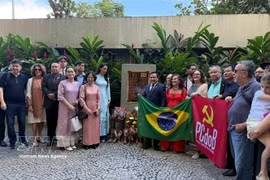
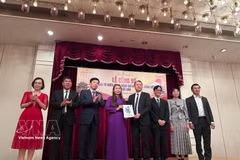
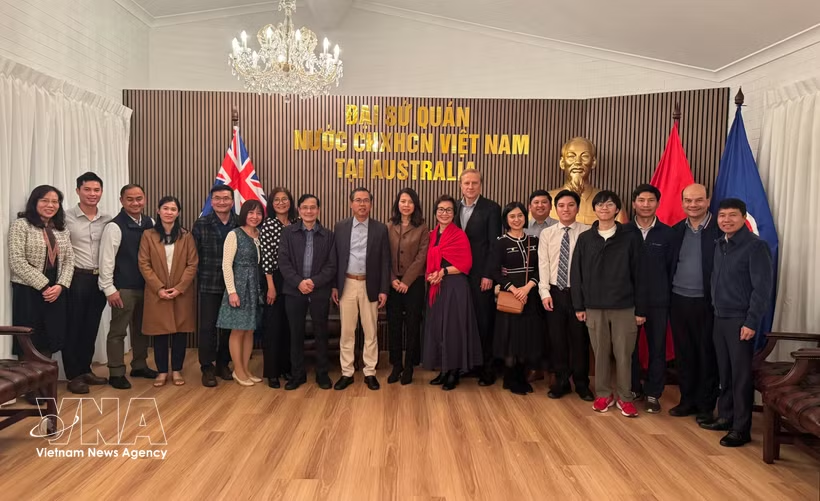
Participants pose for a photo after the incense-offering ceremony in commemoration of President Ho Chi Minh at the Vietnamese Embassy in Australia. (Photo: VNA)

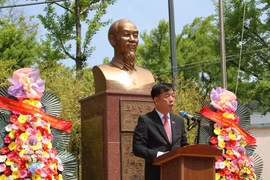
Sydney (VNA) – The Vietnamese Embassy in Australia on May 16 held a solemn incense-offering ceremony at President Ho Chi Minh’s altar at the embassy headquarters in Canberra to mark the 136th birth anniversary of the late leader (May 19, 1890–2026).

Speaking at the event, Ambassador Pham Hung Tam appreciated the contributions made by Vietnamese associations and communities across Australia, particularly in Canberra, in supporting diplomatic missions and strengthening bilateral cooperation in science and technology, innovation, human resources development, education and training, and cultural promotion. He also praised efforts to support disadvantaged people in the homeland and expand people-to-people exchanges, which have helped deepen ties between Australia and Vietnam.

According to the ambassador, these activities reflect the practical application of President Ho Chi Minh’s diplomatic thought and style in contemporary foreign affairs. He expressed his hope that the Vietnamese community in Australia will continue to foster unity, integrate successfully into local society, capitalise on emerging opportunities to further promote bilateral relations, and propose initiatives that contribute to national development and the implementation of the Resolution of the Communist Party of Vietnam’s 14th National Congress.

On the same occasion, the Consulate General of Vietnam in Sydney organised a thematic session on studying and following President Ho Chi Minh’s moral example, focusing on the late leader’s life, revolutionary career, ideology, and his journey for national salvation.

The commemorative activities not only strengthened political awareness but also reinforced solidarity and close connections between representative agencies and Vietnamese organisations and communities in Australia.

In an interview with Vietnam News Agency correspondents in Australia, Vietnamese student Mai Thi Thanh Chung described President Ho Chi Minh’s moral example as a guiding compass for young generations striving to become both morally upright and professionally capable. She said Vietnamese students in Australia continuously seek to follow his example through compassion, solidarity, and efforts to promote a positive image of Vietnam internationally.

Meanwhile, Tran Binh Minh, a member of the Secretariat and Chief of the Office of the Vietnamese Students’ Association in Australia, said President Ho Chi Minh’s lifelong devotion to the nation and people continues to inspire him with gratitude and a deep sense of responsibility.

Beyond admiring the late leader’s ideals and patriotism, Minh said he was particularly moved by the late President’s spirit of self-learning, humility, and unwavering commitment to the people.

For Minh, following President Ho Chi Minh’s example means not only cultivating ethics and resilience, but also mastering knowledge and expertise, especially in science and technology, digital transformation, artificial intelligence (AI), data, and innovation. He noted that such aspirations align closely with Politburo Resolution No. 57-NQ/TW, which identifies science, technology, innovation, and digital transformation as key strategic breakthroughs for national development.

Minh said he wishes to contribute more actively to education, research, technology, and knowledge connectivity in the years ahead. Through his role in the Vietnamese Students’ Association in Australia, he aims to create more opportunities for Vietnamese students to connect with experts, share ideas, and spread a spirit of learning, creativity, and community service.

He stressed that every contribution by Vietnamese youth abroad — whether through scientific research, technological projects, community initiatives, or simply through living responsibly and studying diligently while always looking toward the homeland — helps continue the journey initiated by President Ho Chi Minh toward a strong, prosperous, civilised, and happy Vietnam./.

VNA
See more

The UN Group of Friends for Combating Technology-facilitated Trafficking in Persons, makes its debut at a ceremony in New York on June 12 (Photo: VNA)

Vietnam joins UN group on combating technology-facilitated human trafficking

The ambassador affirmed that Vietnam attaches great importance to cooperation with countries, the UN, UNODC, and relevant partners in combating human trafficking. He also noted that the participation of several ASEAN countries as founding members reflects the region’s shared commitment to implementing the ASEAN Convention Against Trafficking in Persons, Especially Women and Children (ACTIP).

Prime Minister Le Minh Hung launches nationwide campaign for sustainable double-digit growth in Ho Chi Minh City on June 13. (Photo: VNA)

PM launches nationwide campaign for sustainable double-digit growth

Prime Minister Le Minh Hung called on ministries, sectors and localities to promptly translate the emulation movement into practical action plans and programmes, ensuring that emulation becomes not merely a campaign but a driving force for action, an ecosystem for discovering good models, replicating successful models and best practices.

NA Vice Chairwoman Nguyen Thi Thanh guides a student on how to use an English reading pen at the gift presentation event in Dien Bien province on June 12. (Photo: VNA)

NA Vice Chairwoman presents gifts to Dien Bien policy beneficiary families

Vice Chairwoman Nguyen Thi Thanh urged policy beneficiary families to carry forward revolutionary traditions, serve as role models for younger generations, and steer their children to follow Party’s guidelines and the State’s laws and policies, contributing to a more prosperous and civilised province.

The Vietnam Red Cross Society's members deliver gifts to needy people during the 2026 Humanitarian Month. (Photo courtesy of the VNRC)

Humanitarian Month raises nearly 762 billion VND

With the theme '80 Years - A Journey of Compassion for the Community', the campaign continues to affirm its role as a nationwide humanitarian initiative, mobilising participation across all levels, sectors, businesses, organisations, philanthropists and the general public to help those in difficult circumstances.

Participants of the 2026 Vietnam – China children’s exchange programme pose for a group photo (Photo published by VNA)

Vietnamese, Chinese children enhance mutual understanding, friendship

Participants gained deeper insights into the friendship between the revolutionary pioneers of Vietnam and China in their shared quest for national liberation, as well as a greater understanding that the achievements of national reunification in both countries were hard won and that the friendly neighbourly relationship and cooperation between them is of great value.

Border guards from Quang Tri and Khammouane provinces in the joint patrol (Photo: baochinhphu.vn)

Vietnam, Laos conduct joint patrol along shared border

Quang Tri and Laos’ Khammouane province agreed to strictly adhere to legal documents on border management, maintain delegation exchanges at all levels, increase cooperation in crime prevention and control, search and rescue, and run public awareness campaigns to encourage border residents to comply with border and border gate management regulations.

Students take Literature test (Photo: VNA)

Over 1.2 million students begin national high school graduation exam

Under the current examination format, candidates are required to complete the mandatory Literature and Mathematics tests, along with a combined test comprising two subjects selected from a range of options, including Physics, Chemistry, Biology, Informatics, Foreign Languages, History, Geography, Technology-Industry, Technology-Agriculture, and Economics-Law. Students may also choose to take a foreign language different from the one studied at school.