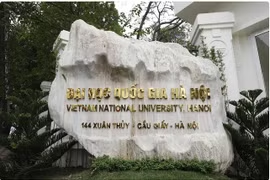
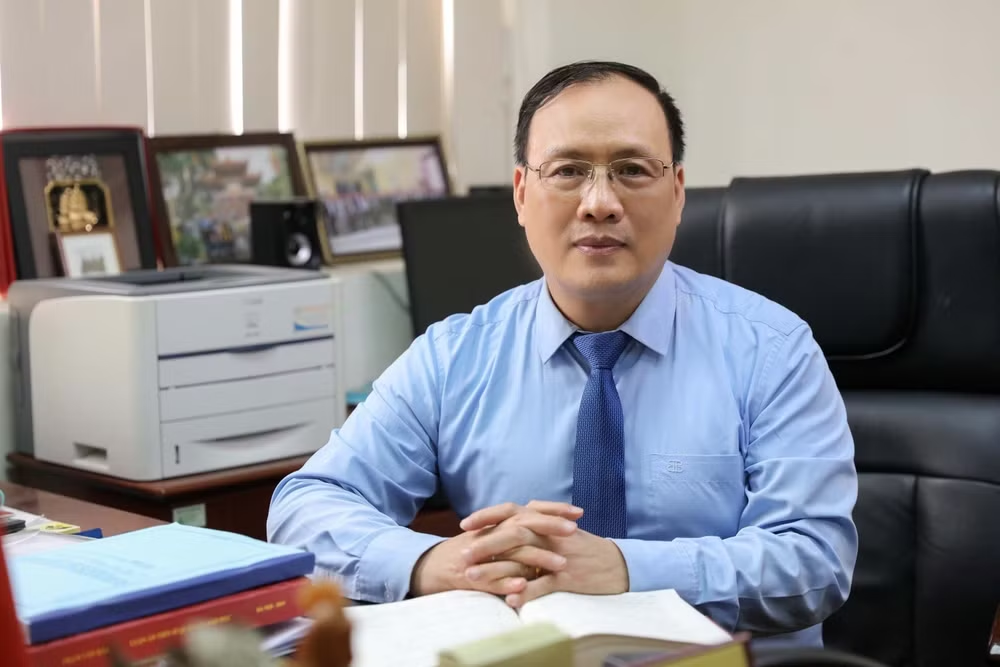
Hanoi (VNA) – Building a world-class university requires not only a long academic tradition but also strong scientific and technological capacity, according to Professor, Doctor of Science Nguyen Dinh Duc, former Chairman of the University of Engineering and Technology under Vietnam National University, Hanoi (VNU-Hanoi).
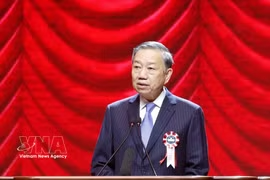
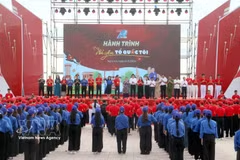
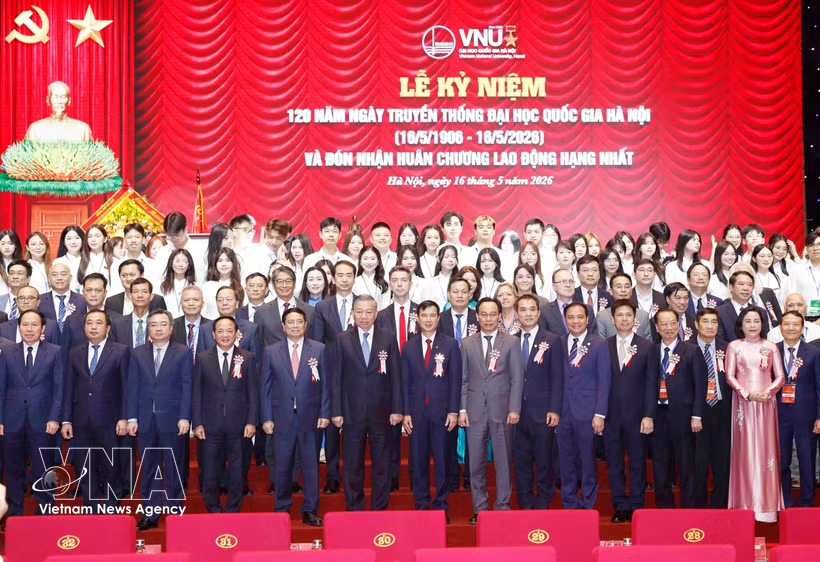
At a ceremony marking the 120th founding anniversary of VNU-Hanoi on May 16, Party General Secretary and State President To Lam outlined strategic directions for the development of Vietnam’s higher education system.
Speaking to the Vietnam News Agency (VNA) on this occasion, Duc said the speech delivered by the top leader conveyed a strategic vision for the future of higher education in Vietnam, placing VNU-Hanoi at the centre of the country’s aspirations for development in the knowledge era.
Innovation-driven university model
According to Duc, the core message in the top leader’s remarks was that VNU-Hanoi must become a truly elite institution that serves as a national academic pillar, a pioneer in science, technology and innovation, and a leading centre for training high-quality human resources.
He noted that the university should no longer be viewed merely as an institution with a proud 120-year tradition, but rather as a strategic force directly linked to the nation’s development trajectory.
“In the new era, competition among nations is fundamentally competition in knowledge, technology, innovation and human resource quality,” Duc said. “Therefore, VNU-Hanoi cannot remain confined to its traditional role of teaching and research. It must transform itself into an innovation-driven university capable of generating new knowledge, mastering strategic technologies and solving major national challenges.”
He stressed that the university’s long-standing tradition must be converted into practical momentum for action, particularly through contributions to fundamental sciences, high technologies and strategic technologies that can support Vietnam’s aspiration to become a developed nation.
Duc said the university needs to pursue several major breakthroughs to realise the vision outlined by the Party and State leader.
First and foremost, institutional and mechanism bottlenecks must be removed to allow for genuine autonomy. “An innovative university cannot operate effectively under rigid administrative mechanisms,” he said, adding that while the Law on Higher Education grants VNU-Hanoi a high degree of autonomy, the implementation by ministries and agencies remains slow and insufficiently flexible.
He argued that the university should be given greater authority in academic affairs, recruitment, talent attraction, research commissioning, international cooperation, public asset management, and the establishment of science and technology enterprises.
In parallel, the university should shift towards governance based on objectives, quality, outputs and social impact rather than administrative procedures. The “One VNU” model should be implemented effectively while fully leveraging the strengths of its member universities and research institutes.
Strategic technologies and interdisciplinary education
Duc also underscored the need for targeted investment in strategic sectors such as artificial intelligence, semiconductors, biotechnology, new materials, big data, renewable energy, green technologies and sustainability sciences. “These must become the areas that generate core technologies and products bearing Vietnamese intellectual value,” he said.
In his view, a truly elite university must possess strong scientific and technological potential, gathering outstanding scientists, leading technology experts, talented lecturers and excellent students, including Vietnamese intellectuals abroad.
To achieve this, Vietnam needs stronger mechanisms to attract, utilise and reward talents. Duc also highlighted the importance of strengthening cooperation among universities, the State, enterprises, localities and scientists so that academic knowledge can be translated into better policies, more useful technologies and stronger businesses.
He described Hoa Lac Hi-tech Park as a crucial development space where the university urban area should evolve into a modern ecosystem integrating higher education, technology, innovation, entrepreneurship and technology transfer.
Regarding the implementation of the Party leader’s directives, Duc proposed a number of concrete measures. These include formulating a five-year action programme for the university with clear targets by 2030, such as achieving top Asian rankings in selected disciplines, establishing internationally recognised research centres and developing Vietnamese-branded technology products.
He also called for the establishment of national key research programmes hosted by the university in areas such as AI, semiconductors, biotechnology, big data and digital transformation, with long-term funding, international scientific councils and strong participation of enterprises.
Duc emphasised the need for special policies on finance, human resources, scientific research and commercialisation of research outcomes. Scientists should benefit fairly from their research results, laboratories should be allowed to establish spin-off enterprises, and students should participate in real-world projects and innovation activities.
He stressed that universities should be evaluated not only by publication numbers but also by citations, patents, technology transfer, innovation revenue, start-up creation and social contributions.
At the same time, the scholar warned that without strong foundations in basic sciences such as mathematics, physics, chemistry, biology and computer science, Vietnam would struggle to develop core technologies and maintain intellectual autonomy.
Training globally competent citizens with national identity
Duc said one of the deepest expectations expressed by the Party leader was the building of an advanced and internationally integrated education system that still preserves national identity.
According to the scholar, the mission of VNU-Hanoi is not only to equip students with professional knowledge and global competitiveness, but also to cultivate a generation of intellectuals with cultural identity, social responsibility and a strong commitment to serving the country.
“Global competence is essential, but if students lack cultural roots, patriotism and social responsibility, they cannot truly become Vietnamese intellectuals in the fullest sense,” he said.
He stressed that students should be capable of working anywhere in the world while maintaining a strong awareness of contributing to Vietnam’s development.
To achieve this, Duc called for educational reforms in a more liberal, interdisciplinary and modern direction while continuing to emphasise moral education, national history, culture and civic responsibility.
“Students must be nurtured not only with scientific knowledge but also with a spirit of dedication, national self-respect and aspirations to elevate Vietnam through Vietnamese intellect,” he said.
Looking ahead from the university’s 120-year milestone, Duc expressed his confidence that VNU-Hanoi can emerge as one of Asia’s leading universities and gradually affirm its position among the world’s top institutions.
He cited the goals set by General Secretary and State President To Lam for the university to rank among Asia’s top 100 universities by 2030 and the world’s top 300 universities by 2035, with several disciplines entering the global top 100.
“These are ambitious goals, but they are necessary and achievable,” Duc said, adding that Vietnam needs elite universities capable of leading national development in the knowledge era.
He said the university’s international standing should not be measured solely by rankings, but also by its capacity to create new knowledge, master core technologies, train talents, attract international scholars and contribute substantively to national development.
“With its 120-year tradition, multidisciplinary academic foundation, strong intellectual community and the special attention of the Party and State, VNU-Hanoi has every condition necessary to rise strongly in the coming decades,” Duc believed./.