Education ministry targets five digital technology incubators at universities

A key target under the new plan is the establishment of five digital technology incubators, or Deeptech Hubs, at universities and research institutes with strong potential. The education ministry also plans to launch a training programme for 1,000 outstanding technology entrepreneurs and develop criteria for selecting and supporting startup ecosystems within educational institutions.

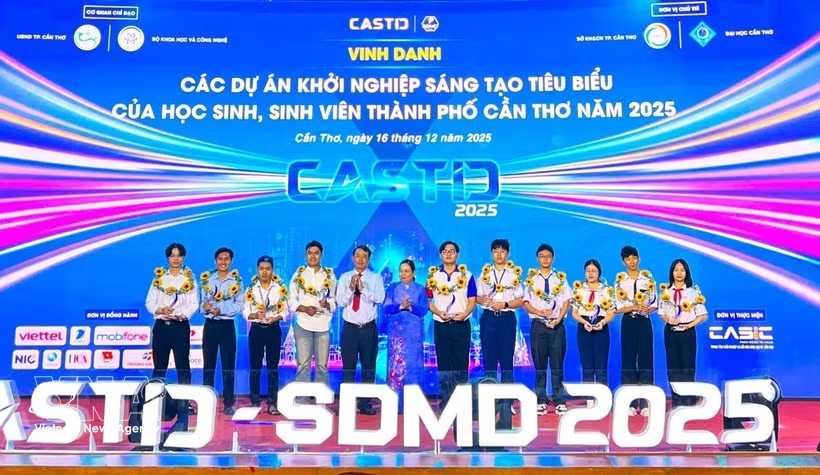
Students in the Mekong Delta city of Can Tho are honoured for their outstanding performance in startup activities. (Photo: VNA)

Hanoi (VNA) – The Ministry of Education and Training has issued a plan to implement a programme on supporting student entrepreneurship in the 2026-2035 period, aiming to develop a comprehensive startup ecosystem across the education sector.

The new plan builds on the outcomes of the previous project while shifting the focus from individual startup activities to the development of an integrated and sustainable entrepreneurship ecosystem.

Unlike the earlier phase, which mainly concentrated on communications campaigns, training programmes, startup competitions, entrepreneurship festivals, support centres and funding assistance, the new strategy seeks to strengthen links among schools, businesses, investors and localities, while promoting startup models within educational institutions.

One notable feature of the plan is the introduction, for the first time, of controlled pilot mechanisms, or “sandboxes”, for startup and spin-off enterprises established within educational institutions. The ministry will also issue guidance on intellectual property rights, management and benefit-sharing mechanisms related to research products and startup projects developed by teachers and students.

The programme also includes measures to support small- and medium-sized enterprises originating from educational institutions, while expanding networks of mentors, businesses, angel investors, alumni and startup support organisations. Sector-based mentor-investment-commercialisation chains are expected to be gradually established to better support startups throughout their development process.

A key target under the new plan is the establishment of five digital technology incubators, or Deeptech Hubs, at universities and research institutes with strong potential. The ministry also plans to launch a training programme for 1,000 outstanding technology entrepreneurs and develop criteria for selecting and supporting startup ecosystems within educational institutions.

Compared to the previous phase, the 2026-2035 plan places greater emphasis on standardising entrepreneurship support activities across schools and training institutions.

The ministry will develop a list of minimum support services, evaluation criteria for innovative startup activities, and entrepreneurship competency standards for consultants, lecturers, teachers and students. Teaching materials, training resources and startup support personnel will also be standardised.

In addition, the education sector plans to introduce digital platforms supporting entrepreneurship, including information portals, monitoring and reporting systems, databases of projects and mentors, and shared data systems serving programme management and implementation.

The programme will prioritise key technical fields, strategic technologies, cultural industries, green startups and the circular economy, while promoting entrepreneurship education linked with career orientation, experiential learning and STEM and STEAM education at schools./.


VNA

See more

At the equipment handover ceremony for the Narcotics Targeting Centre of Vietnam Customs. (Photo: cand.com.vn)

Vietnam Customs expands capacity to tackle cross-border narcotics crime

Established in November 2025, the NTC comprises six officers from the Anti-Smuggling Investigation Sub-Department specialising in surveillance, intelligence collection and information analysis. The centre is tasked with strengthening customs capacity in risk assessment and drug crime targeting, helping authorities detect and prevent illicit cross-border trafficking of narcotics and other dangerous substances at an early stage.

Representatives of the Club of Cambodian Journalists and the Vietnam Journalists Association at the working session in Hanoi on May 12 (Photo: VNA)

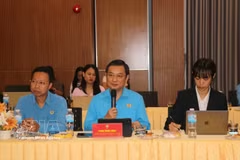
Vietnamese, Cambodian journalists strengthen cooperation

The Vietnam Journalists Association and the Club of Cambodian Journalists agreed to enhance coordination and information sharing between media agencies, exchange experience in professional training and technology application in journalism, and regularly organise training programmes for reporters and editors.

Ca Mau province has consistently attached importance to developing human resources and investing in infrastructure in ethnic minority areas. (Photo: VNA)

Vietnam steps up implementation of ethnic affairs strategy through 2030

To accelerate the implementation of the the Ethnic Affairs Strategy by 2030, with a vision toward 2045, the Prime Minister requested ministries, agencies and local authorities to continue thoroughly carrying out the Party and State’s policies on ethnic affairs, enhancing the effectiveness of State management and strengthening oversight of policy implementation.

Officials from the Market Surveillance Department of Da Nang conduct inspections at business establishments in Hai Chau ward. (Photo: VNA)

No “blind spots” in crackdown on smuggling, counterfeit goods

In the Jan-April period, authorities nationwide uncovered and handled nearly 44,000 cases related to smuggling, trade fraud and counterfeit goods, while initiating 1,464 criminal cases involving 2,277 suspects, according to the National Steering Committee for Combating Smuggling, Commercial Fraud and Counterfeit Goods (National Steering Committee 389).

A delegation of 60 exemplary overseas Vietnamese from 20 countries and territories offers incense to commemorate the Hung Kings. (Photo: VNA)

Overseas Vietnamese community contributes to national unity, development

According to Chairman of the State Committee for Overseas Vietnamese Affairs Nguyen Trung Kien, many overseas Vietnamese entrepreneurs have achieved success in developed economies, gaining experience in corporate governance, advanced technologies, and international-standard operations.

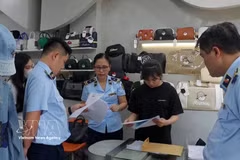
A market surveillance team carries out an unannounced inspection at a fashion business in Hanoi. (Photo: VNA)

Hanoi steps up crackdown on counterfeit goods, IP infringements

The agency has set a target of increasing the number of handled cases by at least 20% compared to the same period last year between May 7 and 30. Inspection and monitoring activities will continue beyond May 30 on a regular, focused and systematic basis across the city.

Construction of Tran Hung Dao bridge, one of seven bridges spanning the Red River, launched in 2025, alongside Hong Ha, Me So, Tu Lien, Ngoc Hoi, Van Phuc and Thuong Cat bridges (Photo: VNA)

📝OP-ED: Beyond rhetoric, urban reconstruction moves ahead

Transport infrastructure development is a key task in the capital’s major development strategies, closely linked with the Hanoi Capital Master Plan with a 100-year vision and the implementation of the revised Capital Law. A series of major projects, including ring roads, urban railways, national railways and regional economic connectivity projects such as the Red River Landscape Boulevard Axis, are being implemented to enhance connectivity, promote the growth of Hanoi and the country, and lay the foundation for urban reconstruction in a modern, synchronised and sustainable direction.

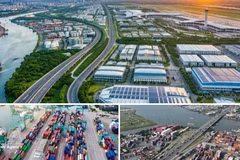
 Dong Nai – aspiration to rise in new era

Dong Nai – aspiration to rise in new era

Following its merger and status elevation to Vietnam’s seventh centrally-run city starting April 30, 2026, Dong Nai is entering a pivotal phase to reposition its role and standing within a broader development landscape. More than an administrative upgrade, the move—coupled with strategic projects such as Long Thanh International Airport—is opening new space for the southern locality to make socio-economic breakthroughs, strengthen regional connectivity and reshape its development model toward services, tourism and innovation.