Party building work prioritises clean, shared data in digital transformation push

Politburo member, Secretary of the Party Central Committee and Chairman of its Organisation Commission Nguyen Duy Ngoc urged provinces and cities to review legal frameworks, decentralisation mechanisms, assigned tasks and administrative procedures, while ensuring synchronisation between local infrastructure systems and the central platform, including equipment, cybersecurity solutions and resource allocation.

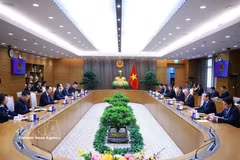
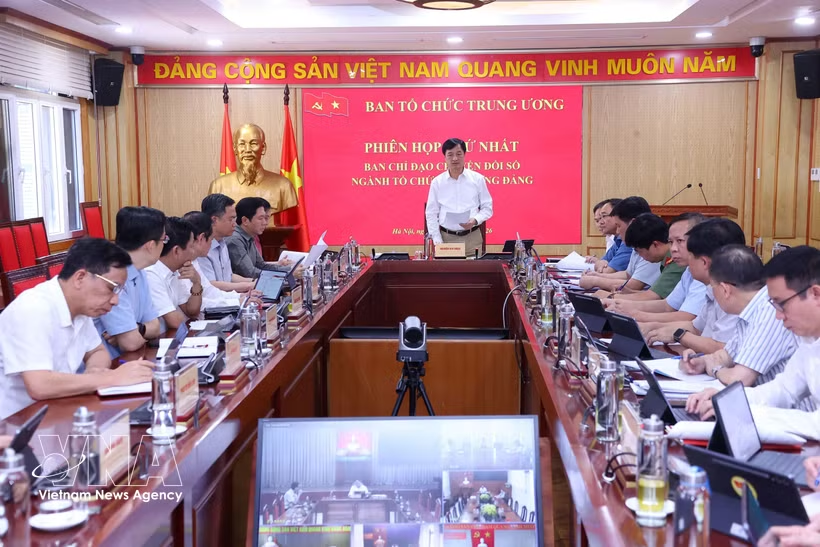
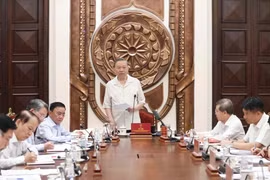
Politburo member, Secretary of the Party Central Committee and Chairman of its Organisation Commission Nguyen Duy Ngoc chairs the first meeting of the steering committee for digital transformation in the Party organisation and personnel sector in Hanoi on May 13, 2026. (Photo: VNA)

Hanoi (VNA) - Politburo member, Secretary of the Party Central Committee and Chairman of its Organisation Commission Nguyen Duy Ngoc has called for faster development of a unified digital database for the Party organisation and building sector, stressing that data must be accurate, complete, continuously updated, standardised and shared nationwide. The official made the appeal while chairing the first meeting of the steering committee for digital transformation in the Party organisation and personnel sector in Hanoi on May 13.

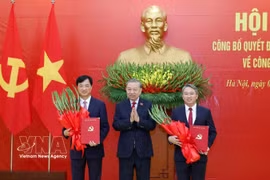
The meeting announced the establishment of the steering committee, comprising 29 members and headed by Ngoc.

The committee is tasked with directing and coordinating digital transformation efforts across the Organisation Commission and the Party organisation and building sector, ensuring alignment with reforms in leadership, advisory work, implementation and data-based governance.

It will also oversee the development and implementation of the sector’s master digital transformation plan through 2030.

In addition, the committee will direct the development of a large-scale database system covering Party organisations, Party members, officials, civil servants, public employees, organisational structures, staffing, job positions, training, personnel policies and internal political protection.

Ngoc urged provinces and cities to review legal frameworks, decentralisation mechanisms, assigned tasks and administrative procedures, while ensuring synchronisation between local infrastructure systems and the central platform, including equipment, cybersecurity solutions and resource allocation.

He stressed that digital transformation must go hand in hand with reforms in leadership, governance and operational management. Departments, agencies, units and localities, he said, must regard digital transformation as a core and long-term political task rather than a symbolic campaign or a race for achievements.
vnanet-nge1bb8dc2.jpg
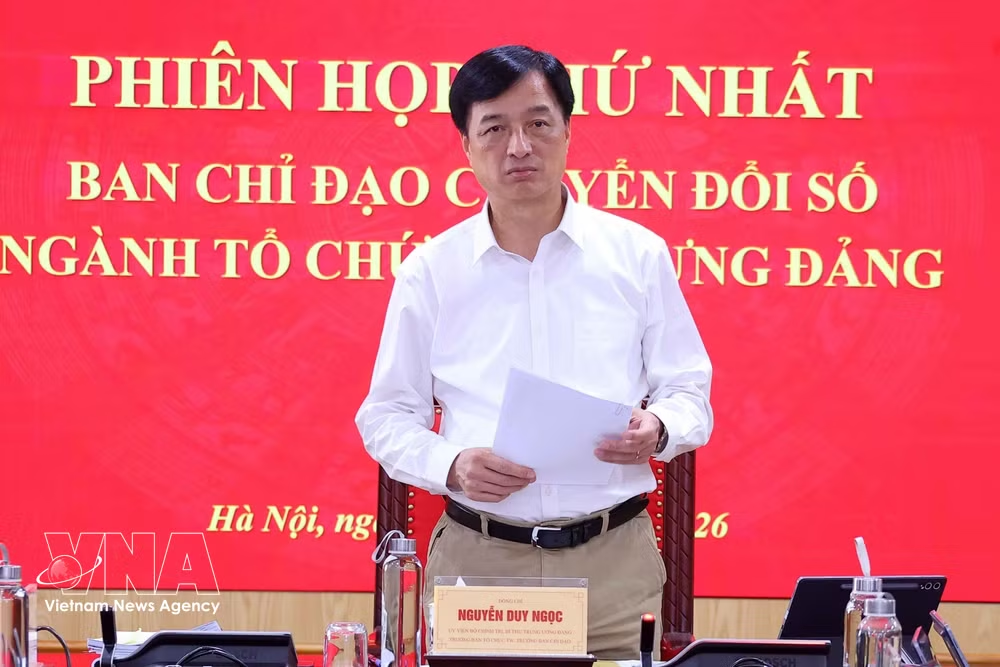
Politburo member, Secretary of the Party Central Committee and Chairman of its Organisation Commission Nguyen Duy Ngoc delivers a speech at the meeting. (Photo: VNA)

Ngoc underscored that information security must be prioritised from the outset, with tangible outcomes and efficiency serving as the key benchmarks. Each task, he said, must have clearly defined deliverables, responsible personnel, timelines and evaluation criteria, ensuring that outputs can be inspected, accepted, applied and measured effectively.

He also reiterated the principle of “clear tasks, clear personnel, clear responsibilities, clear procedures, clear timelines and clear products,” with each task assigned to a single focal point throughout implementation.

Regarding key priorities, Ngoc requested all departments and units to comprehensively review professional procedures under their management, identify priority workflows, define processing contents, delegation mechanisms and implementation timelines.

He highlighted the need to streamline cumbersome, intermediary and manual procedures while focusing on data standardisation and cleansing as core tasks. Data, he said, must remain live and continuously updated, with priority given to frequently used and shared datasets.

The office of the committee was tasked with coordinating with relevant units to urgently review the current status of infrastructure, end-user devices, transmission systems, digital signatures, user accounts and operational capacity. Based on the assessment, priority plans should be proposed to address urgent needs first and ensure stable, seamless and secure operations from the central to grassroots levels.

Ngoc also stressed the importance of strengthening training, user support and changes in working methods. Each unit, he said, must establish its own digital transformation team comprising officials with strong professional expertise, innovative thinking and support capabilities, while leaders must directly monitor progress and resolve bottlenecks through digital platforms.

He further called for the management and use of artificial intelligence (AI) based on the principles of safety, control and efficiency, stressing that AI should serve as a support tool while final decisions must remain under human responsibility.

Ngoc urged members of the steering committee to effectively roll out a 45-day peak campaign aimed at removing bottlenecks in digital transformation. The campaign, running from May 15 to June 30, is expected to serve as a decisive launch phase to tackle foundational obstacles, with weekly priorities, key deliverables, regular briefings, inspections, monitoring, troubleshooting and acceptance reviews./.



VNA

See more

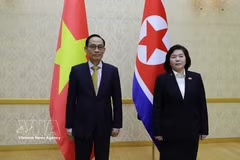
Vietnamese Minister of Foreign Affairs Le Hoai Trung (left) and DPRK Minister of Foreign Affairs Choe Son Hui. (Photo: VNA)

Vietnamese FM, DPRK officials discuss ways to boost bilateral ties

Trung reiterated that Vietnam places strong emphasis on strengthening and advancing its ties with the DPRK in a more practical and effective way, in line with the aspirations of the two nation’s people, while contributing to peace, stability, cooperation and development in the region and the world.

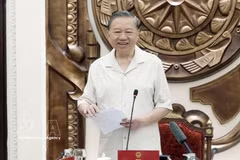
General Secretary of the Communist Party of Vietnam Central Committee and State President To Lam speaks at the working session in Hanoi on May 13, 2026. (Photo: VNA)

Party, State leader calls for consolidation of central steering committees on legal, judicial reform

Consolidating the central steering committees for institutional and legal reform and for judicial reform is necessary in order to streamline organisational structures without reducing responsibilities, while ensuring clear accountability, measurable outputs and concrete results. Following the restructuring, the body will be renamed the central steering committee for institutional improvement and law enforcement, with the Party General Secretary and State President serving as its head.

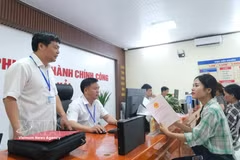
Civil servants provides administrative services for citizens in Son Hai commune of Bac Ninh province. (Photo: VNA)

Reform drive expected to remove barriers, unlock growth momentum

Prime Minister Le Minh Hung recently ordered ministries and agencies to immediately cut at least 30% of administrative procedures, 50% of processing time, 50% of compliance costs and 30% of business conditions, while eliminating all unnecessary procedures.

Ambassador Do Hung Viet, Permanent Representative of Vietnam to the United Nations (UN), meets with Annalena Baerbock, President of the 80th session of the UN General Assembly (UNGA). (Photo: VNA)

Vietnam strives for substantive outcome at NPT review conference

At the meeting this week, Ambassador Viet briefed the UNGA President on developments during the first two weeks of the conference. He stressed that the current international geopolitical landscape poses numerous complex challenges, while reaffirming Vietnam’s determination, together with other member states, to promote substantive and balanced outcomes at the conference.

General Secretary of the Communist Party of Vietnam Central Committee and President of Vietnam To Lam (R) receives Athsaphangthong Siphandone, member of the Lao People’s Revolutionary Party Central Committee, Secretary of the Vientiane Party Committee and Chairman of the municipal People’s Council, in Hanoi on May 12, 2026. (Photo: VNA)

Top leader of Vietnam receives Vientiane official in Hanoi

The host leader stressed that cooperation between localities, particularly between the capitals of Hanoi and Vientiane, plays an especially important role as a pioneering force in effectively implementing the foreign polices of the two Parties and States, while also serving as a bridge between politics and development, as well as between strategy and concrete action.

Prime Minister Le Minh Hung receives Chinese Ambassador to Vietnam He Wei in Hanoi on May 12. Photo: VNA

Prime Minister receives Chinese Ambassador

The Party and State of Vietnam always value the assistance China has provided to Vietnam during its past struggle for national independence as well as in national development today. Vietnam consistently regards the development of relations with China as a steadfast policy, an objective requirement, a strategic choice, and a top priority in its foreign policy of independence, self-reliance, multilateralisation and diversification.

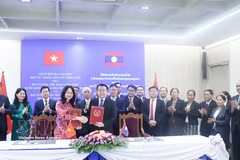
Secretary of the Hanoi Party Committee Tran Duc Thang and Secretary of the Vientiane Party Committee Atsaphangthong Siphandone witness the signing of a memorandum of understanding on cooperation between the Women’s Unions of Hanoi and Vientiane for 2026–2030, as well as a memorandum on enhanced cooperation between the Ho Chi Minh Communist Youth Union of Hanoi and the Lao People’s Revolutionary Youth Union of Vientiane for the same period. (Photo: VNA)

Hanoi, Vientiane promote comprehensive cooperation in new phase

The capitals of Vietnam and Laos signed memoranda of understanding on joint work in the fields of public communication and mass mobilisation, women and youth affairs, foreign relations, industry and trade, education and health care. These are expected to provide an important basis for implementing their cooperation priorities for 2026–2030.