Digital transformation must deliver real improvements in legislative efficiency: NA leader

Chairman Tran Thanh Man underlined that digital transformation must go beyond investing in software or platforms and instead create substantive changes in working methods, advisory quality and operational efficiency.

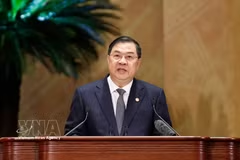
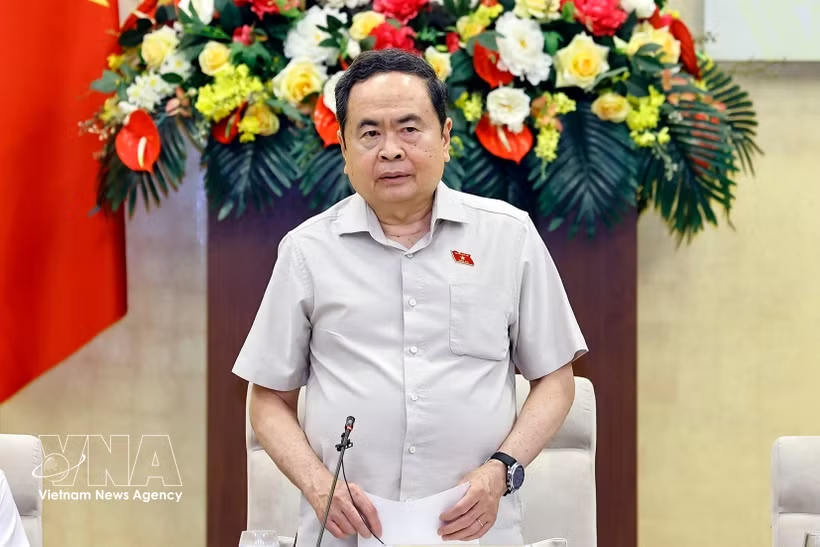
National Assembly Chairman Tran Thanh Man addresses the working session (Photo: VNA)

Hanoi (VNA) – National Assembly (NA) Chairman Tran Thanh Man has stressed the requirement of accelerating digital transformation within the legislature to improve its operational efficiency.

The top legislator was chairing a working session on May 13 with the NA’s Steering Committee for science – technology development, innovation and national digital transformation, alongside the legislature’s Steering Committee for digital transformation.

Considering establishment of NA's AI centre

Chairman Man underlined that digital transformation must go beyond investing in software or platforms and instead create substantive changes in working methods, advisory quality and operational efficiency.

He commended the proactive efforts by both steering committees since the Politburo's issuance of Resolution 57-NQ/TW, noting that initial results are relatively positive and have received high evaluation by Party General Secretary and State President To Lam.

Regarding apparatus consolidation, he assigned Permanent Vice Chairman of the NA Do Van Chien to oversee the merger of the two steering committees into a single body. He emphasised that relevant agencies or individuals must be held accountable for any delays in implementing tasks, reaffirming the principle that those unable to meet requirements should step aside.

The top legislator also called for expanding the “Digital literacy for all – Digital parliament” movement across the political system, while continuing to develop practical digital skills training materials for NA officials and staff.

On the application of artificial intelligence (AI) in 2026–2027, Chairman Man outlined a “three-pillar” model involving task setters, AI experts and infrastructure providers. AI, he said, should be integrated into core parliamentary activities such as legislation, supreme supervision, decision-making on national issues, external affairs and voter affairs.
vnanet-potal-chu-tich-quoc-hoi-lam-viec-ve-phat-trien-khcn-doi-moi-sang-tao-va-chuyen-doi-so-quoc-gia-8757504.jpg
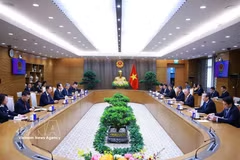
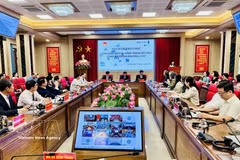
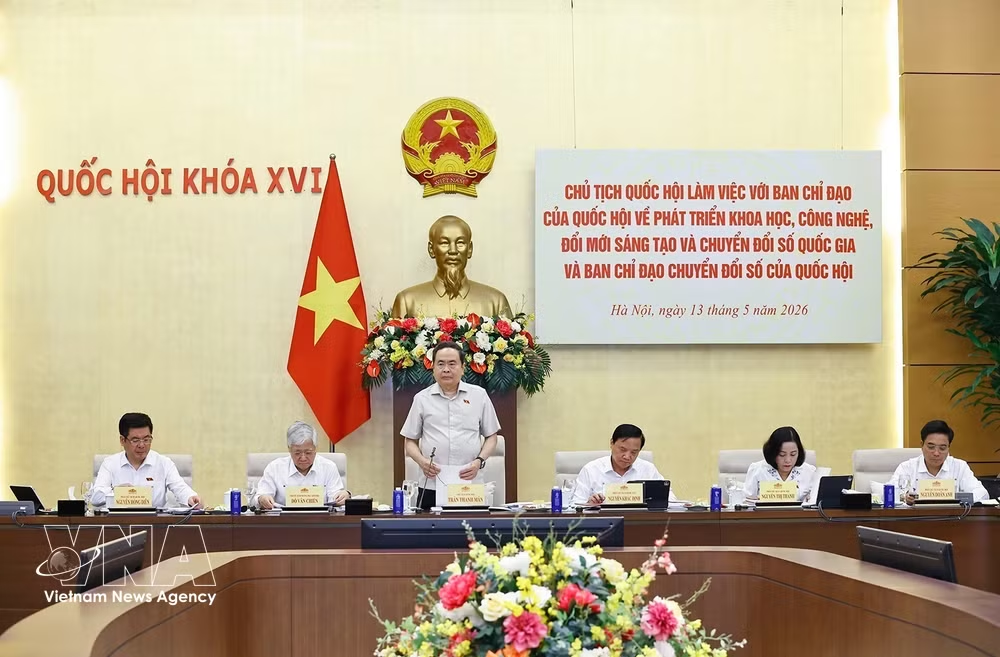
An overview of the working session (Photo: VNA)

The NA will also study the establishment of a dedicated AI centre to directly support legislative and supervisory activities while strengthening connections with parliaments worldwide and Vietnam’s AI community, he added.

Data viewed as strategic asset

The leader requested the NA Office to accelerate the official operation of digital systems already tested successfully and prioritise key applications to avoid delays or inefficiency. A list of prioritised software and applications for application must be submitted within July.

He stressed that digital transformation must be linked to administrative reform, improved work quality and performance evaluation.

He also directed the completion of the NA’s Digital Architecture 2.0 in line with the national digital framework and compatible with digital transformation efforts across Party agencies by the end of 2026.

Highlighting the importance of data governance, the top legislator stated that data should be treated as a strategic asset of the NA. He requested developing a digital data strategy of the NA and a roadmap for digitising archival records, ensuring connectivity with the national data centre and other political system databases.

The Chairman further urged the rapid deployment of a secure internal network and confidential operational system for NA agencies by the second quarter of 2026, alongside stronger cybersecurity monitoring and early-warning mechanisms.

He also emphasised the need to develop digital human resources, foster digital culture, attract technology experts, improve coordination mechanisms and perfect digital transformation evaluation criteria.

Chairman Man expressed confidence that with strong determination from NA leaders, steering committees, relevant agencies and technology partners, the implementation of Resolution 57-NQ/TW and the NA’s digital transformation agenda for 2026–2030 will achieve more visible and substantive progress, helping achieve Vietnam’s target of double-digit economic growth./.
VNA

See more

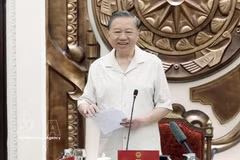
General Secretary of the Communist Party of Vietnam Central Committee and State President To Lam speaks at the working session in Hanoi on May 13, 2026. (Photo: VNA)

Party, State leader calls for consolidation of central steering committees on legal, judicial reform

Consolidating the central steering committees for institutional and legal reform and for judicial reform is necessary in order to streamline organisational structures without reducing responsibilities, while ensuring clear accountability, measurable outputs and concrete results. Following the restructuring, the body will be renamed the central steering committee for institutional improvement and law enforcement, with the Party General Secretary and State President serving as its head.

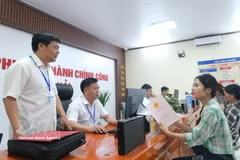
Civil servants provides administrative services for citizens in Son Hai commune of Bac Ninh province. (Photo: VNA)

Reform drive expected to remove barriers, unlock growth momentum

Prime Minister Le Minh Hung recently ordered ministries and agencies to immediately cut at least 30% of administrative procedures, 50% of processing time, 50% of compliance costs and 30% of business conditions, while eliminating all unnecessary procedures.

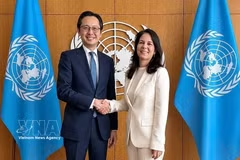
Ambassador Do Hung Viet, Permanent Representative of Vietnam to the United Nations (UN), meets with Annalena Baerbock, President of the 80th session of the UN General Assembly (UNGA). (Photo: VNA)

Vietnam strives for substantive outcome at NPT review conference

At the meeting this week, Ambassador Viet briefed the UNGA President on developments during the first two weeks of the conference. He stressed that the current international geopolitical landscape poses numerous complex challenges, while reaffirming Vietnam’s determination, together with other member states, to promote substantive and balanced outcomes at the conference.

General Secretary of the Communist Party of Vietnam Central Committee and President of Vietnam To Lam (R) receives Athsaphangthong Siphandone, member of the Lao People’s Revolutionary Party Central Committee, Secretary of the Vientiane Party Committee and Chairman of the municipal People’s Council, in Hanoi on May 12, 2026. (Photo: VNA)

Top leader of Vietnam receives Vientiane official in Hanoi

The host leader stressed that cooperation between localities, particularly between the capitals of Hanoi and Vientiane, plays an especially important role as a pioneering force in effectively implementing the foreign polices of the two Parties and States, while also serving as a bridge between politics and development, as well as between strategy and concrete action.

Prime Minister Le Minh Hung receives Chinese Ambassador to Vietnam He Wei in Hanoi on May 12. Photo: VNA

Prime Minister receives Chinese Ambassador

The Party and State of Vietnam always value the assistance China has provided to Vietnam during its past struggle for national independence as well as in national development today. Vietnam consistently regards the development of relations with China as a steadfast policy, an objective requirement, a strategic choice, and a top priority in its foreign policy of independence, self-reliance, multilateralisation and diversification.

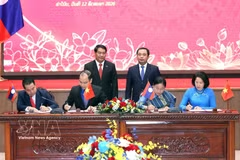
Secretary of the Hanoi Party Committee Tran Duc Thang and Secretary of the Vientiane Party Committee Atsaphangthong Siphandone witness the signing of a memorandum of understanding on cooperation between the Women’s Unions of Hanoi and Vientiane for 2026–2030, as well as a memorandum on enhanced cooperation between the Ho Chi Minh Communist Youth Union of Hanoi and the Lao People’s Revolutionary Youth Union of Vientiane for the same period. (Photo: VNA)

Hanoi, Vientiane promote comprehensive cooperation in new phase

The capitals of Vietnam and Laos signed memoranda of understanding on joint work in the fields of public communication and mass mobilisation, women and youth affairs, foreign relations, industry and trade, education and health care. These are expected to provide an important basis for implementing their cooperation priorities for 2026–2030.

An overview of the seminar held in Hanoi on May 12 (Photo: VNA)

Two-tier local administration improves public service delivery: Seminar

The two-tier local government model has operated relatively stable despite heavy workloads and high reform demands. Many localities have quickly adapted, while people have shown support for streamlined administration and expectations for a more modern, efficient and accountable public sector.

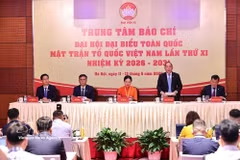
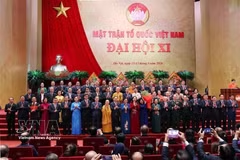
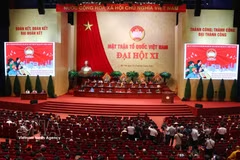
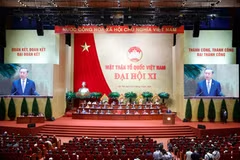
At the VFF's 11th National Congress for the 2026-2031 tenure. (Photo: VNA)

Vietnam Fatherland Front must better harness strength of great national unity: Top leader

In the new era, great national unity is not only a spiritual tradition, but also a national development capacity and a source of strength to unlock resources and creativity, create social consensus, and safeguard the country early and from afar. Unity now means respecting legitimate differences, harmonising interests, taking national interests as common ground, and rallying all patriotic Vietnamese around the aspiration to build a peaceful, independent, democratic, strong, prosperous, civilised, and happy Vietnam, the top leader said.