Two-tier local administration improves public service delivery: Seminar

The two-tier local government model has operated relatively stable despite heavy workloads and high reform demands. Many localities have quickly adapted, while people have shown support for streamlined administration and expectations for a more modern, efficient and accountable public sector.

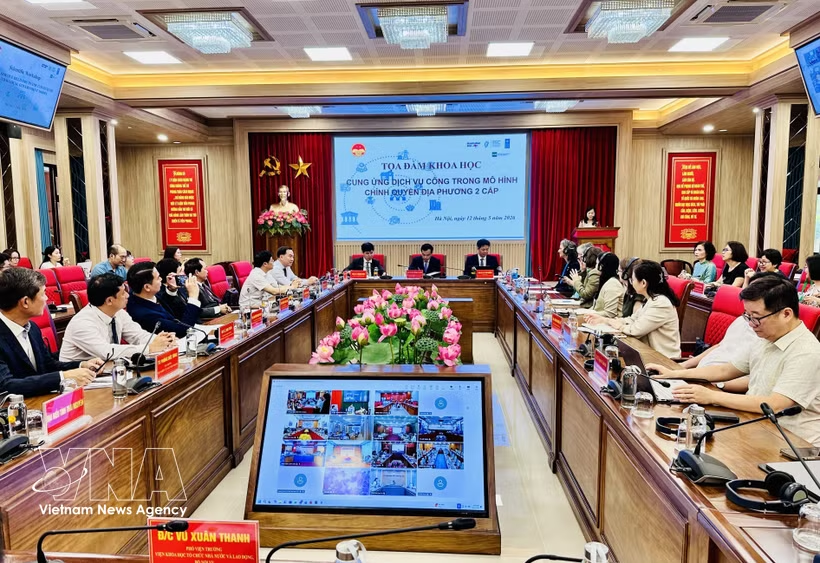
An overview of the seminar held in Hanoi on May 12 (Photo: VNA)

Hanoi (VNA) – After nearly one year of operation, the two-tier local government model has brought about considerable improvement in public service delivery, heard a seminar held in Hanoi on May 12 by the Ho Chi Minh National Academy of Politics (HCMA) in coordination with the United Nations Development Programme (UNDP) in Vietnam, with support from the Australian and Irish embassies.

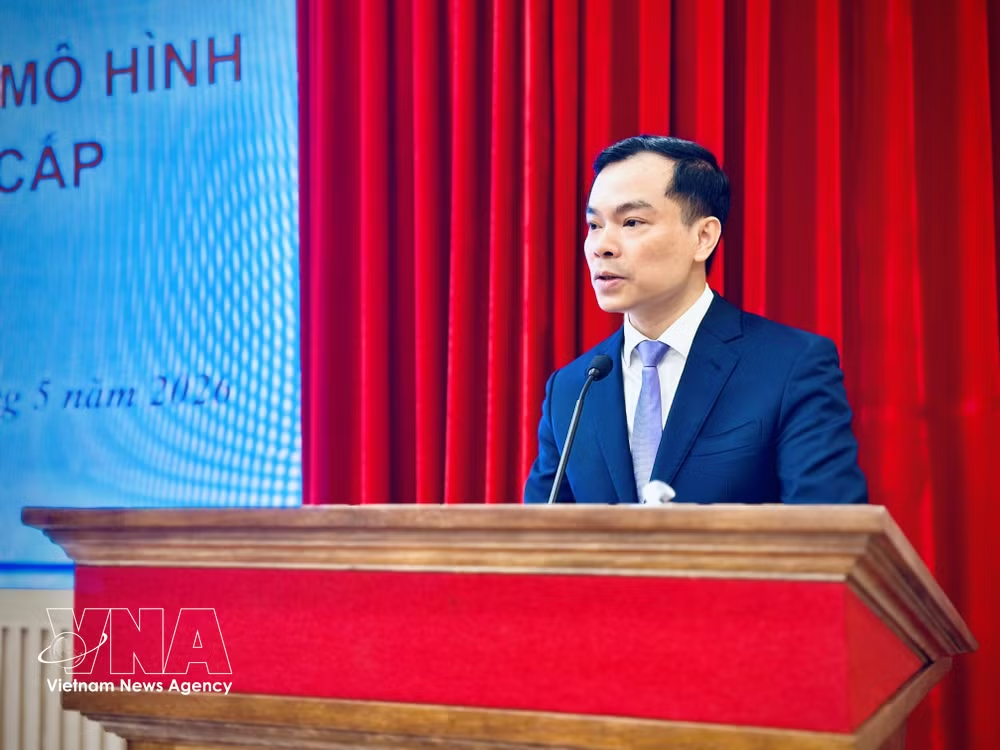
Associate Professor, Dr. Nguyen Manh Hung, HCMA Vice President and Vice Chairman of the Central Theory Council, described the shift from a three-tier to the two-tier local administration model as a major governance reform in terms of authority allocation, responsibilities, resources and interactions between authorities and citizens.

He noted that the new system has operated relatively stable despite heavy workloads and high reform demands. Many localities have quickly adapted, while people have shown support for streamlined administration and expectations for a more modern, efficient and accountable public sector.

However, Hung acknowledged persistent challenges, including limited resources, human capacity and digital infrastructure, which have hindered public service delivery. In some cases, citizens still have to wait or travel multiple times due to unclear administrative focal points, while grassroots officials face increasingly complex tasks without adequate conditions or skills.
vnanet-potal-ha-noi-toa-dam-danh-gia-nhanh-cung-ung-dich-vu-cong-trong-boi-canh-chinh-quyen-dia-phuong-hai-cap-8755722.jpg
Associate Professor, Dr. Nguyen Manh Hung, HCMA Vice President and Vice Chairman of the Central Theory Council, speaks at the seminar. (Photo: VNA)

He stressed the need for a shift in governance thinking, from requiring people to follow administrative procedures to designing services around citizens’ actual needs.

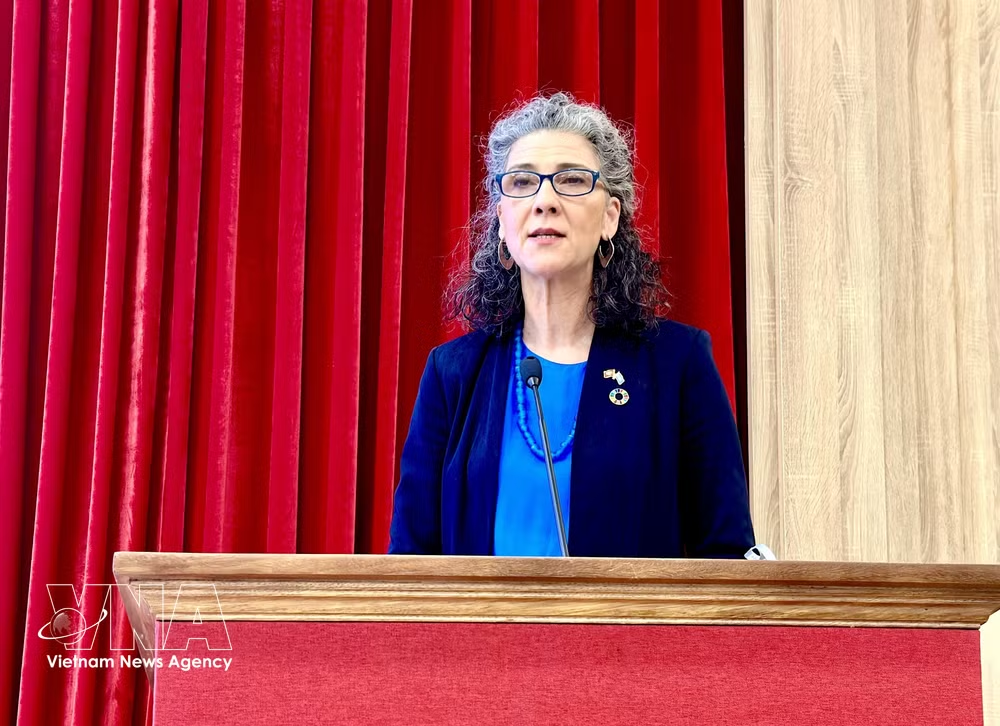
At the seminar, international partners shared perspectives on Vietnam’s reform process. UNDP Resident Representative in Vietnam Ramla Khalidi said decentralisation reform requires not only structural changes but also capable grassroots personnel, stable financial resources and secure, people-centred digital systems.

Australian Ambassador Gillian Bird and Irish Ambassador Deirdre Ní Fhallúin highlighted the importance of evidence-based research and public feedback in helping policymakers improve the effectiveness and inclusiveness of public services.

The seminar took place as Vietnam prepares to review one year of officially operating the two-tier local administration model from July 1, 2025.

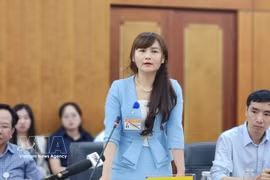
At the event, researchers from the HCMA and the Mekong Development Research Institute released findings from a nationwide survey of nearly 5,000 people, including 299 persons with disabilities, alongside case studies in the northern provinces of Bac Ninh and Hung Yen.
vnanet-potal-ha-noi-toa-dam-danh-gia-nhanh-cung-ung-dich-vu-cong-trong-boi-canh-chinh-quyen-dia-phuong-hai-cap-8755707.jpg
UNDP Resident Representative in Vietnam Ramla Khalidi addresses the event. (Photo: VNA)

The report showed broad public support for administrative streamlining and positive assessments of removing district-level administration. Satisfaction with commune-level administrative services reached 4.1 out of 5 points.

However, major bottlenecks remain. Only 21.8% of respondents had used the National Public Service Portal, highlighting a significant digital divide, particularly among persons with disabilities, 93.65% of whom had never accessed the platform. For decentralised procedures such as land-use right certificates, the on-time settlement rate stood at 71.1%, while more than 26% of respondents reported repeated travel to complete procedures.

In healthcare, 34.47% of respondents sought treatment at provincial hospitals, indicating continued pressure on higher-level facilities. Grassroots officials also face “functional overload” due to multi-sector responsibilities and limited staffing.

Based on the findings, participants proposed policy recommendations for the 2026–2031 period, including aligning decentralisation and delegation of power with resource allocation, increasing support for grassroots digitalisation, shifting from payroll management to human resource governance, and reforming salary policies based on job positions to better reflect workloads at the communal level./.
VNA

See more

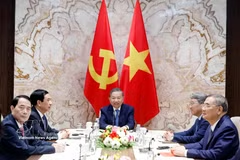
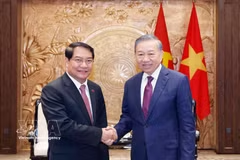
General Secretary of the Communist Party of Vietnam Central Committee and President of Vietnam To Lam (R) receives Athsaphangthong Siphandone, member of the Lao People’s Revolutionary Party Central Committee, Secretary of the Vientiane Party Committee and Chairman of the municipal People’s Council, in Hanoi on May 12, 2026. (Photo: VNA)

Top leader of Vietnam receives Vientiane official in Hanoi

The host leader stressed that cooperation between localities, particularly between the capitals of Hanoi and Vientiane, plays an especially important role as a pioneering force in effectively implementing the foreign polices of the two Parties and States, while also serving as a bridge between politics and development, as well as between strategy and concrete action.

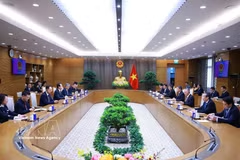
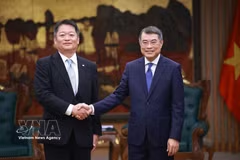
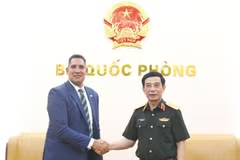
Prime Minister Le Minh Hung receives Chinese Ambassador to Vietnam He Wei in Hanoi on May 12. Photo: VNA

Prime Minister receives Chinese Ambassador

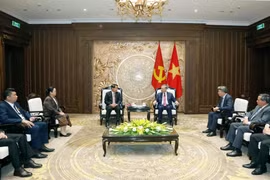
The Party and State of Vietnam always value the assistance China has provided to Vietnam during its past struggle for national independence as well as in national development today. Vietnam consistently regards the development of relations with China as a steadfast policy, an objective requirement, a strategic choice, and a top priority in its foreign policy of independence, self-reliance, multilateralisation and diversification.

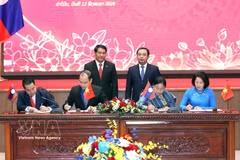
Secretary of the Hanoi Party Committee Tran Duc Thang and Secretary of the Vientiane Party Committee Atsaphangthong Siphandone witness the signing of a memorandum of understanding on cooperation between the Women’s Unions of Hanoi and Vientiane for 2026–2030, as well as a memorandum on enhanced cooperation between the Ho Chi Minh Communist Youth Union of Hanoi and the Lao People’s Revolutionary Youth Union of Vientiane for the same period. (Photo: VNA)

Hanoi, Vientiane promote comprehensive cooperation in new phase

The capitals of Vietnam and Laos signed memoranda of understanding on joint work in the fields of public communication and mass mobilisation, women and youth affairs, foreign relations, industry and trade, education and health care. These are expected to provide an important basis for implementing their cooperation priorities for 2026–2030.

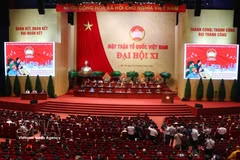
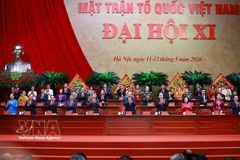
At the VFF's 11th National Congress for the 2026-2031 tenure. (Photo: VNA)

Vietnam Fatherland Front must better harness strength of great national unity: Top leader

In the new era, great national unity is not only a spiritual tradition, but also a national development capacity and a source of strength to unlock resources and creativity, create social consensus, and safeguard the country early and from afar. Unity now means respecting legitimate differences, harmonising interests, taking national interests as common ground, and rallying all patriotic Vietnamese around the aspiration to build a peaceful, independent, democratic, strong, prosperous, civilised, and happy Vietnam, the top leader said.

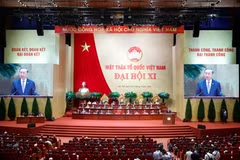
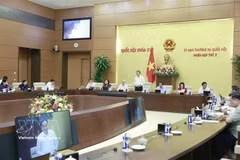
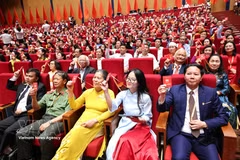
At the opening of the VFF's 11th National Congress. (Photo: VNA)

Vietnam Fatherland Front convenes 11th National Congress for 2026-2031 term

With the spirit of “Unity – Democracy – Innovation – Creativity – Development”, the Presidium called on delegates to uphold their sense of responsibility, solidarity, and wisdom, and contribute substantive and quality opinions on documents so that the congress would become a major milestone in the process of renewing and improving the VFF’s effectiveness in the new revolutionary period.

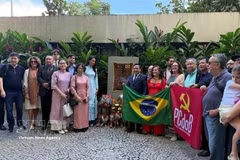
A flower-laying ceremony is held at the plaque in commemoration of President Ho Chi Minh on May 9 in Brazil's Rio de Janeiro city. (Photo: VNA)

Ceremony in Brazil honours President Ho Chi Minh, Vietnam–Brazil friendship

Addressing a ceremony dedicated to the Vietnamese leader in Rio de Janeiro city on the occasion of the 136th anniversary of his birth (May 19, 1890–2026) and the 37th anniversary of the establishment of diplomatic relations between Vietnam and Brazil (May 8, 1989–2026), Vietnamese Ambassador to Brazil Bui Van Nghi highlighted that Ho Chi Minh’s forward-thinking vision laid the foundation for friendship and cooperation between the peoples of Vietnam and Brazil more than a century ago.

General Secretary of the Communist Party of Vietnam Central Committee and State President To Lam holds phone talks with President of Switzerland Guy Parmelin on May 11. (Photo: VNA)

Top Vietnamese leader affirms high regard for ties with Switzerland during phone talks

General Secretary of the Communist Party of Vietnam Central Committee and State President To Lam held phone talks with President of Switzerland Guy Parmelin, during which the Vietnamese leader voiced his hope that both sides would continue joint work to effectively realise and further deepen the bilateral Comprehensive Partnership established in January 2025.

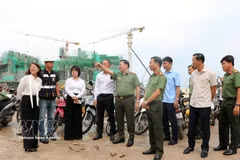
The delegation checks a venue for activities of the APEC Economic Leaders’ Week 2027. (Photo: VNA)

Security preparations reviewed for APEC 2027 in Phu Quoc

The team examined the APEC 2027 Convention Centre, where main conference activities are scheduled; Sun Serenia Hospital, designated to provide healthcare and emergency medical services for delegates; provincial road DT.975, which connects Phu Quoc International Airport to the convention centre; and the area surrounding Phu Quoc International Airport.