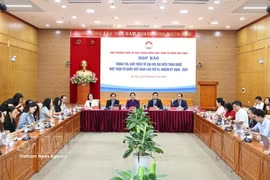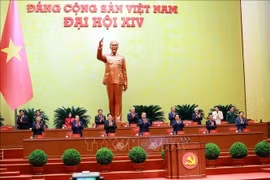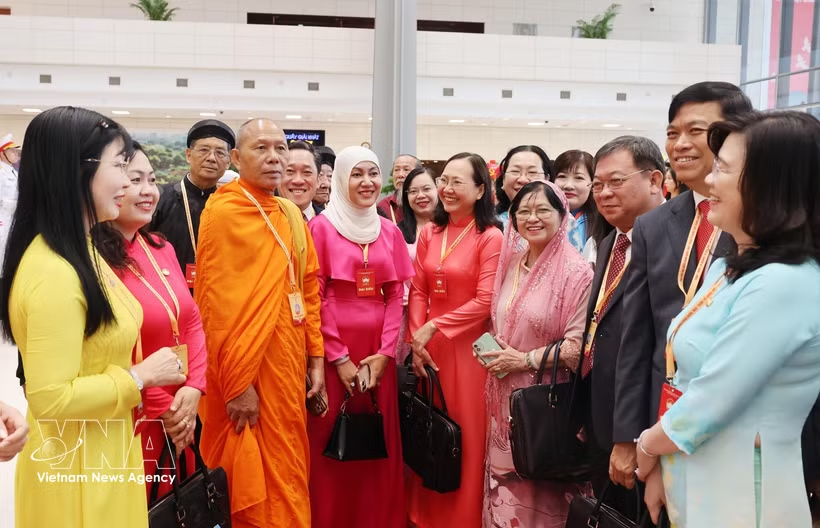
Hanoi (VNA) – Delegates at the 11th National Congress of the Vietnam Fatherland Front (VFF) for the 2026–2031 tenure have highlighted that the application of artificial intelligence (AI) and digital transformation is an inevitable step for the country’s development in the coming period.
Mobilising national resources for a new era
Most Venerable Thich Tam Hai, member of the Executive Council of the Vietnam Buddhist Sangha, head of its Information and Communications Board in Ho Chi Minh City, and Editor-in-Chief of Giac Ngo newspaper, stressed that religion, including Buddhism, is an integral part of the nation and will actively contribute to mobilising resources for the country’s new development era.
He said the application of digital technology in governance, administration and connectivity, particularly for large communities such as the VFF, is inevitable. Religious organisations must participate in digital transformation to remain connected with society. The Vietnam Buddhist Sangha has applied digital transformation in its administration for years and will continue accelerating the process in line with national development, he noted.
Expressing confidence in the congress’s goals, Most Venerable Thich Tam Hai said the VFF’s action programmes will create fresh momentum and mobilise nationwide resources for development and public well-being.
Nguyen Van Dung, President of the VFF Committee of Con Dao special zone in Ho Chi Minh City, voiced hope that the congress will concretise the spirit of the 14th National Party Congress with solidarity, creativity and determination to drive national development.
As the only island-based administrative unit among Ho Chi Minh City’s 168 communes and wards, Con Dao has consistently upheld solidarity among military forces, local authorities and residents, he said. The city’s “Fund for national seas and islands, and the frontline of the Fatherland” has strengthened confidence among local residents despite their remote location, he said.
Regarding digital transformation, Dung said the special zone is implementing the “Digital Literacy for All” movement across communities, initially targeting grassroots-level VFF officials. By the end of 2026, all VFF officials are expected to complete the programme.
Building public trust in VFF
Huynh Tan Dat, member of the 10th Central Committee of the VFF, President of the Vietnamese Students’ Association in Australia and one of the youngest delegates, said he hopes to receive guidance from the Party, State and VFF for overseas Vietnamese communities, especially youth and students, to help orient their community activities, academic pursuits and scientific research towards practical contributions to Vietnam.
According to Australia’s Department of Home Affairs, around 37,000 Vietnamese students are currently studying in Australia, mainly in New South Wales and Victoria.
The Vietnamese Students’ Association in Australia has organised activities supporting students at different stages, including study-abroad counselling, accommodation assistance, career orientation and scientific research promotion.
Dat said the association also encourages students to focus on academic advancement and absorb positive values from the host country for future contributions to Vietnam. It has also connected Vietnamese agencies and organisations with students through competitions and innovation initiatives addressing science-technology challenges.
He proposed that the VFF establish regular communication channels with overseas Vietnamese youth and student associations to provide clearer orientations and practical assignments, ensuring youth activities deliver tangible outcomes.
Kieu My, member of the 10th Central Committee of the VFF and Director of the Institute of Artificial Intelligence Technology and Digital Transformation, said the VFF has made positive innovations, notably through the development of the “Mat tran” application to gather information and receive public feedback.
According to him, applying AI to collect public opinions and monitor social sentiment is a sound direction that should be expanded further.
To attract experts and intellectuals to implement the Politburo’s Resolution No. 57-NQ/TW on science-technology development, innovation and digital transformation, Kieu suggested that the VFF establish expert advisory groups, strengthen public outreach, develop two-way communication channels, and utilise AI for faster and more accurate responses to citizens’ feedback.
He also expressed high expectations for the Digital VFF Portal, hoping more people, especially the youth in urban and rural areas, would use it to submit feedback and opinions, thereby strengthening public trust in the VFF and reinforcing the great national unity bloc./.
VNA