Hanoi (VNA) – As Vietnam seeks to unlock new growth drivers, domestic enterprises are increasingly looking beyond national borders to expand their presence in international markets.
Vietnam’s overseas investment continued to surge in recent years. In 2025, the country’s outbound investment reached more than 1.36 billion USD, up 88.7% year-on-year. In the first four months of 2026 alone, overseas investment totalled 713.9 million USD, 2.3 times higher than the same period last year.
Expanding to new sectors
After two decades of overseas expansion, the Military Industry-Telecoms Group (Viettel) has established a presence in 16 countries. Its international operations now generate annual revenue of more than 3 billion USD, supported by sustained yearly growth of around 20%.
Notably, Viettel currently ranks as the leading telecom operator in seven out of its 10 overseas telecom markets. The group has also officially launched 5G services in Laos, Cambodia, Timor-Leste, Burundi and Tanzania.
According to Chairman of Viettel Global Dao Xuan Vu, the corporation is shifting from a traditional overseas investment model to a broader “Go Global 2.0” strategy.
If telecommunications once served as Viettel’s main vehicle for international expansion, the next phase will rely on the combined strength of a high-tech industrial and technology conglomerate, he said.
The group plans to drive future growth through four pillars: consolidating traditional telecom services, accelerating digital services, developing new business areas, and expanding into potential markets.
Several overseas markets, including Timor-Leste, Tanzania, Burundi and Cambodia, have recently granted Viettel additional next-generation spectrum frequencies, creating favourable conditions for deploying advanced infrastructure and expanding business operations.
Beyond telecommunications, Viettel has officially launched logistics services in Laos and plans to expand into Cambodia and Myanmar. The group is also broadening its digital finance ecosystem through the establishment of NatTransfer, a remittance service company in Haiti.
At the same time, Viettel is exploring investment opportunities in emerging markets such as the Dominican Republic, Panama and Ecuador.
Meanwhile, Vietnam Posts and Telecommunications Group (VNPT) is pursuing international expansion through artificial intelligence (AI).
As part of its transition from a traditional telecom operator to a digital technology corporation, VNPT has established VNPT AI with the ambition of becoming a leader in AI research, development and application.
Nguyen Tien Cuong, Director of VNPT AI, said the company will focus on developing AI and generative AI ecosystems while bringing Vietnamese AI products to international markets, initially targeting the US, Japan, the Republic of Korea and other potential destinations.
The company also aims to become Vietnam’s leading AI brand and a new growth engine for VNPT’s long-term development strategy.
Building sustainable global presence
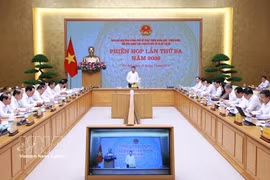
The Government recently approved the “Go Global” programme for 2026-2030, which identifies the private sector as a key driving force in Vietnam’s international expansion process.
The programme aims to help Vietnamese private enterprises strengthen their overseas presence in a comprehensive, effective and sustainable manner through international investment, business activities and deeper integration into regional and global supply and value chains.
To achieve these goals, the programme outlines five major groups of solutions.
These include developing a transparent and supportive institutional framework to encourage and reduce risks for overseas investment; improving businesses’ access to information, training and international integration capacity; and promoting overseas mergers and acquisitions (M&A) to help firms access global resources and expand growth opportunities.
The programme also seeks to support deeper participation in global supply and value chains to increase export value and strengthen the economy’s resilience and strategic autonomy.
Another priority is facilitating cross-border digital trade activities to promote growth driven by technology, data, innovation and sustainability.
Mai Thu Hien, Deputy Director of the Department of Planning, Finance and Enterprise Management under the Ministry of Industry and Trade, said the ministry will strengthen training, consultancy and specialised information services to help enterprises improve investment strategies, international governance capacity and understanding of foreign legal standards.
The “Go Global” programme also prioritises online exports through cross-border e-commerce platforms, enabling Vietnamese enterprises, especially small- and medium-sized firms, to access global markets more effectively at lower costs.
By 2030, the programme aims to develop at least 20 major Vietnamese enterprises in strategic sectors capable of participating deeply in regional and global supply chains and value chains.
The vision is for Vietnamese businesses to truly “Go Global” with their own products, technology and brands, rather than remaining outsourcing manufacturers for foreign partners./.