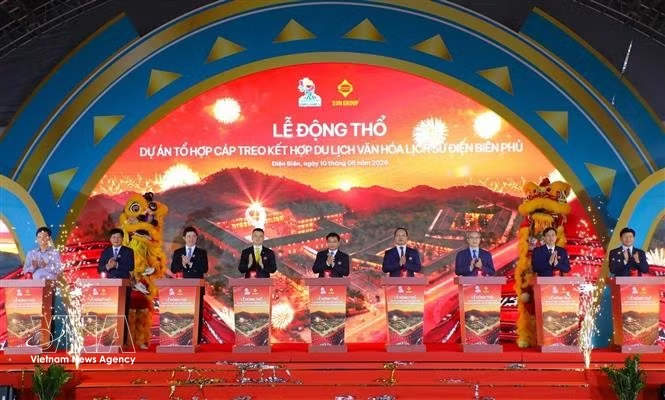
Dien Bien (VNA) – The People’s Committee of Dien Bien, in coordination with Sun Group, held the groundbreaking ceremony for the Dien Bien Phu cultural-historical tourism and cable car complex project in Muong Phang commune on May 10.
Addressing the event, Deputy Prime Minister Nguyen Van Thang said the implementation of the cable car complex project carries practical significance in realising northern mountainous province’s tourism development orientations in the years to come.
He urged the investor to mobilise maximum resources, apply modern technologies and organise construction in a scientific manner while ensuring labour safety and project quality. Particular attention should be paid to environmental protection, ecosystems and the preservation of the natural landscape. The investor must adhere to committed timelines and harmoniously incorporate the distinctive cultural values of Dien Bien’s 19 ethnic groups into the tourism products, creating a destination that is both modern and rich in cultural identity.
The Deputy PM also encouraged Sun Group to continue exploring investment opportunities in Dien Bien in order to promote regional tourism connectivity and international tourism links with neighbouring countries such as Laos, China and Thailand.
For its part, Dien Bien province was asked to work closely with the investor, particularly in site clearance efforts, and create the most favourable conditions for the project to be implemented on schedule and put into operation at the earliest possible date.
Secretary of the provincial Party Committee Tran Tien Dung affirmed that the province would continue to uphold the principle of “a government that serves and accompanies businesses”. He called on local departments and agencies to maximise the effectiveness of a “green lane” mechanism to promptly resolve difficulties and obstacles faced by the investor in accordance with the law, while ensuring compensation and site clearance are carried out in a manner that safeguards the legitimate rights and interests of local residents.
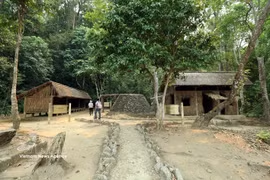
Regarding heritage preservation, he stressed the principle of protecting the land, the people and the forests, noting that the project must develop in harmony with the Muong Phang historical forest ecosystem and preserve the historical relic site.
At the ceremony, Dang Minh Truong, Chairman of the Board of Directors of Sun Group, pledged to make every effort and uphold the highest sense of responsibility in completing procedures and accelerating project implementation while ensuring quality, progress and long-term benefits for the locality.
The project is expected to cover 35.35 hectares in Muong Phang and Pu Nhi communes. Of the total area, the departure station will occupy 15.51 hectares, the arrival station 5.89 hectares, the cable corridor 9.71 hectares, and transport infrastructure 4.24 hectares. Some 6.6 hectares, accounting for 18.67% of the total project area, including roads, green buffer zones, public green spaces and water surface areas, will be handed over to local authorities for management after construction. The remaining land will be used for functional zones serving tourism and commercial operations, with a capacity of around 15,000 visitors per day.
The project aims to effectively tap the area’s natural landscapes, geographical advantages and distinctive historical value, while creating a high-quality tourism product with strong competitiveness. It is also intended to preserve, honour and promote the value of the Dien Bien Phu Victory special national historical relic site. In addition, the project is expected to improve connectivity among historical sites in the area and enhance accessibility and visitor experiences, particularly in mountainous terrain, through a modern cable car system and synchronised infrastructure. It will also support the development of a professional and integrated cultural-historical tourism complex combined with commercial and entertainment services, contributing to making Dien Bien Phu a leading cultural and historical tourism destination in northern mountainous Vietnam.
Construction and commencement of operations are expected to be completed within five years from the land allocation or lease date. The operational term of the project will be 70 years from the date of the land allocation, lease or land-use conversion decision.
Dien Bien, once a ferocious battlefield, is undergoing a visible overhaul, with gains in economic growth, poverty reduction, infrastructure, and social welfare that lay the groundwork for a new expansion phase. It welcomed more than 1.4 million tourists in 2025. In 2026, it is targeting over 1.6 million visitors, including more than 10,000 foreign arrivals, with total revenue projected at 2.88 trillion VND and an average stay of three days./.
VNA