Ho Chi Minh City pushes for full public investment disbursement

Ho Chi Minh City was allocated a record 147.599 trillion VND (5.6 billion USD) in public investment capital for 2026, up 22.6% from last year and accounting for nearly 14.6% of the nation’s total public investment budget. However, disbursement by the end of April remained below the national average.

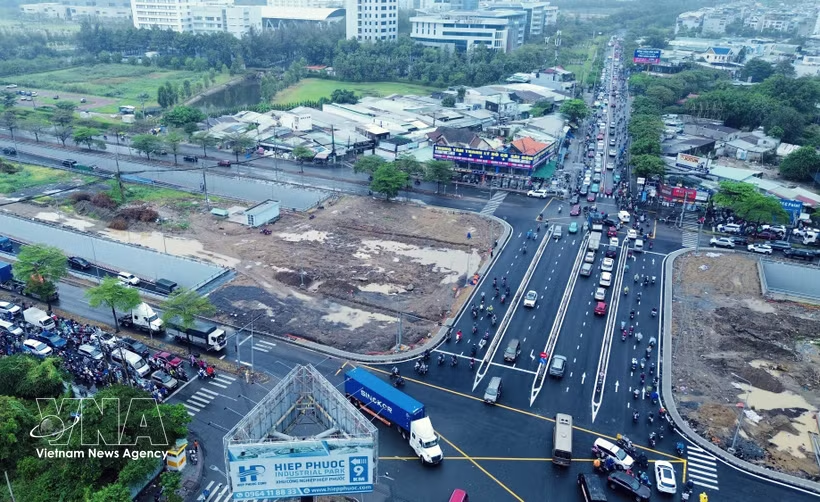
The Nguyen Van Linh–Nguyen Huu Tho intersection fully opens both underpasses to traffic, helping ease congestion in the area. (Photo: VNA)

Ho Chi Minh City (VNA) – Ho Chi Minh City is stepping up efforts to accelerate public investment disbursement after releasing just 10.5% of its 2026 capital plan in the first four months of the year, as the southern economic hub identifies public spending as an important driver for achieving its double-digit growth target.

The city was allocated a record 147.599 trillion VND (5.6 billion USD) in public investment capital for 2026, up 22.6% from last year and accounting for nearly 14.6% of the nation’s total public investment budget. However, disbursement by the end of April remained below the national average.

The municipal Department of Finance attributed the slowdown largely to the restructuring of the public investment management system and the reassignment of duties among agencies. City authorities said several major bottlenecks had already been addressed in April to pave the way for faster disbursement in the months ahead.

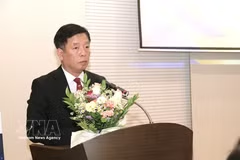
Speaking at a socio-economic conference on May 8, Vice Chairman of the municipal People’s Committee Hoang Nguyen Dinh called on agencies to move beyond a “target-oriented” mindset and ensure full disbursement of allocated capital in line with directives from the central government.

The city has ordered the swift consolidation of commune- and ward-level project management boards while tightening accountability among agency heads. Local authorities and project investors that fail to meet disbursement targets could face scrutiny during year-end performance reviews.

The Department of Finance has also urged departments, local administrations and investors to speed up capital allocation and disbursement, with the goal of reaching 30-35% of the annual plan in the second quarter and 100% for the full year.

Authorities said implementation must strictly follow the principle of clearly defined responsibilities, authority, timelines and outcomes, while intensifying field inspections and resolving bottlenecks related to planning, bidding, contractor selection and land clearance.

Land clearance remains one of the biggest hurdles for key infrastructure projects across the city. Ho Chi Minh City allocated 33.685 trillion VND in compensation funding for 165 projects this year, with around 8.614 trillion VND, or 25%, disbursed so far.

According to the municipal Department of Agriculture and Environment, many newly funded projects are still undergoing land recovery, surveys, inventory checks and legal verification procedures required under the 2024 Land Law, slowing overall progress despite the relatively higher disbursement rate.

The city aims to finalise compensation and resettlement plans in the third quarter to speed up payments and capital disbursement, while also strengthening steering committees and task forces to handle local bottlenecks more quickly.

Authorities in 168 communes, wards and special zones have been instructed to review all obstacles related to compensation and land clearance and proactively resolve issues within their authority to avoid delays caused by overlapping administrative procedures.

In addition to procedural bottlenecks, rising construction material costs are placing mounting pressure on major public investment projects. Higher fuel prices have increased the costs of mining and transporting sand and stone, as well as operating construction machinery.

The Ring Road No.3 project in Ho Chi Minh City, one of southern Vietnam’s flagship infrastructure developments, is now projected to be delayed by around six months from the original schedule. The city’s Transport Works Construction Investment Project Management Board said the project has reached around 76% completion overall, with packages in the former Thu Duc city area at 83%, while those in Cu Chi, Hoc Mon and Binh Chanh have reached about 68%.

The management board cited fuel price volatility linked to escalating tensions in the Middle East, alongside shortages of imported bitumen and asphalt concrete, as major factors affecting construction progress.

Project investors and contractors are coordinating with quarry operators to secure additional material supplies while also calling for construction material prices to be updated more frequently in line with market movements to ease cost pressures.

With the largest public investment programme in its history, Ho Chi Minh City is expected to face significant disbursement pressure throughout 2026. However, officials believe that if bottlenecks involving land clearance, investment procedures and material supply are removed in a timely manner, public investment will continue to serve as a key growth driver for the city this year./.

VNA
See more

Viettel launches the Unitel Logistics brand in Laos. (Photo: VNA)

Vietnamese firms expand global footprint

The Government recently approved the “Go Global” programme for 2026-2030, which identifies the private sector as a key driving force in Vietnam’s international expansion process. It aims to help Vietnamese private enterprises strengthen their overseas presence in a comprehensive, effective and sustainable manner through international investment, business activities and deeper integration into regional and global supply and value chains.

Vietnam and Cambodia are seeking to strengthen supply chain connectivity and promote sustainable border trade at a trade promotion conference in Vietnam's Mekong Delta province of Dong Thap on May 15. (Photo: https://thoibaonganhang.vn/)

Vietnam, Cambodia eye stronger border trade, supply chain connectivity

Vietnam–Cambodia trade ties have grown rapidly in recent years, becoming one of the major pillars of economic cooperation in the Mekong sub-region. The two countries share a 1,137-km border and an increasingly developed network of international and secondary border gates, facilitating cross-border trade, logistics and investment.

Illustrative image. (Photo: VNA)

Three proposals to connect overseas Vietnamese resources with private economy at home

There are currently many Vietnamese IT specialists working in technology corporations, banks, start-ups and innovation ecosystems across Canada. With appropriate mechanisms in place, this workforce could become a technology bridge, helping Vietnamese enterprises access management expertise, technical solutions, international standards and partnership networks in North America.

Visitors explore Quang Tri province’s OCOP products (Photo: VNA)

Quang Tri links OCOP products with tourism to expand farm produce markets

The central province currently has 160 OCOP products developed by cooperatives, cooperative groups and businesses, including two five-star and 31 four-star products. These locally distinctive products are gradually becoming "ambassadors" showcasing Quang Tri’s culture and identity to domestic and international visitors.

Work starts on Hanoi’s Red River Landscape Boulevard Axis project on December 19, 2025. (Photo: VNA)

Hanoi approves nearly 28-bln-USD Red River landscape boulevard project

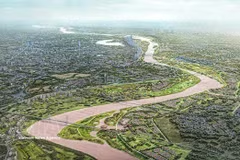
Covering more than 11,400 hectares and requiring an estimated 736.96 trillion VND (nearly 28 billion USD), the project is expected to reshape urban development along both banks of the Red River over the coming decades while improving transport connectivity and public spaces in the capital.

Deputy Prime Minister Nguyen Van Thang and delegates perform the ground-breaking ceremony for the Northwest Dien Bien Phu New Urban Area, Resort and Sports Complex project. (Photo: VNA)

Vingroup launches largest-ever urban development project in Dien Bien

Under the master plan, the project will span more than 228.5ha and accommodate around 12,000 residents. It is designed under a “city within a city” model integrating residential areas, commercial and service facilities, resorts, schools, healthcare services, public spaces and sports infrastructure.

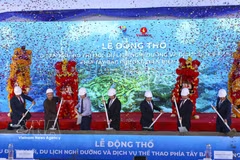
Deputy Prime Minister Nguyen Van Thang and delegates press the button to launch construction of the Dien Bien Phu cultural-historical tourism and cable car complex project in Dien Bien province on May 10, 2026. (Photo: VNA)

Dien Bien Phu cultural-historical tourism, cable car complex project launched

The project aims to effectively tap the area’s natural landscapes, geographical advantages and distinctive historical value, while creating a high-quality tourism product with strong competitiveness. It is also intended to preserve, honour and promote the value of the Dien Bien Phu Victory special national historical relic site.

Politburo member Nguyen Duy Ngoc (third, right), who is Standing Deputy Head of the Central Steering Committee for Science-Technology Development, Innovation and Digital Transformation, holds a working session with the Colombo Port City Management Board. (Photo: VNA)

Vietnam studies Colombo smart port city model

Ngoc praised Sri Lanka’s orientations in developing seaport infrastructure, digital infrastructure, digital economy and international service centres, describing them as valuable references for Vietnam in developing strategic infrastructure, innovation centres, smart urban areas and digital economy ecosystems.