Vietnam maintains people-centred approach to migration governance

Phan Thi Minh Giang, Deputy Director General of the Consular Department under the Ministry of Foreign Affairs, has affirmed that Vietnam maintains a balanced and people-centred approach to migration governance at the second International Migration Review Forum (IMRF) recently held at the United Nations headquarters in New York.

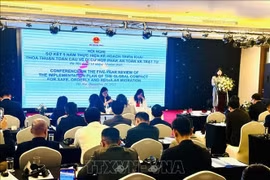
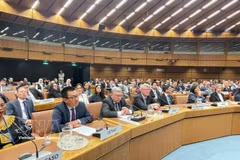
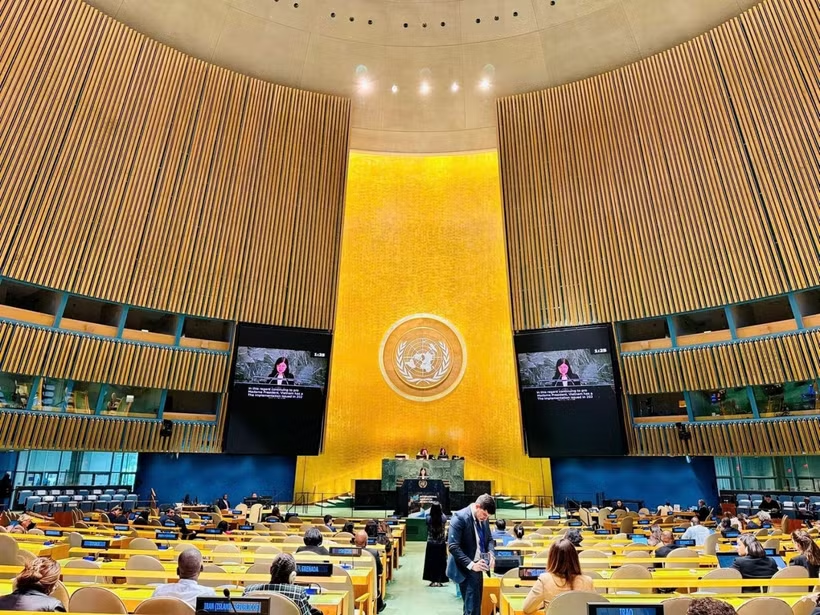
The second International Migration Review Forum (IMRF) is held at the United Nations headquarters in New York. (Photo courtesy of the Ministry of Foreign Affairs)

Hanoi (VNA) – Vietnam remains committed to a balanced and people-centred approach to migration governance, according to Phan Thi Minh Giang, Deputy Director General of the Consular Department under the Ministry of Foreign Affairs, speaking at the second International Migration Review Forum (IMRF) recently held at the United Nations headquarters in New York.

Giang noted that global migration trends continue to evolve in increasingly complex ways. Gaps in migration governance and the lack of regular migration pathways have left migrants more vulnerable, while human trafficking and migrant smuggling have become increasingly sophisticated, including new forms of exploitation linked to digital technology and coercion into criminal activities at online scam centres.

In this context, Vietnam affirmed that the Global Compact for Safe, Orderly and Regular Migration (GCM) remains an important framework for promoting dialogue and practical cooperation on migration, in line with the conditions and priorities of each country.

She said Vietnam has been actively implementing its national plan for the GCM, issued in 2020, with notable progress in improving policies and legislation, promoting safe and regular migration pathways through bilateral labour cooperation, fair recruitment practices and measures to reduce migration costs. Vietnam has also accelerated digital transformation in migration management, including the development of migration databases to support evidence-based policymaking.

The Vietnamese representative stressed the importance of expanding safe and sustainable legal migration channels, strengthening cooperation along migration routes, and promoting a victim-centred approach in combating human trafficking and migrant smuggling. Vietnam also reaffirmed its commitment to constructive cooperation with partners in advancing the GCM implementation.

The IMRF attracted broad participation from nearly 130 countries, international organisations and other stakeholders. The forum reviewed progress made in implementing the GCM since the first IMRF in 2022, while also discussing opportunities, challenges and future priorities for international migration cooperation.

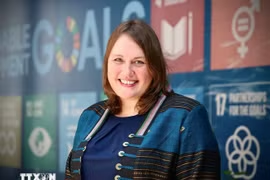
In her opening remarks, Annalena Baerbock, President of the United Nations General Assembly, emphasised the role of governments in ensuring that migration becomes a triple-win model benefiting migrants, countries of origin and destination countries alike.

She stressed the need for effective migration management based on a people-centred approach to migration agreements, while encouraging member states to engage in frank and substantive discussions so that the outcomes could be translated into national policies and bilateral and regional agreements.

The four-day forum featured roundtable discussions, policy debates and plenary sessions. More than 90 countries submitted voluntary review reports on the implementation of the GCM, representing an increase of around 30% compared with 2022.

During the forum, the Vietnamese delegation shared the country’s achievements in implementing the GCM since the first IMRF, and proposed areas for enhanced cooperation in the years to come. Vietnam also submitted its voluntary national review report on the implementation of the GCM.

At the conclusion of the four-day meeting, participating countries adopted a progress declaration assessing achievements to date, identifying remaining challenges and setting priorities for the next phase of efforts to promote safe, orderly and people-centred migration governance. The third IMRF is expected to take place in 2030./.

VNA
See more

☕ Afternoon briefing on May 14

☕ Afternoon briefing on May 14

The first meeting of the steering committee tasked with reviewing the Party’s century-long leadership of the Vietnamese revolution, the 100-year master plan of Hanoi approved, and Vietnam securing a berth at the FIFA U17 World Cup 2026 for the first time are among news highlights on May 14.

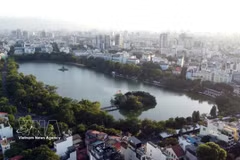
A view of the Hoan Kiem lake area, downtown Hanoi. (Photo: VNA)

Hanoi approves 100-year master plan

By 2035, Hanoi aims to become a green, smart and modern city, as well as an important regional centre for finance, commerce and innovation. Its gross regional domestic product (GRDP) is expected to reach approximately 200 billion USD, with per capita GRDP exceeding 18,800 USD.

At the steering committee's meeting (Photo: VNA)

Top leader confident in landmark national review for future development

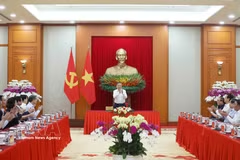
He made the statement in Hanoi on May 14 while chairing the first meeting of a steering committee tasked with reviewing the Party’s century-long leadership of the Vietnamese revolution, mapping strategic directions for the next century, and evaluating four decades of the Platform on National Construction in the period of transition to socialism.

Vietnam promotes cooperation with United Nations on crime prevention

Vietnam promotes cooperation with United Nations on crime prevention

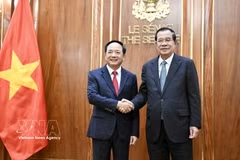
Vietnam highly values the support of the United Nations Office on Drugs and Crime (UNODC) in strengthening national capacity in crime prevention and criminal justice, drug control, and addressing emerging challenges, particularly cybercrime, said Ambassador Vu Le Thai Hoang.

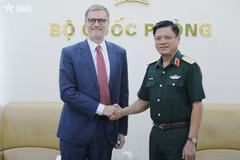
Deputy Minister of National Defence Sen. Lieut. Gen. Nguyen Truong Thang (R) meets with French Ambassador to Vietnam Olivier Brochet in Hanoi on May 13. (Photo: qdnd.vn)

Vietnam, France see new strides in defence ties

Deputy Minister of National Defence Sen. Lieut. Gen. Nguyen Truong Thang stressed that defence ties, a key pillar of bilateral relationship, have been growing substantively and effectively, with progress in the exchange of all-level delegations, especially those at high level, defence industry, training, and United Nations peacekeeping operations, consistent with agreements reached by leaders and the two defence ministries, plus signed cooperation documents.

☀️ Morning digest on May 14

☀️ Morning digest on May 14

Foreign Minister Le Hoai Trung's meetings with DPRK officials, the State President's order to promulgate nine laws adopted by the 16th National Assembly at the first session, and the repatriation of 28 rare turtles from the RoK to Vietnam are among news highlights on May 13 evening.

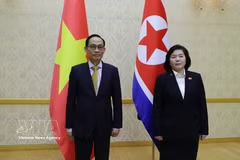
Vietnamese Minister of Foreign Affairs Le Hoai Trung (left) and DPRK Minister of Foreign Affairs Choe Son Hui. (Photo: VNA)

Vietnamese FM, DPRK officials discuss ways to boost bilateral ties

Foreign Minister Le Hoai Trung reiterated that Vietnam places strong emphasis on strengthening and advancing its ties with the DPRK in a more practical and effective way, in line with the aspirations of the two nation’s people, while contributing to peace, stability, cooperation and development in the region and the world.

Politburo member, Secretary of the Party Central Committee and Chairman of its Organisation Commission Nguyen Duy Ngoc chairs the first meeting of the steering committee for digital transformation in the Party organisation and personnel sector in Hanoi on May 13, 2026. (Photo: VNA)

Party building work prioritises clean, shared data in digital transformation push

Politburo member, Secretary of the Party Central Committee and Chairman of its Organisation Commission Nguyen Duy Ngoc urged provinces and cities to review legal frameworks, decentralisation mechanisms, assigned tasks and administrative procedures, while ensuring synchronisation between local infrastructure systems and the central platform, including equipment, cybersecurity solutions and resource allocation.

General Secretary of the Communist Party of Vietnam Central Committee and State President To Lam speaks at the working session in Hanoi on May 13, 2026. (Photo: VNA)

Party, State leader calls for consolidation of central steering committees on legal, judicial reform

Consolidating the central steering committees for institutional and legal reform and for judicial reform is necessary in order to streamline organisational structures without reducing responsibilities, while ensuring clear accountability, measurable outputs and concrete results. Following the restructuring, the body will be renamed the central steering committee for institutional improvement and law enforcement, with the Party General Secretary and State President serving as its head.

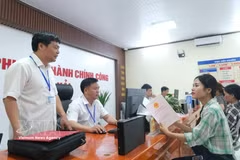
Civil servants provides administrative services for citizens in Son Hai commune of Bac Ninh province. (Photo: VNA)

Reform drive expected to remove barriers, unlock growth momentum

Prime Minister Le Minh Hung recently ordered ministries and agencies to immediately cut at least 30% of administrative procedures, 50% of processing time, 50% of compliance costs and 30% of business conditions, while eliminating all unnecessary procedures.