Hanoi (VNA) – As predictably as clockwork, every year on World Press Freedom Day, May 3, the organisation Reporters Without Borders (RSF) releases what it calls the “World Press Freedom Index”. In its 2026 report, Vietnam was again placed near the bottom of the rankings, at 174th out of 180 countries.
This is far from the first time RSF has issued what many in Vietnam regard as deeply unobjective assessments. Yet the repeated recycling of familiar allegations suggests more than mere criticism. It points to an approach shaped by preconception – one that appears dismissive of the political systems, historical experiences and cultural contexts of countries.
A review of RSF’s assessment methodology over many years suggests that the organisation relies heavily on one-sided surveys, drawing opinions from a limited number of groups, individuals and organisations that have long held political biases against Vietnam.
Much of the report appears to draw upon secondary sources lacking independent verification. In some instances, it even reproduces claims circulated by overseas anti-government groups. Rather than offering an objective reflection of the media landscape, RSF’s rankings increasingly resemble an attempt to impose a distinctly Western political understanding upon vastly different societies.
In its 2026 report, the organisation continued to label certain anti-state actors, those spreading distorted propaganda, and individuals calling for protests that disrupt social order as 'independent journalists.
Such assertions lack a sound legal basis and are dangerous in that they deliberately blur the line between the legitimate right to freedom of expression and the abuse of that freedom to undermine national interests or infringe upon the lawful rights and interests of organisations and individuals.
In fact, no country, regardless of political system, permits the banner of “press freedom” to be used as cover for inciting unrest, promoting subversion or threatening national stability. The US and many Western nations themselves enforce stringent laws on counter-terrorism, state secrecy and online misinformation.
Ironically, RSF’s own report this year acknowledges mounting pressures on media environments across Western countries – from shrinking newsroom budgets and restrictions on information access to rising violence against journalists and the growing influence of technology conglomerates and media tycoons.
Yet when Western governments introduce regulatory measures, RSF tends to describe them as “necessary adjustments”. When Vietnam enforces its laws, however, the same actions are swiftly branded “press repression”. It is this “double standard” that increasingly undermines confidence in the organisation’s objectivity.
The contradiction extends further to the very framework through which RSF defines press freedom. The organisation appears to treat the Western model of privately owned, multi-party media as the sole benchmark of legitimacy, implicitly dismissing alternative media systems shaped by differing historical and political realities.
The inconsistency also lies in the very framework through which RSF defines press freedom. The organisation appears to assume that the Western model of privately owned, multi-party media represents the only legitimate standard, thereby dismissing other press systems shaped by the distinct historical conditions and political institutions of individual nations.
In reality, the press has never existed outside a specific political and social context. Western media organisations themselves operate within the orbit of powerful media corporations and prevailing Western political values. As such, the notion of “absolute press freedom” has never truly existed in the way some Western organisations frequently claim.
In stark contrast to the distorted picture portrayed by RSF, the reality of journalism in Vietnam in recent years reflects a media landscape that is vibrant, increasingly open and steadily growing in professionalism.
Following a process of restructuring and streamlining under Resolution No. 18-NQ/TW issued on October 25, 2017 by the 12th Party Central Committee on continuing the reform and reorganisation of the political system towards a leaner, more effective and efficient apparatus, Vietnam had a total of 778 press agencies and nearly 21,000 accredited journalists working across print, digital, radio and television media, by the end of 2025.
Many media organisations have since developed integrated newspaper-radio-television models, streamlined their organisational structures and improved the effectiveness of public communication. Journalists have also been supported by the State in undertaking overseas training, professional exchanges and reporting assignments in numerous countries around the world. International media organisations operating and reporting in Vietnam are likewise provided with favourable conditions, without technological or legal barriers imposed upon them.
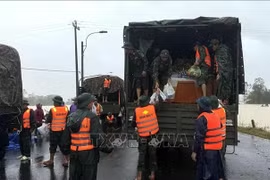
Vietnamese journalism has played an active role in social oversight, anti-corruption efforts, policy supervision and the protection of the legitimate rights and interests of the public. During the COVID-19 pandemic, for instance, thousands of journalists reported directly from outbreak epicentres, field hospitals and quarantine facilities to deliver accurate information, counter misinformation and foster a spirit of social solidarity. During natural disasters and flooding, reporters have consistently remained on the front lines, documenting the lives of affected communities and actively participating in relief efforts. It is the image of a humane press, closely connected to the interests and wellbeing of both the nation and its people.
At the same time, the Vietnamese press has uncovered numerous major cases of wrongdoing and misconduct. Press outlets have openly and candidly brought issues such as unsafe food, high-tech fraud, land violations, environmental pollution, school violence and shortcomings in public administration into the public sphere. In many cases, media investigations have prompted the authorities to step in and take firm action.
In Vietnam, freedom of the press is clearly enshrined in the 2013 Constitution and further codified through the 2016 Press Law and related legislation. The portrayal of Vietnam as a country where the press is supposedly “suppressed”, as repeatedly claimed by extremist elements, bears little resemblance to reality.
RSF’s biased reports are increasingly being exploited by hostile and ill-intentioned organisations as tools to distort perceptions of democracy and human rights in Vietnam, exert pressure in international relations and foster misleading narratives abroad. When inaccurate information is repeated often enough, it can begin to acquire the appearance of an “accepted truth”, even when the reality is entirely different.
In recent years, Vietnam’s press has undergone rapid digital transformation, creating fresh momentum for journalism to become more practical, effective and responsive. Many media organisations have adopted artificial intelligence, big data and multi-platform strategies to broaden audience engagement and improve content delivery. National journalism forums, major press awards and international training programmes for reporters are now held regularly, contributing to the growing professionalism and competitiveness of Vietnamese journalism within the global digital media environment.
Naturally, like any press system in the world, Vietnamese journalism still faces issues requiring further improvement, including strengthening critical analysis, combating fake news, protecting digital copyright, adapting to multi-platform communications and reinforcing professional ethics. However, these are matters of internal development and modernisation within Vietnam’s revolutionary press system – fundamentally different from the politically motivated accusations often levelled from abroad.
Ultimately, what matters most is not the judgement of ideologically driven rankings, but the evidence found in lived reality. Tens of millions of Vietnamese people access news every day through newspapers, radio, television, digital platforms and press content shared across social media. Public trust in mainstream media, together with the press’s pioneering role and social responsibility, remains the clearest testament to the effectiveness, resilience and enduring vitality of Vietnam’s revolutionary journalism./.
VNA