Administrative streamlining: Bringing administration closer to people for stronger governance

Authorities at both central and local levels have emphasised that further institutional reform, stronger discipline, enhanced digital transformation and effective personnel arrangements will be essential to ensuring the two-tier local administration model becomes a true driver of fast and sustainable national development.

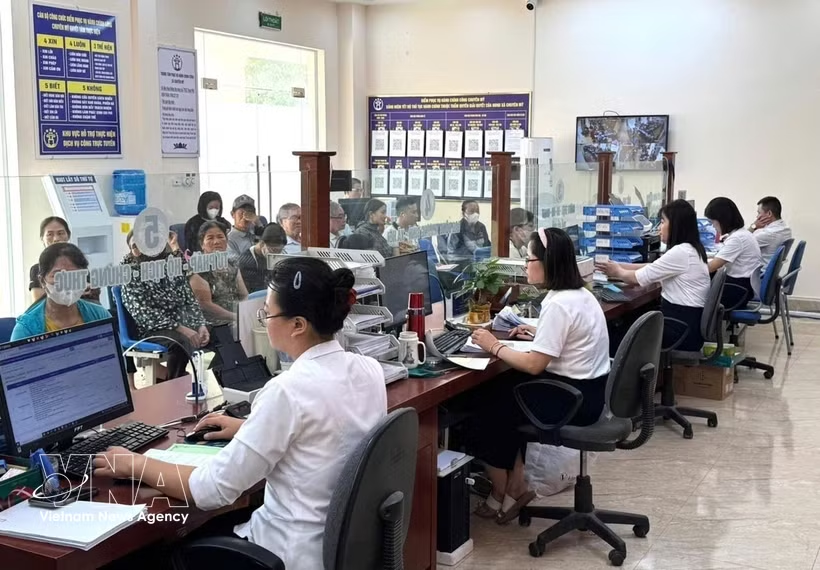
Civil servants of Chuyen My commune in Hanoi handl administrative procedures for local residents. (Photo: VNA)

Hanoi (VNA) – With tangible outcomes seen after nearly one year of implementing the reorganisation of the administrative apparatus and operating the two-tier local government model, further efforts are being made to refine the model so that grassroots administrations can operate more effectively and efficiently.

Recently, the Prime Minister issued Directive No. 18/CT-TTg on improving the quality of commune-level officials and civil servants to meet the requirements of the new situation.

The directive notes that the contingent of commune-level personnel has largely been consolidated and that working methods are gradually shifting towards better serving people and businesses. However, requirements of the new development phase are now significantly higher.

As the functions and responsibilities of grassroots administrations continue to expand, and as the country pursues the ambitious double-digit growth target, commune-level authorities are no longer merely handling routine administrative tasks. Instead, they are expected to directly organise the implementation of development policies and address emerging issues right at the grassroots level.

Directive No. 18 therefore calls for a comprehensive review of the quality of commune-level personnel, ensuring the right people are assigned to the right positions at the right time and in the right locations, while leveraging their practical capabilities, expertise and experience. It also requires decisive staff streamlining for those with weak capacity, a poor sense of responsibility or who fail to meet task requirements.

Priority is to be given to talented, capable and experienced individuals who can withstand pressure and possess in-depth expertise in complex areas such as land management, construction, and complaint and denunciation settlement. Notably, the evaluation of personnel must be directly linked to work processing progress as well as the satisfaction of citizens and businesses.

This spirit has also been reflected consistently in major directions from the central level. National Assembly Chairman Tran Thanh Man, while presiding over a session examining the legal normative document system, stressed that the process is a “comprehensive institutional review”. He demanded clear identification of regulations hindering development, overlapping provisions and outdated regulations, warning against superficial or vague reporting.

At the first regular meeting of the 16th-tenure Government, PM Le Minh Hung also requested stronger acceleration of decentralisation and delegation of authority in tandem with strengthened inspection and supervision, while using reform outcomes as criteria for evaluating ministries, sectors and localities.

The Government has issued eight resolutions on cutting and simplifying administrative procedures and business conditions, abolishing 184 administrative procedures, delegating the handling of 134 procedures to local authorities and removing 890 business conditions.

These figures demonstrate that reforms are moving into practical implementation. However, the Government itself has acknowledged that the operation of the two-tier local administration model still faces shortcomings, including incomplete decentralisation and delays in issuing some guiding documents.
vnanet-potal-quang-ngai-tinh-gon-bo-may-hieu-qua-phuc-vu-nhan-dan-8291872-1.jpg
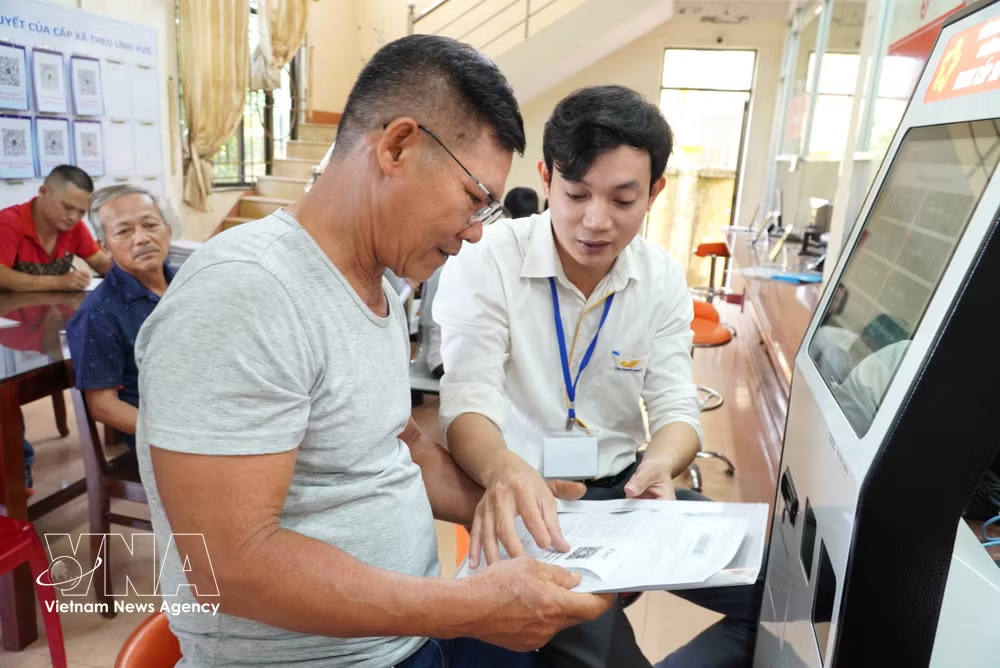
A civil servant guides citizens through administrative procedures in Quang Ngai province. (Photo: VNA)

Therefore, the resolution of the Government's April 2026 meeting asks for a preliminary review of the one-year implementation and calls for reducing administrative procedure processing times and compliance costs by 50% in 2026 compared to the 2024 levels.

The National Assembly has also urged the Government to tighten discipline and order, practise thrift rigorously and address wastefulness in public asset management, land use and delayed projects. At the same time, savings generated from apparatus streamlining are allowed to supplement salary reform resources.

Practical implementation nationwide has already shown significant changes under the new model.

Lam Dong province, merged with Binh Thuan and Dak Nong, has reduced 66.6% of Party units and 61.9% of administration units while deploying more than 730 personnel to support grassroots authorities.

Thai Nguyen province, has accelerated digital transformation after the administrative merger with Bac Kan, with Phan Dinh Phung ward processing nearly 25,000 administrative dossiers online since July 2025 and achieving a 97.2% resolution rate with support from an AI-powered virtual assistant system.

However, challenges remain. Some localities still face difficulties in operating the new model, including personnel imbalances, uneven digital capabilities and slow adaptation among some civil servants.

Da Nang city has acknowledged that some personnel continue to work according to outdated methods and stressed that weak or irresponsible ones must be replaced and not be allowed to hinder development.

Authorities at both central and local levels have emphasised that further institutional reform, stronger discipline, enhanced digital transformation and effective personnel arrangements will be essential to ensuring the two-tier local administration model becomes a true driver of fast and sustainable national development./.
VNA

See more

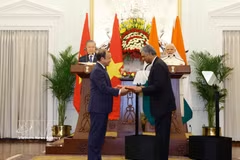
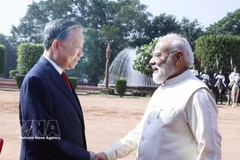
General Secretary of the Communist Party of Vietnam Central Committee and State President To Lam (L) and Indian Prime Minister Narendra Modi witness the exchange of cooperation documents between the two countries. (Photo: VNA)

Vietnam-India relations enter new phase of development: Indian expert

The elevation of bilateral ties to an Enhanced Comprehensive Strategic Partnership reflects the increasingly deep convergence of geopolitical, economic, maritime and civilisational interests between the two countries, former Indian Deputy National Security Adviser S.D. Pradhan told Vietnam News Agency correspondents in New Delhi.

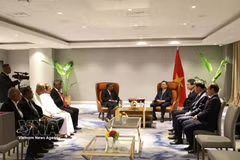
At the meeting between Vietnam's Politburo member Nguyen Thanh Nghi and General Secretary of the Communist Party of Sri Lanka G. Weerasinghe and General Secretary of the Sri Lanka-Vietnam Solidarity Association Sudasinghe Sugathapala. (Photo: VNA)

Vietnamese Party official meets leaders of Sri Lankan political parties

Nguyen Thanh Nghi, Politburo member, Secretary of the CPV Central Committee and Chairman of its Commission for Policies and Strategies, held meetings in Colombo, Sri Lanka, on May 8 with leaders of the Janatha Vimukthi Peramuna (JVP - People's Liberation Front), the Communist Party of Sri Lanka and the Sri Lanka-Vietnam Solidarity Association.

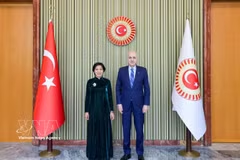
Speaker of the Turkish Grand National Assembly Numan Kurtulmuş (R) receives Vietnamese Ambassador to Türkiye Dang Thi Thu Ha (Photo: VNA)

Vietnam, Türkiye strengthen parliamentary cooperation

Speaker of the Turkish Grand National Assembly Numan Kurtulmuş affirmed that Türkiye considers Vietnam an important partner in Southeast Asia, emphasising that similarities in historical depth, cultural identity, foreign policy orientations and family values provide a strong foundation for elevating bilateral ties to a new level.

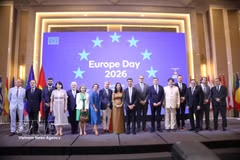
Participants pose for a group photo at the ceremony in Hanoi on the evening of May 8,2026, to celebrate Europe Day (May 9). (Photo: VNA)

Europe Day 2026 marked in Hanoi

EU Ambassador to Vietnam Julien Guerrier reaffirmed the bloc's commitment to accompanying Vietnam in achieving its goals of becoming a developed economy by 2045 and reaching net-zero emissions by 2050, while ensuring energy security amid global uncertainties.

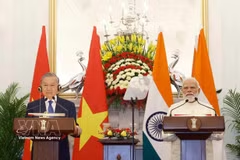
General Secretary of the Communist Party of Vietnam Central Committee and State President To Lam (L) and Indian Prime Minister Narendra Modi meet the press to announce the outcomes of their talks. The two sides issued a joint statement on the Enhanced Comprehensive Strategic Partnership between Vietnam and India. (Photo: VNA)

Top leader’s visits opening new phase of deeper, more effective ties with India, Sri Lanka: FM

Minister of Foreign Affairs Le Hoai Trung described the visits as particularly important and historic, taking place at a meaningful moment as Vietnam and India mark the 10th anniversary of their Comprehensive Strategic Partnership and just one month after the top leader of Vietnam assumed his new position. For Sri Lanka, this was the highest-level visit by a Vietnamese leader since the two countries established diplomatic relations.

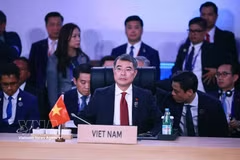
Prime Minister Le Minh Hung attends the plenary session of the 48th ASEAN Summit in Cebu, the Philippines. (Photo: VNA)

PM’s presence in ASEAN Summit spreads message of dynamic, strongly rising Vietnam: official

Deputy Foreign Minister Dang Hoang Giang said that the Vietnamese delegation made important contributions to the summit’s success, reflecting the foreign policy orientation set out by the 14th National Congress of the Communist Party of Vietnam, which continues to place ASEAN at the centre of Vietnam’s regional engagement, as well as its commitment to proactive, positive and responsible contributions to ASEAN Community-building process.

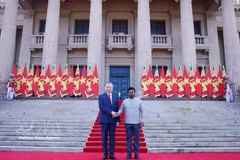
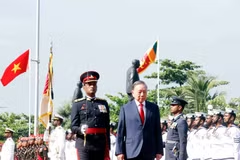
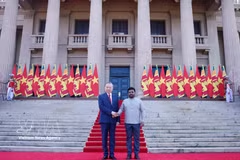
General Secretary of the Communist Party of Vietnam Central Committee and State President To Lam reviews the honor guard. Photo: VNA

Vietnam’s top leader concludes successful state visit to Sri Lanka

Vietnam and Sri Lanka agreed to elevate political trust and comprehensively develop the traditional friendship and multifaceted cooperation as well as expand high-level and all-level exchanges and contacts, regularly implement bilateral cooperation mechanisms across various fields.

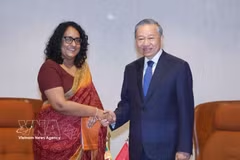
General Secretary of the Communist Party of Vietnam Central Committee and President of Vietnam To Lam (R) meets with Prime Minister of Sri Lanka Harini Amarasuriya in Colombo on the afternoon of May 8. (Photo: VNA)

Top Vietnamese leader meets with Sri Lankan PM in Colombo

The two leaders agreed that their countries will work together to turn the good intentions and aspirations for bilateral relations into tangible outcomes so that in the future, they could look back with pride on the achievements born from today’s determination.

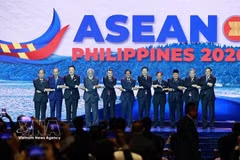
Prime Minister Le Minh Hung (fifth, left) and heads of delegations from ASEAN countries attend the opening ceremony of the 48th ASEAN Summit on May 8, 2026. (Photo: VNA)

PM Le Minh Hung concludes trip to 48th ASEAN Summit

The trip was considered a success both multilaterally and bilaterally, leaving a positive impression of Vietnam’s proactive, active and responsible spirit, as well as its substantive and effective contributions to ASEAN’s common work and efforts to promote ties with member states.

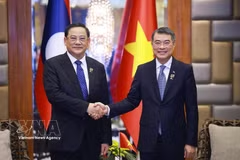
Vietnamese Prime Minister Le Minh Hung (right) and his Lao counterpart Sonexay Siphandone at their meeting in Cebu on May 8 (Photo: VNA)

Vietnam PM meets with Lao, Malaysian counterparts in Philippines

Vietnam always gives the highest priority to the Vietnam–Laos relationship and will continue joining Laos in nurturing and deepening bilateral cooperation in a sustainable and practical manner for the benefit of the two countries' people, said Prime Minister Le Minh Hung.

Vietnamese Prime Minister Le Minh Hung (right) meets with ASEAN Secretary-General Kao Kim Hourn in Cebu, the Philippines, on May 8. (Photo: VNA)

Vietnamese Prime Minister meets ASEAN Secretary-General

Vietnam wishes to continue working closely with ASEAN member states and the ASEAN Secretariat in the community building process, said Prime Minister Le Minh Hung while meeting ASEAN Secretary-General Kao Kim Hourn on May 8 on the sidelines of the 48th ASEAN Summit in Cebu, the Philippines.

Vietnamese Prime Minister Le Minh Hung (right) and Singaporean Prime Minister Lawrence Wong at their meeting in Cebu, the Philippines, on May 8 (Photo: VNA)

Vietnamese PM meets leaders of Singapore, Thailand, Indonesia

Vietnamese Prime Minister Le Minh Hung held separate meetings with Singaporean Prime Minister Lawrence Wong, Thai Prime Minister Anutin Charnvirakul, and Indonesian President Prabowo Subianto on May 8 as part of his trip to attend the 48th ASEAN Summit in Cebu, the Philippines.

Prime Minister Le Minh Hung (fifth, left) and the heads of delegations attend the retreat session of the 48th ASEAN Summit in Cebu, the Philippines, on May 8 (Photo: VNA)

PM outlines three key proposals to respond to energy crisis at ASEAN Summit

ASEAN should take the lead in upholding rules and strengthening trust in international relations by consistently promoting multilateralism and respect for international law. It should actively contribute to maintaining security, safety, and freedom of navigation and overflight globally and in the region, said Prime Minister Le Minh Hung.

General Secretary of the Communist Party of Vietnam (CPV) Central and President of Vietnam To Lam (second, right) talks to Speaker of Sri Lanka's Parliament Jagath Wickramaratne at their meeting in Colombo on May 8 (Photo: VNA)

Top leader of Vietnam stresses parliamentary ties' importance to relations with Sri Lanka

Highlighting the important role of parliamentary cooperation, the Party and State leader of Vietnam expressed his wish for the two legislatures to strengthen coordination, soon sign a cooperation agreement, and work together to effectively supervise the implementation of the high-level agreements and signed cooperation documents, especially economic cooperation initiatives aimed at achieving 1 billion USD in bilateral trade turnover.