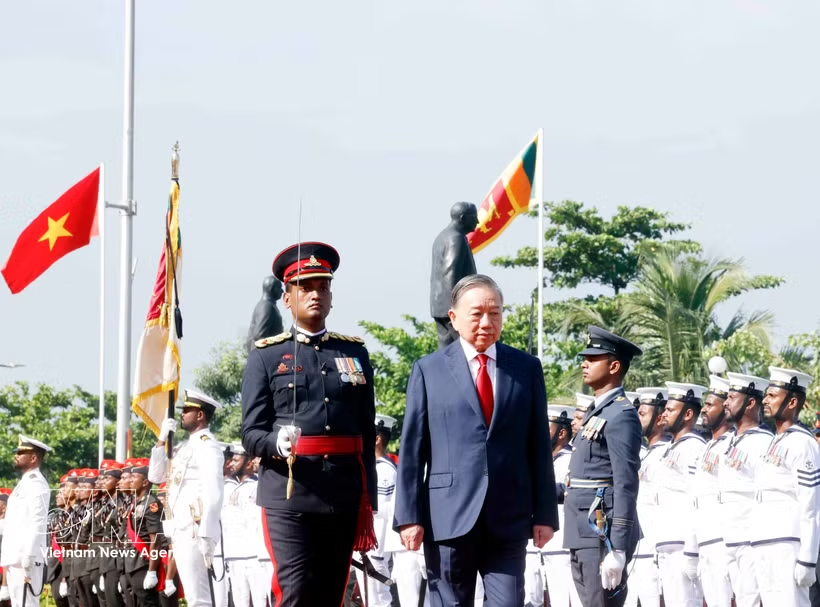
Vietnam’s top leader concludes successful state visit to Sri Lanka

Vietnam and Sri Lanka agreed to elevate political trust and comprehensively develop the traditional friendship and multifaceted cooperation as well as expand high-level and all-level exchanges and contacts, regularly implement bilateral cooperation mechanisms across various fields.

General Secretary of the Communist Party of Vietnam Central Committee and State President To Lam reviews the honor guard. Photo: VNA

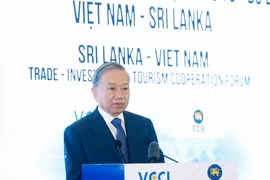
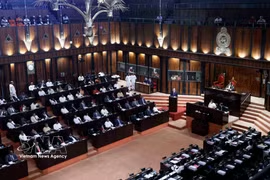
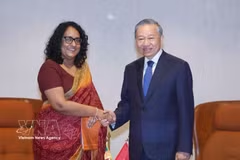
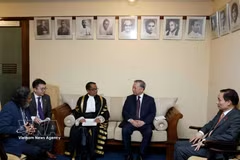
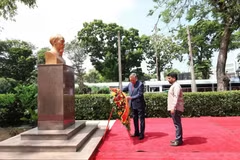
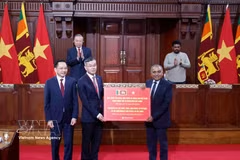
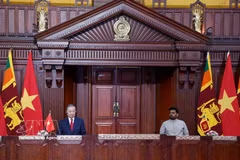
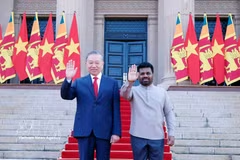
Hanoi (VNA) – General Secretary of the Communist Party of Vietnam Central Committee and State President To Lam and a high-ranking Vietnamese delegation on May 8 evening (local time) left Colombo for home, concluding their two-day successful state visit to Sri Lanka.

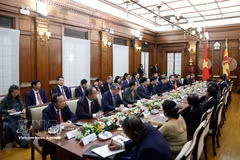
During meetings and talks held in an open, sincere, trustworthy, and mutually understanding atmosphere, the two sides briefed each other on the situation in their respective countries and expressed satisfaction with the traditional friendship and multifaceted cooperation built over more than half a century, characterised by political trust, loyalty, wholehearted support, shared Buddhist values, and active participation in the Non-Aligned Movement.

They agreed to elevate political trust and comprehensively develop the traditional friendship and multifaceted cooperation, expand high-level and all-level exchanges and contacts, regularly implement bilateral cooperation mechanisms across various fields, strengthen ties between the two ruling parties, and enhance exchanges on theory, foreign policy, and regional and international issues of mutual concern.

The two sides consented to make defence and security cooperation more substantive and effective, particularly in training United Nations peacekeeping forces; expanding cooperation in information exchange and defence technology transfer; and strengthening collaboration in maritime security and cybersecurity.

Highlighting the strong potential for trade and investment cooperation, Vietnam and Sri Lanka agreed to implement breakthrough measures to soon achieve the bilateral trade target of 1 billion USD.

They concurred on strengthening cooperation in agriculture, agricultural supply chain connectivity, post-harvest preservation technology, fisheries, science and technology, and digital transformation, while sharing experience in developing key export products and implementing mutually beneficial research and technology transfer projects aimed at creating symbolic bilateral projects.

The two sides also agreed to make cultural and education cooperation, people-to-people exchanges, and connectivity an important pillar of bilateral relations.

Regarding regional and international issues of mutual concern, both sides stressed that amid increasingly complex global and regional developments, Vietnam and Sri Lanka should continue coordinating closely at multilateral forums, especially at the United Nations, the Non-Aligned Movement, and the Global South Forum.

The two sides reaffirmed the importance of maintaining peace, stability, security, and freedom of navigation, while emphasising the importance of peacefully resolving disputes based on respect for and compliance with international law, particularly the 1982 United Nations Convention on the Law of the Sea (UNCLOS 1982)./.

VNA
See more

Deputy Minister of Foreign Affairs Le Thi Thu Hang speaks at the panel discussion titled “Russia – APEC: Broad Cooperation Prospects on the Horizon until 2035”. (Photo: VNA)

Vietnam shares vision, preparations for APEC 2027

Deputy Foreign Minister Le Thi Thu Hang underlined the importance of stronger coordination between APEC and other regional and global mechanisms in order to improve efficiency and optimise resources in addressing common challenges.

General Secretary of the Central Committee of the Communist Party of Vietnam and President of Vietnam To Lam delivers a keynote address at the opening of the 23rd Shangri-La Dialogue in Singapore on May 29. (Photo: VNA)

Singaporean FM highlights shared strategic outlook with Vietnam

Singapore and Vietnam remain committed to supporting a rules-based international order, strengthening ASEAN integration, and enhancing the bloc’s resilience. The two countries upgraded their ties to a Comprehensive Strategic Partnership (CSP) last year, marking Singapore’s first CSP with an ASEAN member state.

Deputy Minister of Foreign Affairs Nguyen Manh Cuong (Photo: VNA)

ASEAN Future Forum 2026 to advance ASEAN community-building process

Vietnam hopes the forum will continue to demonstrate its role as an active and responsible member of the Association of Southeast Asian Nations (ASEAN), contributing to regional affairs and advancing the Party and State’s foreign policy and international integration strategy.

General Secretary of the Communist Party of Vietnam Central Committee and State President To Lam speaks at the 23rd Shangri-La Dialogue on May 29, 2026. (Photo: VNA)

Vietnam contributes to shaping regional agenda at 23rd Shangri-La Dialogue: Indian expert

Speaking to Vietnam News Agency correspondents in New Delhi, Pradhan noted that, drawing on his extensive experience in national security and international relations, as well as his deep knowledge of international law, the top Vietnamese leader identified three closely interrelated crises facing the world today: a crisis of the international order, a crisis of the development model, and a crisis of strategic trust.

Administrative procedures cut and simplified will be publishedNational Public Service Portal (Photo: VNA)

Administrative procedures cut, simplified to be published online

The dispatch states that in implementing Conclusion No. 18-KL/TW dated April 2, 2026 of the 14th Party Central Committee on the 2026–2030 socio-economic development plan, national finance, public debt management and medium-term public investment, linked to the goal of achieving double-digit economic growth, the Government on April 29 issued 11 resolutions on cutting, decentralising and simplifying administrative procedures, business conditions, and conditional business lines. The Prime Minister subsequently directed ministries, agencies and localities to implement these resolutions.