📝 OP-ED: Boosting "ideological immunity" to counter harmful information

A single post can reach millions of people within minutes. A short video can influence public sentiments on a broad scale. When the speed of dissemination far exceeds the speed of verification, safeguarding social trust in cyberspace becomes a matter of primary importance. That is why ideological work must adapt, move ahead of developments, take the initiative and provide guidance.

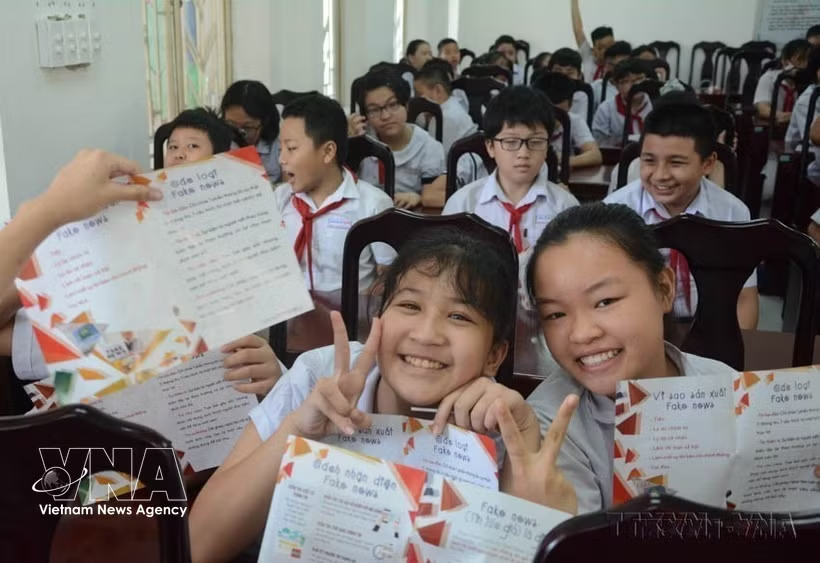
Students in Da Nang city joint a communication programme "Say No to Fake News" launched by the Vietnam News Agency. (Photo: VNA)

Hanoi (VNA) - The digital space is no longer a peripheral part of social life. It has become the arena where people receive information, shape perceptions and make choices every day.

A single post can reach millions of people within minutes. A short video can influence public sentiments on a broad scale. When the speed of dissemination far exceeds the speed of verification, safeguarding social trust in cyberspace becomes a matter of primary importance. That is why ideological work must adapt, move ahead of developments, take the initiative and provide guidance.

Reality has shown that both the scale and impact of digital communications are growing rapidly. By the end of 2025, Vietnam’s digital economy accounted for nearly 18% of GDP, with millions of people participating in online platforms. Yet the expansion of the digital sphere has also been accompanied by a surge in harmful and malicious information.

During the 2025-2026 period alone, the number of cases involving harmful online content increased by more than 300%, with over 70% directly targeting the Party’s ideological foundation. Losses caused by online fraud in 2025 alone amounted to trillions of Vietnamese dong. This is not merely a matter of cybersecurity. It is a warning over ideological security.

Globally, misinformation and information manipulation are now ranked among the leading short-term risks. The rise of generative artificial intelligence and deepfake technologies has made the production of false information faster, cheaper and more sophisticated, pushing the struggle in the ideological sphere to a new level.

vnanet-potal-dan-van-kheo-110-o-hung-yen-cach-lam-sang-tao-viec-kho-hoa-de-8168272.jpg
The "Effective Public Mobilization 1+10" model has helped many households gain more knowledge and vigilance against harmful and toxic information, and escape online scams. (Photo: VNA)

This is no longer simply a debate of opinions. It has become an instrument of geopolitical competition — a form of cognitive warfare.

In this context, identifying the digital space as the principal ideological front is no longer a choice but an objective necessity. Without presence, initiative and guidance in this environment, the ideological work would lose its role of going ahead to open the way.

It should be recognised that in recent years, important progress has been made. The Party’s ideological foundation has remained firm, social confidence has been strengthened, and the legal framework has continued to improve. Forces tasked with ideological struggle in cyberspace have been established and expanded.

In several localities, thousands of information pages and communication channels have been developed, linking reporters, propagandists and public opinion collaborators with artificial intelligence systems capable of detecting harmful information at an early stage. The press has also accelerated its transition to multi-platform operations, while the time required to remove violating content on cross-border platforms has been reduced to 24 hours. Laws and regulations related to cybersecurity, data protection and personal information protection have also been strengthened.

Yet these results remain insufficient for the requirements of the digital era. The most significant bottleneck is the absence of a unified and interconnected digital ideological ecosystem. Data remains fragmented and disconnected. There is still no common platform, while isolated and uncoordinated approaches persist. Content delivery often remains one-way, slow to innovate and lacking appeal, even as digital audiences increasingly favour short, visual, interactive and multi-platform content.

Capacity for monitoring, analysis and forecasting also remains limited. In some cases, it has taken hours, even days, before official responses were issued, while harmful information had already spread widely. A number of officials and Party members still lacks adequate digital skills, while society as a whole has yet to build sufficiently strong "ideological immunity".

The urgent task, therefore, is comprehensive and fundamental renewal — beginning with methods.

The ideological work must shift from one-way transmission to shaping understanding, strengthening confidence, guiding public perceptions and encouraging actions. It must move from passive reaction to active prevention. Every major guideline and policy should be translated into a coordinated digital communication package tailored to specific target groups. Response time must be shortened according to clear thresholds for orientation, feedback and removal of violating content. These are concrete indicators of the capacity to master digital space.

At the core, however, remains the human factor. Building "ideological immunity" for society must become a strategic and long-term objective. This requires equipping people with the skills to identify false information, while strengthening digital culture and digital ethics. When each citizen is able to distinguish right from wrong, truth from falsehood, harmful information will find less space to spread, and social trust will be reinforced from within.

At the same time, tools matter greatly. The ideological work in the digital era cannot reach its full effectiveness without data and technology. The creation of a digital ideological ecosystem is therefore of decisive importance. Such an ecosystem should include databases of theory, Party documents and educational materials; public opinion databases; content governance platforms; early warning and analytical tools; and “Make in Vietnam” artificial intelligence applications.

In the coming period, the country must basically complete a unified ecosystem across the Party, establish a central-level ideological information operations centre, and master a number of AI platforms and tools serving the ideological work.

With data, the ideological work will move from intuition to scientific methodology. With effective tools, information can be detected and handled more quickly and accurately. With an interconnected ecosystem, resources will no longer remain fragmented but will generate combined strength.

The development of ideological work teams must also meet new requirements. We must form a core team of experts in digital political commentary and media, and cultivate a force of propaganda and mass mobilisation cadres with enhanced digital capabilities. This is a force that is "both politically sound and technologically proficient," capable of operating effectively in cyberspace.

Looking further ahead to 2045, the task will not simply be adaptation, but mastery of the digital ideological space. By then, hostile schemes must be detected early and handled promptly; society must possess strong "ideological immunity"; and the official information ecosystem must be robust enough to compete internationally.

As the digital space becomes the principal ideological front, every piece of information and every action directly affects social trust. Safeguarding this front means not only protecting the Party’s ideological foundation, but also protecting social confidence and the nation’s development future in the digital era./.
VNA

See more

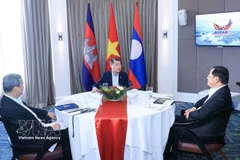
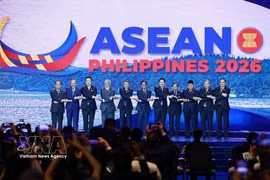
Prime Minister Le Minh Hung attends the 48th ASEAN Summit Plenary in Cebu, the Philippines, on May 8. (Photo: VNA)

Vietnamese PM puts forward proposals to address multidimensional challenges at 48th ASEAN Summit

Prime Minister Le Minh Hung emphasised the need to concentrate resources on ensuring essential security needs, including energy security, food security, and human security, including the ratification and effective implementation of the ASEAN Petroleum Security Agreement, and the substantive implementation of the ASEAN Plan of Action for Energy Cooperation 2026–2030, the ASEAN Power Grid, and the ASEAN Gas Pipeline network.

The Vietnamese delegation holds a working session with representatives of Singapore’s Ministry of Law. (Photo: VNA)

Vietnam, Singapore strengthen supreme court cooperation

Quang affirmed that Vietnam highly values Singapore’s experience in settling international commercial disputes and proposed the Supreme Court of Singapore support Vietnam in developing the specialised court through advanced training programmes for Vietnamese judges and court officials, as well as professional placements in Singapore.

NA Chairman Tran Thanh Man speaks at the working session. (Photo: VNA)

Court reform must deliver measurable results: NA Chairman

Chairman Man urged the people’s court system to keep thoroughly grasping and effectively following the Party’s policies and guidelines on comprehensive national renewal and strategic breakthroughs for national development.

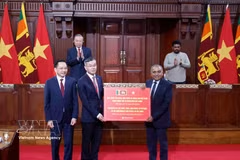
Vietnam presents 100 tonnes of urea and superphosphate fertiliser to the Government and people of Sri Lanka. (Photo: VNA)

Vietnam, Sri Lanka step up cooperation

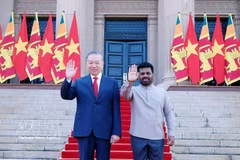
General Secretary of the Communist Party of Vietnam (CPV) Central Committee and State President To Lam and Sri Lankan President Anura Kumara Dissanayake witnessed the exchange of cooperation documents between ministries and agencies of the two countries after their talks on the morning of May 8.

Prime Minister Le Minh Hung attends the 48th ASEAN Summit Plenary in Cebu, the Philippines. (Photo: VNA)

PM Le Minh Hung attends opening ceremony of 48th ASEAN Summit

At the 48th ASEAN Summit, Prime Minister Le Minh Hung is expected to deliver key speeches conveying Vietnam’s foreign policy orientations adopted at the 14th National Congress of the Communist Party of Vietnam, as well as the country’s views on ASEAN priorities.

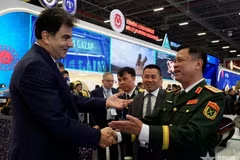
Vietnamese Deputy Minister of National Defence Sen. Lieut. Gen. Nguyen Truong Thang (R) meets with Turkish Deputy Minister of National Defence Musa Heybet. (Photo: qdnd.vn)

Vietnam seeks stronger defence ties with Türkiye, Azerbaijan

The agreement was reached during talks on May 7 between Deputy Minister of National Defence of Vietnam Sen. Lieut. Gen. Nguyen Truong Thang and Turkish Deputy Minister of National Defence Musa Heybet, held during the Vietnamese official’s visit to Türkiye to attend the SAHA 2026 Defence and Aerospace Exhibition.

General Secretary of the Communist Party of Vietnam (CPV) Central Committee and State President To Lam and Sri Lankan Prime Minister Harini Amarasuriya at Bandaranaike International Airport in Colombo (Photo: VNA)

Top Vietnamese leader begins state visit to Sri Lanka

General Secretary of the Communist Party of Vietnam (CPV) Central Committee and State President To Lam’s state visit is expected to further consolidate the traditional friendship and deepen the sincere ties between the leaders and peoples of the two countries.

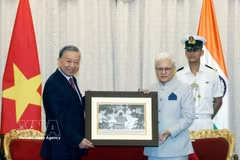
Governor of Maharashtra state Jishnu Dev Varma (right) presents General Secretary of the Communist Party of Vietnam Central Committee and State President To Lam with a photograph of President Ho Chi Minh attending a reception hosted by the Governor of Bombay (now Mumbai) during his visit to the city in February 1958. (Photo: VNA)

Top Vietnamese leader receives Governor of India's Maharashtra state

General Secretary of the Communist Party of Vietnam Central Committee and State President To Lam welcomed the establishment of the twin relationship between Ho Chi Minh City and Mumbai - the first of its kind, considering it an important foundation and motivation for further fostering cooperation and connectivity between localities of the two countries.

Party General Secretary and State President To Lam (R) receives Arun Kumar Singh, Chairman of the Oil and Natural Gas Corporation Limited (ONGC). (Photo: VNA)

Party General Secretary, State President receives Indian business leaders in Mumbai

The Vietnamese leader said Vietnam is prioritising both short- and long-term national energy security, including securing stable crude oil and gas supplies while continuing to improve the legal framework for the oil and gas sector. He expressed his hope that ONGC will continue to be an important partner in exploration and production activities, helping maintain output and ensure energy supply.

Vietnamese Prime Minister Le Minh Hung (R) and Philippine President Ferdinand Marcos Jr. at their meeting on the sidelines of the 48th ASEAN Summit in Cebu, the Philippines, on May 7, 2026. (Photo: VNA)

Vietnam seeks stronger cooperation with ASEAN nations, ADB

During meetings with ASEAN leaders, Vietnamese Prime Minister Le Minh Hung exchanged views on regional and international issues of mutual concern. They agreed to strengthen cooperation and coordination within the bloc and the United Nations, while promoting ASEAN centrality in addressing regional and global issues.

Deputy Minister of Foreign Affairs Le Thi Thu Hang (R) receives Diego Diaz, President of SNCF International under the French National Railway Company, in Hanoi on May 7, 2026. (Photo: Ministry of Foreign Affairs)

Deputy FM calls for SNCF's stronger coordination in Vietnam’s railway industry development

Informing the guest on Vietnam’s priorities in socio-economic development and transport infrastructure, the Deputy FM called on SNCF to continue close coordination in supporting Vietnam’s railway industry development, particularly in high-quality workforce training, technology transfer, experience sharing, and improving policy-making and investment management capacity.