New regulation on political, ideological work in Party highlighted at national conference

The regulation, adopted at the second plenum of the 14th Party Central Committee and issued as Regulation No. 19-QD/TW on April 8, 2026, marks the first comprehensive and systematic framework governing political and ideological work in the Party. It reflects a new step in theoretical mindset and strong political resolve to enhance Party building as well as the Party's leadership and combat capacity.

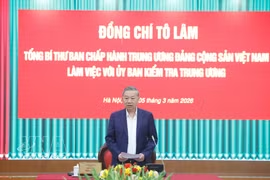
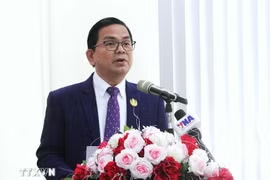
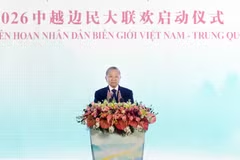
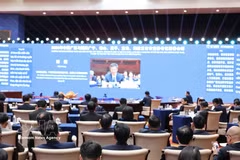
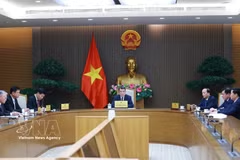
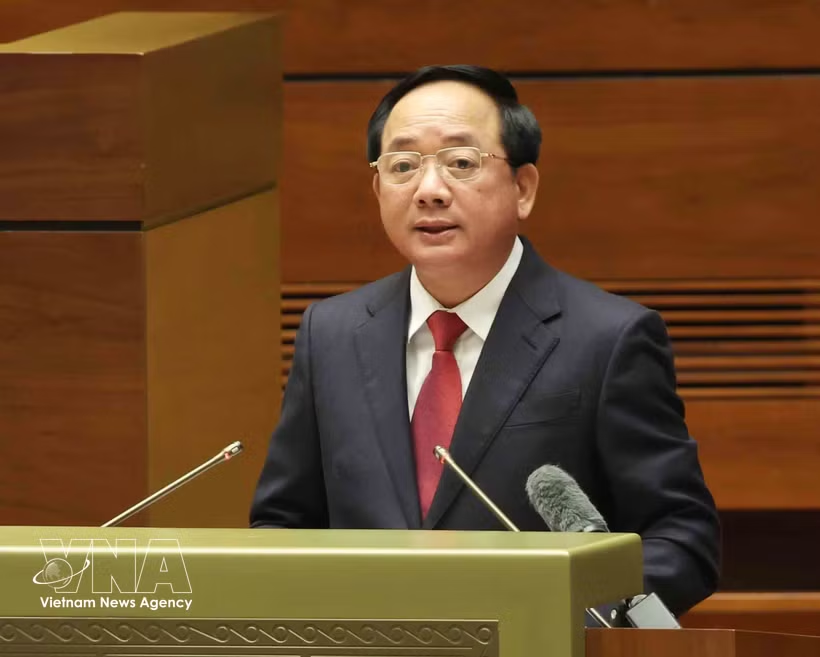
Politburo member, Secretary of the Party Central Committee and Chairman of its Commission for Information, Education and Mass Mobilisation Trinh Van Quyet speaks at the national conference. (Photo: VNA)

Hanoi (VNA) – Politburo member, Secretary of the Party Central Committee and Chairman of its Commission for Information, Education and Mass Mobilisation Trinh Van Quyet presented key contents of the newly issued regulation on political and ideological work within the Party at a national conference on April 13.

The regulation, adopted at the second plenum of the 14th Party Central Committee and issued as Regulation No. 19-QD/TW on April 8, 2026, marks the first comprehensive and systematic framework governing political and ideological work in the Party. It reflects a new step in theoretical mindset and strong political resolve to enhance Party building as well as the Party's leadership and combat capacity.

According to Quyet, the regulation specifies the spirit of the 14th National Party Congress, shifting from general orientation to binding rules with clearly defined principles, responsibilities, methods, and mechanisms for inspection and supervision.

A key highlight of the regulation is that, for the first time, political and ideological work is approached as a governance system with defined objectives and criteria, capable of being quantified, measured, monitored, and held accountable. It goes beyond an internal regulatory document to represent a strategic elevation in Party building in terms of political and ideological work, serving as a foundation to strengthen public trust, reinforce the nation's internal strength, and meet the requirements of rapid and sustainable development in the country’s new era of advancement.

Structured into five chapters and 16 articles, the regulation applies to all Party organisations and members without exception, making political and ideological work a mandatory task. It seeks to strengthen political steadfastness, unity in thought and action, and public trust, while preventing ideological degradation, “self-evolution” and “self-transformation”.

The regulation underscores the principle of maintaining core ideological commitments while promoting innovation, proactive leadership, and adaptability in the digital era.

It expands the scope of political and ideological work from one-way communication to active guidance and shaping of public perception, including on digital platforms. Emphasis is placed on applying modern technologies, digital transformation and data systems to monitor, analyse and forecast public opinion, especially online.

The regulation clearly defines responsibilities, in which Party committees hold overall accountability, while heads of organisations bear direct and highest responsibility. Party members are required to act as proactive agents in promoting positive values and countering false and hostile views.

Inspection and supervision must be conducted regularly and rigorously, with strict handling of violations and timely recognition of good performance. The regulation also calls for integrating political and ideological work into all aspects of Party building, including organisation, personnel, inspection and mass mobilisation.

It also underlines the need to strongly and comprehensively renew methods of political and ideological work in a modern, scientific and effective direction, with a focus on accelerating the application of digital technologies, artificial intelligence and big data. Proactively provide official information in a timely and accurate manner, leaving no information gaps for false or hostile narratives to take hold, thereby maintaining initiative and securing an advantage on the ideological front.

Quyet stressed that effective implementation is decisive, requiring urgent, substantive and result-oriented actions. He urged Party organisations and members to move from “studying resolutions” to “acting on them”, with measurable outcomes as the ultimate benchmark.

The regulation is expected to serve as a crucial institutional and spiritual foundation for building a clean, strong Party capable of leading the country’s development in the new era./.

VNA
See more

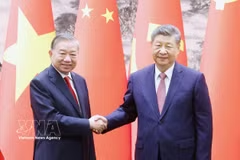
General Secretary of the Communist Party of China (CPC) Central Committee and President Xi Jinping (R) welcomes General Secretary of the Communist Party of Vietnam (CPV) Central Committee and State President To Lam (Photo: VNA)

Vietnam, China issue joint statement on deepening Comprehensive Strategic Cooperative Partnership in new era

The State visit to China by Party General Secretary and State President To Lam was a great success, positively contributing to strengthening the traditional friendship and accelerating the building of the Vietnam–China community with a shared future that carries strategic significance, thus promoting peace, stability, development, and prosperity in the region and the world.

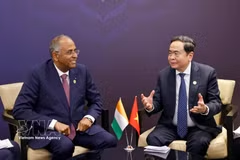
Chairman of the National Assembly Tran Thanh Man (R) meets President of the National Assembly of Côte d’Ivoire Patrick Achi on the sidelines of the 152nd Assembly of the Inter-Parliamentary Union (IPU-152) in Istanbul, Türkiye, on April 16. (Photo: VNA)

Vietnam, Côte d'Ivoire strengthen parliamentary, economic ties

On parliamentary cooperation, the top Vietnamese legislator called for increased the exchange of high-level delegations and closer collaboration between the two legislatures, including sharing legislative experience and strengthening ties between their respective committees.

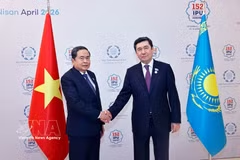
National Assembly Chairman Tran Thanh Man (left) and Yerlan Koshanov, Speaker of the Mazhilis - the lower house of Kazakhstan’s parliament, during their in Istanbul, Türkiye, on April 16 (Photo: VNA)

NA Chairman meets with Kazakhstan’s lower house speaker in Türkiye

The two sides also consented to continue close coordination at multilateral parliamentary forums, particularly the IPU, promoting the role of legislatures in advancing multilateralism and respect for international law, and contributing to peace, stability, cooperation and development regionally and globally.

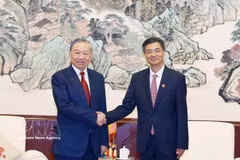
General Secretary of the Communist Party of Vietnam Central Committee and State President To Lam (L) receives Chen Gang, member of the Communist Party of China Central Committee, Secretary of the CPC Committee and Chairman of the Standing Committee of the People’s Congress of the Guangxi Zhuang Autonomous Region (Photo: VNA)

Top Vietnamese leader receives Secretary of Guangxi’s Party Committee

Vietnam is a close neighbour, trusted friend and one of Guangxi’s most important partners. The Party organisation and authorities of China's autonomous region attach great importance to friendship and cooperation with Vietnamese localities; and will continue to take the lead in thoroughly implementing the important common perceptions reached by the two top leaders, thereby deepening cooperation and friendship between China and Vietnam.

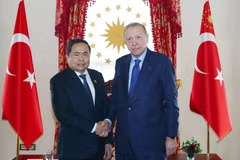
Vietnam’s National Assembly Chairman Tran Thanh Man (L) and Turkish President Recep Tayyip Erdogan at their meeting in Istanbul on April 16, 2026. (Photo: VNA)

Vietnamese NA Chairman meets Turkish President

Vietnam’s National Assembly Chairman Tran Thanh Man and Turkish President Recep Tayyip Erdogan emphasised that economic, trade, and investment ties should serve as key pillars of the relationship. They agreed to create favourable conditions to raise bilateral trade turnover to 4 billion USD, while continuing to encourage Turkish enterprises to invest in Vietnam and contribute to its economic development.

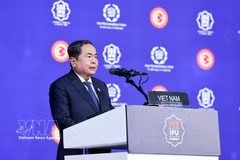
Chairman of the Vietnamese National Assembly Tran Thanh Man speaks at the general debate of the 152nd Assembly of the Inter-Parliamentary Union (IPU-152) in Türkiye on April 16, 2026. (Photo: VNA)

Vietnam's top legislator addresses general debate at 152nd IPU Assembly

Vietnam is striving with confidence and self-strengthening to enter a new stage of development, aiming to become a developing country with modern industry and upper-middle income by 2030, and a high-income developed country by 2045, said NA Chairman Tran Thanh Man at the general debate of the 152nd Assembly of the Inter-Parliamentary Union (IPU-152).

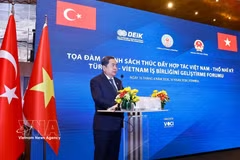
Chairman of the Vietnamese National Assembly Tran Thanh Man speaks at the policy dialogue aimed at promoting Vietnam–Türkiye cooperation (Photo: VNA)

NA Chairman attends policy dialogue promoting Vietnam–Türkiye cooperation

Türkiye is one of Vietnam’s key partners in the region, serving as a strategic bridge between Asia and Europe. Conversely, Vietnam, with its dynamic and fast-growing economy, is an important gateway for Türkiye to access Southeast Asian and Asia-Pacific markets. These complementary advantages provide a solid foundation for the two countries to further deepen their cooperation in the coming period.

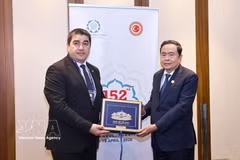
Chairman of the Vietnamese National Assembly Tran Thanh Man (R) presents a commemorative gift to Chairman of the Georgian Parliament Shalva Papuashvili during their meeting in Istanbul on April 16, 2026. (Photo: VNA)

NA Chairman meets Georgian parliament speaker on IPU-152 sidelines

NA Chairman Tran Thanh Man underlined that there remains ample room to further expand cooperation between Vietnam and Georgia in areas where both sides have strengths and potential, including education and training, culture, tourism, sports, logistics and transport, particularly rail transport.

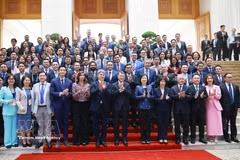
Prime Minister Le Minh Hung (C, first row) and representatives from 52 leading US enterprises (Photo: VNA)

Prime Minister meets delegation of leading US businesses

At the meeting, representatives of USABC, the US Embassy in Vietnam and participating businesses commended Vietnam’s socio-economic achievements and improving investment climate, as well as its strategic development orientation toward rapid and sustainable growth driven by science, technology, innovation and digital transformation.

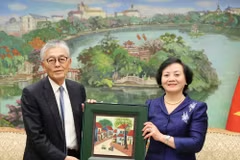
Deputy Prime Minister Pham Thi Thanh Tra (R) receives President and CEO of Japan’s erex Co., Ltd. Honna Hitoshi (Photo: VGP)

Deputy PM hails cooperation in personnel training with Japan

Deputy Prime Minister Pham Thi Thanh Tra highly valued the training programme jointly implemented since 2022 by Vietnam’s Ministry of Home Affairs and Japan’s erex Co., Ltd, which focuses on enhancing public administration capacity, particularly for grassroots officials, young civil servants and female cadres. Through the initiative, nearly 300 local-level officials and leaders from Vietnam have been sent to Japan for training and professional development.

☕ Afternoon briefing on April 16

☕ Afternoon briefing on April 16

Vietnamese PM Le Minh Hung's phone talks with his Singaporean counterpart Lawrence Wong, NA Chairman Tran Thanh Man's attendance at the opening of the IPU-152, and the presentation of the 20th Devotion Awards are among news highlights on April 16.

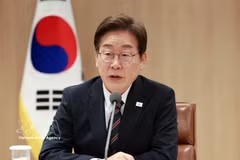
President of the Republic of Korea (RoK) Lee Jae Myung (Photo: Yonhap)

RoK President to pay state visit to Vietnam

President of the Republic of Korea (RoK) Lee Jae Myung and his spouse will pay a state visit to Vietnam from April 21 – 24 at the invitation of General Secretary of the Communist Party of Vietnam Central Committee and State President To Lam and his wife./.

Prime Minister Le Minh Hung holds phone talks with his Singaporean counterpart Lawrence Wong on April 16. (Photo: VNA)

Vietnamese Prime Minister holds phone talks with Singaporean counterpart

PM Hung noted that Vietnam is preparing new policies to attract greater foreign investment, including from Singapore. He called Singapore’s support in developing international financial centres in Vietnam, as well as expanding and upgrading next-generation Vietnam–Singapore Industrial Parks (VSIP) in tandem with high technology transfer.