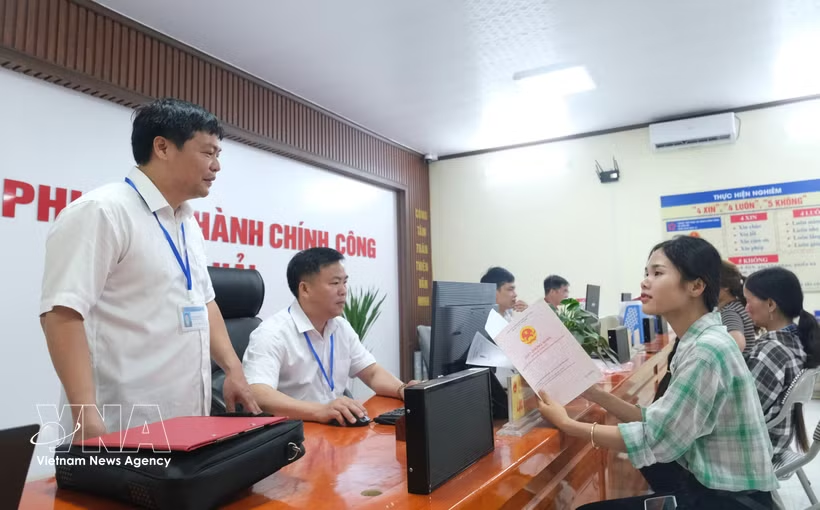
Hanoi (VNA) – The latest administrative reform push, with the issuance of eight resolutions on reducing, decentralising and simplifying administrative procedures and business conditions, is being seen as one of the largest overhauls in recent years, directly affecting thousands of procedures and processes tied to investment, production and business activities nationwide.
The move reflects the new-tenure Government’s determination to fundamentally change the operation of the state management apparatus, with the goal of achieving double-digit economic growth as early as 2026.
Strengthening business confidence
Business environment reform is often measured through reductions in administrative procedures and business conditions. However, despite previous streamlining efforts, many enterprises say “sub-licences” still persist in different forms. Although some procedures have been simplified on paper, businesses still face repeated travel to complete dossiers, seek approvals or wait for inter-agency consultations. Vietnam currently has 198 conditional business sectors with around 4,603 business conditions.
Against that backdrop, Prime Minister Le Minh Hung recently ordered ministries and agencies to immediately cut at least 30% of administrative procedures, 50% of processing time, 50% of compliance costs and 30% of business conditions, while eliminating all unnecessary procedures. The directive is seen as a strong message that the Government will no longer tolerate unreasonable administrative barriers and that business environment reform is now a top priority.
Le Tuan Linh, Director of Nam Linh Manufacturing and Trading Co., Ltd, said a notable feature of this reform round is the shift from “inspection before licensing” to “inspection after licensing”.
Instead of focusing heavily on licensing at the initial stage, authorities will place greater emphasis on standards, regulations and supervision during business operations. The approach is considered more modern, helping create a more open business environment while maintaining effective state management.
Van Tien Duc, Director of Duc Phuc Co., Ltd., said the reform momentum is expected to shorten administrative processing times and simplify procedures, creating more favourable conditions for businesses. Once bottlenecks are eased and resources unlocked, enterprises will have greater room to expand investment and accelerate private sector growth.
Chairman of the Vietnam Chamber of Commerce and Industry (VCCI) Ho Sy Hung also described the reform package as an important driver for improving the investment climate and enhancing Vietnam’s competitiveness. Beyond reducing barriers, the reforms are expected to strengthen business confidence in the Party and State’s commitment to institutional reform.
Removing bottlenecks to support growth
According to estimates, implementing eight Government resolutions on simplifying administrative procedures and business conditions could cut more than 50% of compliance time and costs compared with 2024. However, the new approach also places higher demands on governance capacity.
Technical standards and regulations must be clearer, management data more transparent and comprehensive, while supervision increasingly relies on digital technologies.
Experts warn that if "inspection after licensing" mechanisms are ineffective, cutting procedures alone may fail to deliver substantive results and could create new governance gaps. Many businesses said what they expect is not merely numerical commitments on paper, but tangible changes in implementation practices.
That is why the Ministry of Justice, during its review of proposed reforms, urged ministries and agencies to adopt feasible replacement measures to avoid superficial reductions. Experience from previous years shows the greatest challenge of administrative reform lies not in policy direction, but in implementation.
Although regulations may appear more open, additional paperwork requirements and delays often emerge at the local level. Economists therefore argue that ministries, sectors and localities must accelerate decentralisation, strengthen the capacity and accountability of grassroots officials, expand digital applications and improve shared databases so citizens and businesses only need to provide information once.
Resources should be concentrated on managing the right risks and targeting areas truly requiring oversight. If implemented effectively, the reforms will not only reduce procedures, but also create substantive improvements, helping build a more transparent business environment and unlock resources for enterprises to operate more efficiently.
Ultimately, experts said, meaningful reform depends on changing the implementation mindset within the state apparatus. If officials continue to rely on licensing mechanisms and “ask-give” practices, reforms will struggle to achieve practical results.
Conversely, if "inspection after licensing" is conducted transparently, based on digital data, compliance records and clear accountability, the current reform drive could become a major turning point in Vietnam’s business environment reform process.
In turn, this will help remove institutional bottlenecks, unlock resources more effectively and create new momentum for sustainable economic growth./.