Ho Chi Minh City posts decade-high growth, presses for reforms to sustain momentum

To meet the city’s full-year target of more than 10% growth, the remaining quarters would need to expand by over 10.5%, supported by stronger public investment, domestic consumption, exports and emerging drivers such as the digital economy.

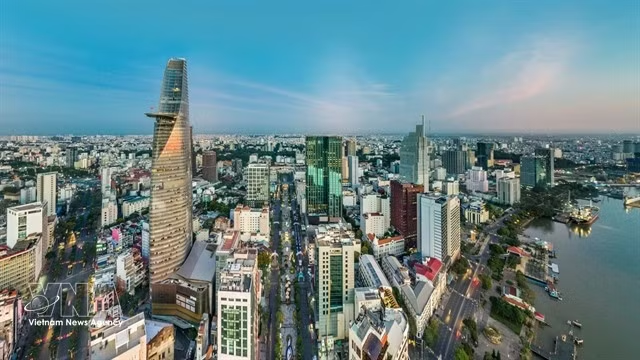
 A view of Ho Chi Minh City’s skyline, Vietnam’s largest economic hub (Photo: VNA)
A view of Ho Chi Minh City’s skyline, Vietnam’s largest economic hub (Photo: VNA)

Ho Chi Minh City (VNS/VNA) – Ho Chi Minh City, Vietnam’s largest economic hub, reported its fastest first-quarter growth in a decade and called for faster reforms and more decisive action to achieve double-digit expansion this year.

Gross regional domestic product (GRDP) rose by 8.27% year-on-year in the first quarter of 2026, the highest increase in 10 years, according to city officials.

The strong performance was underpinned by broad-based gains.

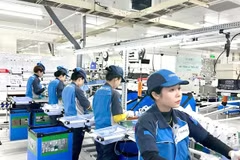
Retail sales and consumer service revenue expanded more than 13%, industrial production increased by 11%, and budget revenues rose by 19% to more than 247 trillion VND (9.5 billion USD).

Foreign direct investment (FDI) inflows reached nearly 2.9 billion USD, more than tripling from a year earlier, while the city welcomed over 19 million visitors.

Authorities also accelerated administrative procedures for 831 out of 838 delayed projects, representing over 99%, with a combined investment value exceeding 205 trillion VND.

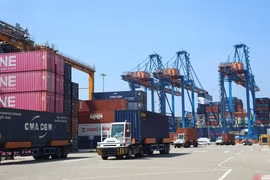
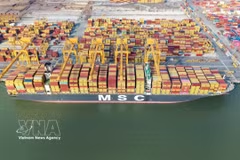
The data highlight the resilience of Vietnam’s commercial centre amid an uncertain global environment, reinforcing its role as a key growth engine for the export-driven economy.

Challenges

However, officials cautioned that the current pace may be difficult to sustain without structural improvements.

Nguyen Loc Ha, Vice Chairman of the municipal People’s Committee, said: “A strong start alone is not sufficient. To achieve double-digit growth, the city must act more decisively, differently and effectively.”

He pointed to persistent challenges, including slow implementation across agencies, incomplete growth planning and delays in administrative processing.

More than 42% of units have yet to finalise double-digit growth plans while a significant share of assigned tasks remain overdue, according to the city’s review.

Growth quality also remains a concern, with expansion still heavily reliant on services, while public investment disbursement has lagged and land-related procedures continue to hinder project execution.

Three growth scenarios

The Ho Chi Minh City Institute for Development Studies outlined three scenarios for the second quarter, depending on global and domestic conditions.

Growth could range from 7.7–8.6% in a downside scenario, 9.1–10% under baseline conditions, and 10.7–11.6% in a favourable scenario.

To meet the city’s full-year target of more than 10% growth, the remaining quarters would need to expand by over 10.5%, supported by stronger public investment, domestic consumption, exports and emerging drivers such as the digital economy.

City authorities have set an April 15 deadline for agencies to finalise growth plans and are prioritising faster disbursement of public funds, infrastructure development and administrative reform.

Ha said the city faced a critical window to accelerate but stressed that outcomes would depend on execution.

Officials must shift “from reporting achievements to delivering measurable results,” he added.

The push comes as Vietnam seeks to balance robust economic expansion with macroeconomic stability, a policy stance emphasised by national leaders amid rising global uncertainties./.

VNA

See more

Delegates at the opening ceremony of the Made in Da Nang Expo 2026 (Photo: VNA)

Nearly 300 firms join Made in Da Nang Expo 2026

Speaking at the opening ceremony, Vice Chairman of the Da Nang People’s Committee Tran Chi Cuong said the exhibition is a large-scale trade promotion event aimed at showcasing products, connecting markets, and helping businesses enhance competitiveness while expanding domestic and export markets.

 Green production, standardised value chains key to fruit, vegetable sector growth

Green production, standardised value chains key to fruit, vegetable sector growth

Facing mounting pressure from increasingly stringent domestic and international standards, Vietnam’s fruit and vegetable sector is accelerating its shift toward green, safe, and sustainable production models. Beyond changing farming practices, localities and businesses are stepping up efforts to standardise value chains and build brands to achieve growth targets for 2026.

The launch of the Vietnam National Brand Week 2026 on April 16 (Photo: VNA)

Vietnam National Brand Week 2026 opens

Running from April 16 to 23 nationwide, the Vietnam National Brand Week 2026 marks the 18th anniversary of Vietnam Brand Day (April 20, 2008 – 2026).

Ca Mau is currently home to more than 5,200 fishing vessels, including nearly 1,900 boats measuring over 15 metres in length, and all have been equipped with vessel monitoring systems. (Illustrative photo: VNA)

Ca Mau drives changes among fishermen to tackle IUU fishing

Ca Mau is stepping up communication campaigns to disseminate legal regulations on IUU fishing, highlight recent enforcement results, and convey recommendations from the European Commission (EC)’s fifth inspection mission to fishing communities and relevant stakeholders.

The new infrastructure system will not only meet immediate needs but also create new growth poles, helping reshape the economic landscape. (Photo: VNA)

Construction sector striving for high-growth target

The construction sector faces mounting pressure to keep major projects on schedule while managing costs and stabilising markets. Yet, with gains from institutional reform, infrastructure investment, and growth model transformation, it remains well positioned to serve as a key growth engine.

Fuel taxes are slashed to 0% from April 16 under a National Assembly resolution. (Illustrative photo: VNA)

Fuel taxes cut to 0% from April 16

Accordingly, the environmental protection tax on petrol (excluding ethanol), diesel, kerosene, mazut, and aviation fuel has been cut to 0 VND per litre. These products are also exempt from VAT declaration and payment, while still eligible for input VAT credit.