Buenos Aires (VNA) – Secretary-General of the Brazil–Vietnam Friendship Association (ABRAVIET) Pedro Oliveira affirmed the enduring value of Ho Chi Minh Thought for the global revolutionary movement and for contemporary Vietnam–Brazil relations in an interview granted to the Vietnam News Agency on May 10.
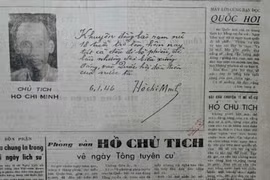
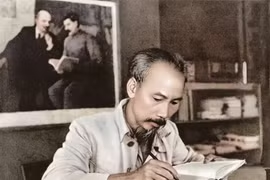
The interview took place ahead of the 115th anniversary of the late Vietnamese President’s departure in search of a path to national salvation (June 5, 1911–2026) and his 136th birth anniversary (May 19, 1890–2026).
Pedro Oliveira stressed that President Ho Chi Minh’s decision to leave Vietnam in 1911 and travel around the world in search of a path to national liberation was of exceptional significance, given that Vietnam had been under French colonial rule since 1858. At the time, severe limitations in information and communications made it difficult to fully grasp the nature of colonialism and international dynamics. The journey therefore enabled him to directly engage with anti-colonial struggles across different continents. The journalist and historian noted that throughout the period from 1911 until his return to Vietnam in 1941, President Ho Chi Minh conducted in-depth studies of global developments, which allowed him to chart an appropriate revolutionary path for the Vietnamese nation. He highlighted the late leader’s pivotal role in contributing to the founding of the Indochinese Communist Party in 1930, laying the foundations for national liberation and reunification.
Reflecting on international support for Vietnam during its struggles for independence, Oliveira underlined the importance of global solidarity movements against colonialism and imperialism. He said the Brazilian people actively supported Vietnam’s just cause in the past and continue to stand alongside the country in its current development process.
Assessing the global significance of Ho Chi Minh Thought, Oliveira summarised it in two core dimensions. First, President Ho Chi Minh made major political and ideological contributions to the international socialist and communist movements by emphasising that the liberation of the global working class could only succeed if revolutionary parties firmly supported struggles against colonialism and imperialism worldwide, including in Latin America. Second, the President consistently affirmed that the struggle against colonialism must be inseparable from the goal of building socialism, a path that enabled Vietnam to overcome wars of aggression and advance toward peace, development, social justice and scientific and technological progress.
Regarding Vietnam–Brazil relations, Oliveira expressed confidence that cooperation projects in science, technology and innovation, along with partnerships between universities in the two countries, will further strengthen mutual understanding. He also highlighted untapped potential for exchanges among students, lecturers, artists and athletes, particularly in football.
He added that ABRAVIET, together with the Communist Party of Brazil, remains committed to promoting people-to-people exchanges to nurture bilateral friendship.
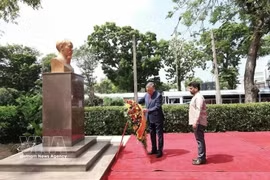
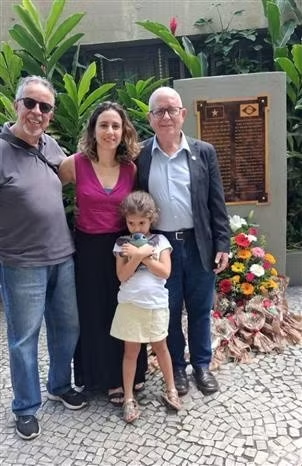
Oliveira noted that on May 9, marking the 37th anniversary of diplomatic ties and President Ho Chi Minh’s birth anniversary, ABRAVIET organised an event in Santa Teresa, Rio de Janeiro, where the late Vietnamese leader once set foot during his journey in 1912. A statue of him now stands there, commemorating his historic visit and symbolising the solidarity between the Brazilian and Vietnamese people./.
Ho Chi Minh Thought continues to inspire world: Uruguayan official
A member of the Communist Party of Uruguay (PCU) Central Committee described President Ho Chi Minh as one of the most influential revolutionary figures of the 20th century.