Hanoi (VNA) - As Hanoi and many localities nationwide step up investment in strategic transport and urban infrastructure to unlock new growth drivers and advance long-term urban transformation, distorted narratives on social media aimed at undermining site clearance efforts and denying public consensus must not be allowed to obstruct projects that serve the public interest and development goals of the country.
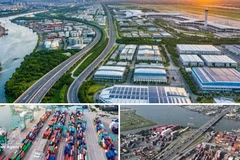
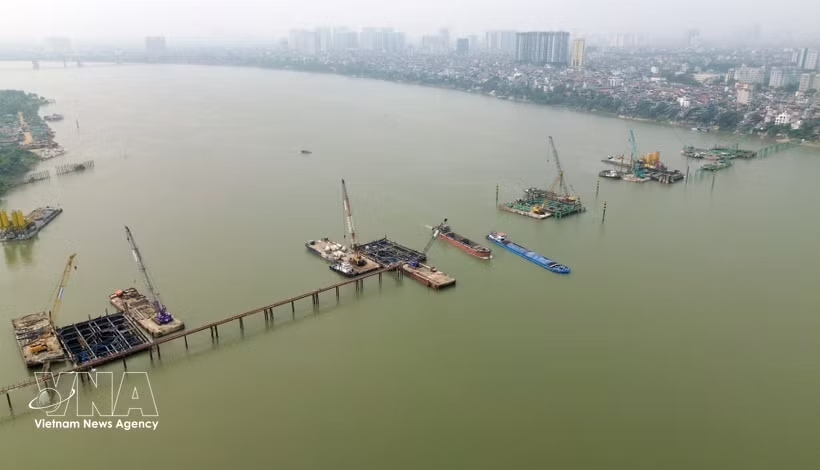
Transport infrastructure development is a key task in the capital’s major development strategies, closely linked with the Hanoi Capital Master Plan with a 100-year vision and the implementation of the revised Capital Law. A series of major projects, including ring roads, urban railways, national railways and regional economic connectivity projects such as the Red River Landscape Boulevard Axis, are being implemented to enhance connectivity, promote the growth of Hanoi and the country, and lay the foundation for urban reconstruction in a modern, synchronised and sustainable direction.
Beyond Hanoi, Ho Chi Minh City and many other major urban hubs and localities across the country are ramping up investment in transport and urban infrastructure, as well as regional connectivity, laying a crucial foundation for broadening development space, enhancing competitiveness and spurring economic growth in the new era.
At a working session with the Hanoi Party Committee’s standing board earlier this year, Party General Secretary and State President To Lam highly valued the capital’s progress, particularly improvements in site clearance for key transport projects, which have gained public consensus. This is considered an important factor enabling Hanoi to speed up strategic projects, thus creating new development momentum for the capital and the northern key economic region.
The simultaneous implementation of large-scale infrastructure projects not only demonstrates the municipal authorities’ strong political determination, but also translates the Party’s and State’s major policies on strategic infrastructure development into action, creating a foundation for realising double-digit growth targets of Hanoi and the country in line with the Resolution of the 14th National Party Congress. These projects are also expected to create new room for the real estate market, public investment and regional connectivity infrastructure development, while paving the way for the restructuring and reconstruction of the entire urban space and surrounding areas.
Meanwhile, some misleading narratives circulating on social media have deliberately distorted the site clearance process, denied public consensus and people’s willingness to make sacrifices for the greater good, as well as dismissed the sound policies and developmental significance of these projects. In reality, however, implementation has shown broad public consensus in support of the common interest, while the municipal authorities continue to place resettlement policies, social welfare and people’s livelihoods at the heart of the process.
In pursuit of this goal, Hanoi is accelerating site clearance, long regarded as the “most difficult task” and the "biggest bottleneck" affecting investment efficiency and construction progress. The city is speeding up construction and land clearance to ensure progress on key projects such as Ring Road 2.5 and Ring Road 3.5, Ring Road No.4 in the Hanoi Capital Region, urban railway projects and national railway projects, including the North-South high-speed railway and the Lao Cai – Hanoi – Hai Phong railway.
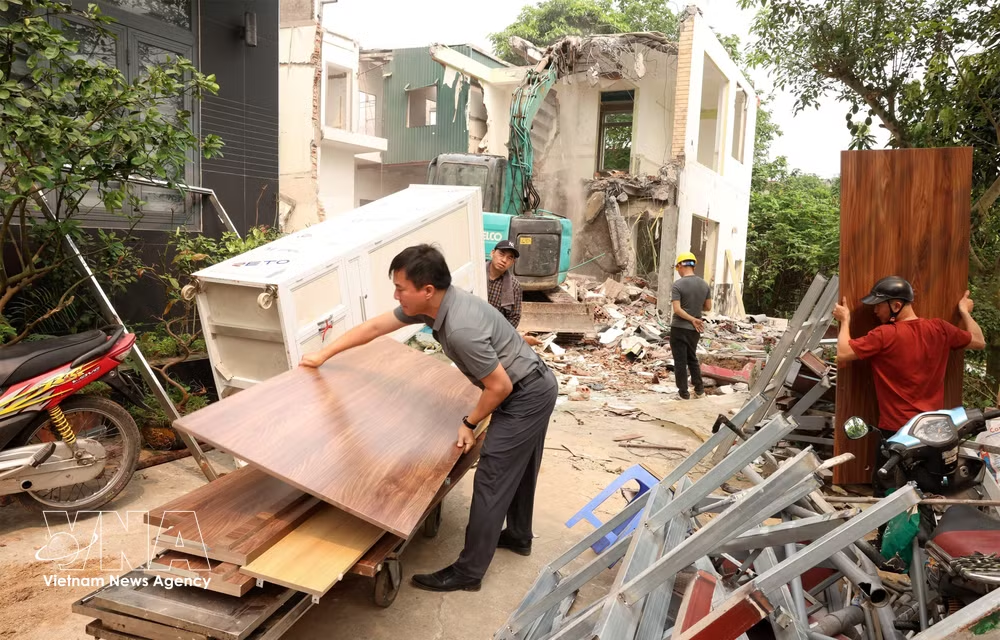
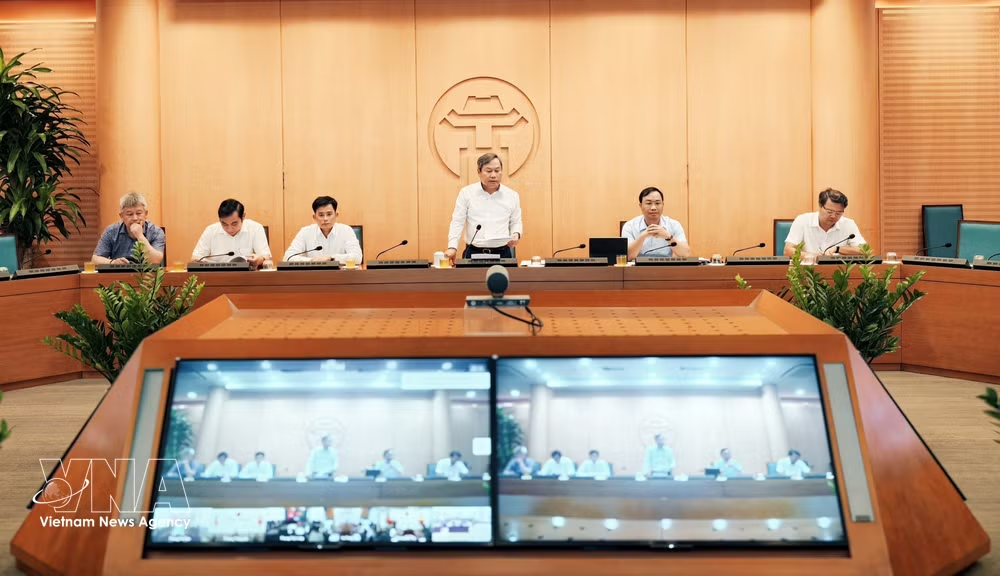
At a recent meeting on removing obstacles to site clearance for the Ring Road 2.5 and Ring Road 3.5 projects – two key transport arteries of the capital – Chairman of the municipal People’s Committee Vu Dai Thang requested local authorities to intensify efforts and complete many sections before May 15 and May 30, 2026, while accelerating resettlement arrangements and beginning construction immediately in areas where cleared land is available.
Ensuring the rights and interests of residents in planned areas is regarded as a matter of utmost importance and a consistent guiding principle of the municipal People’s Committee leadership. Thang requested local authorities to continue mobilising the entire political system, while departments and agencies were instructed to promptly resolve issues under their authority, particularly approving the price of resettlement housing and allocating resettlement housing and land areas so that residents can soon stabilise their lives in new homes.
At the same time, investors were required to immediately commence construction in areas where site clearance has been completed, avoiding situations in which land is available but projects are delayed, which could erode public trust.
For cases requiring the relocation of enterprises, factories and industrial clusters, the city requested the early development of appropriate support mechanisms to ensure production continuity, employment and livelihoods for labourers.
Thang also stressed the need to guarantee social welfare during land recovery, with particular attention given to disadvantaged households and vulnerable groups to prevent complicated complaints.
Implementation shows that site clearance has consistently been carried out in a transparent manner, ensuring the legitimate rights and interests of residents. From projects that had remained stalled for years such as Ring Road 1 and Ring Road 2.5, Hanoi is now demonstrating clear improvements in site clearance work.
A typical example is the Hoang Cau–Voi Phuc section of Ring Road 1 project, which had been delayed for many years due to site clearance issues involving thousands of households. After more than five months of implementing the two-tier local administration model, compensation, resettlement and land recovery procedures for 1,295 households have basically been completed, nearly doubling the results reported over the previous seven years.
Reality has also shown that when direct engagement with each household, listening and public outreach are harmoniously combined with transparent policies and strict legal discipline, many long-standing "bottlenecks" can be resolved quickly. In particular, preparing sufficient resettlement housing and land areas from the outset helps reassure residents and stabilise their lives, thereby shortening implementation time.
Recognising the importance of preparing resettlement housing funds, under Plan No. 144/KH-UBND recently issued, the municipal People’s Committee requested agencies to review and assess resettlement demand in order to implement independent compensation, support and resettlement projects before approving investment policies for major projects.
Biased information on some social media platforms has deliberately focused on relocation and land recovery issues to distort the city’s infrastructure development policies, even denying the consensus of residents in planned areas. Such narratives ignore the essence of the issue that infrastructure development is an inevitable requirement for expanding development space, easing congestion, strengthening regional connectivity and creating new growth momentum for the capital and surrounding areas.
At the same time, such misleading information deliberately overlooks the fact that residents themselves have proactively handed over land and coordinated with authorities so projects can proceed on schedule for the long-term common interest.
Every stage of development inevitably requires sacrifice in pursuit of a better quality of life. The site clearance and relocation work in Hanoi has continued overnight and through holidays with the strong support of residents. Old houses and gardens have made way for cleared land ready for construction.
These achievements have been made possible thanks to the consensus, contributions and sacrifices of residents in project areas. Although these places were home to decades of memories and attachments, the residents still agreed to relocate in the hope that projects will be implemented on schedule, helping expand infrastructure, giving the capital a facelift and contributing to national development..
Reality shows that once people are aware of their responsibilities to the State, greatest benefits will come to the community and future generations. The unity and consensus of each individual have created the greatest motivation for projects to be completed soon and bring about a new face for the country.
When authorities act decisively, compensation and resettlement policies are implemented transparently, the rights of residents are guaranteed, and mass mobilisation is prioritised, bottlenecks in site clearance can be completely removed. Experience in Hanoi and many localities nationwide shows that although implementation inevitably causes initial impacts and disruptions, the great significance of strategic infrastructure projects lies in not only expanding development space and creating new growth drivers, but also promoting urban reconstruction, towards improving the quality of life for people. Therefore, any distorted narratives, incitement or denial of infrastructure development policies run counter to the interests of the community and the country’s development./.