Government issues decree guiding implementation of civil judicial assistance law

The decree sets out regulations on procedures, costs and responsibilities of relevant agencies in carrying out Vietnam’s mutual legal assistance activities in civil matters.

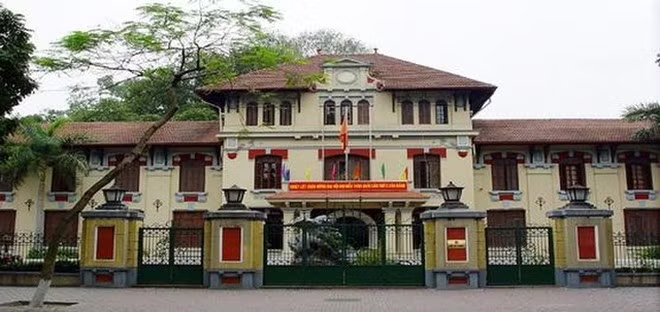
The headquarters of the Ministry of Justice in Hanoi. (Illustrative photo: vietnamnet.vn)

Hanoi (VNA) – The Government has issued Decree No. 158/2026/ND-CP dated May 15, 2026, detailing a number of articles and measures for implementing the Law on Mutual Judicial Assistance in Civil Matters.

The decree sets out regulations on procedures, costs and responsibilities of relevant agencies in carrying out Vietnam’s mutual legal assistance activities in civil matters.

Comprising five chapters and 24 articles, the decree provides guidance on dossiers, procedures and processes for implementing mutual legal assistance in civil matters, as well as state management measures in this field.

The decree applies to Vietnamese and foreign agencies, organisations and individuals involved in mutual legal assistance in civil matters between Vietnam and other countries.

Under the decree, which will take effect from July 1, 2026, persons obliged to pay actual costs arising from Vietnam’s requests for mutual legal assistance in civil matters include litigants specified in Articles 152 and 153 of the 2015 Civil Procedure Code in cases involving service of procedural documents, collection of evidence for settlement of civil cases, and service of protest, cassation or retrial decisions.

Agencies, organisations and individuals requesting enforcement of judgments or decisions under the Law on Civil Judgment Enforcement that result in requests for mutual legal assistance abroad are also required to bear the costs. Civil judgment enforcement agencies must pay the costs in cases where they proactively issue enforcement decisions.

For costs collected by competent foreign authorities, if the amount has already been determined under foreign regulations at the time the dossier is prepared, the obligated party must pay such costs in accordance with Vietnamese law and relevant foreign law.

If the costs have not yet been determined, the obligated party must make an advance payment of 3 million VND (about 114 USD) to the provincial-level civil judgment enforcement agency where the competent Vietnamese authority requesting mutual legal assistance is headquartered.

The decree also specifies conditions for a valid dossier requesting mutual legal assistance in civil matters.

Accordingly, dossiers must contain sufficient documents, copies and translations as prescribed in Article 17 of the Law on Mutual Judicial Assistance in Civil Matters. Translations must bear authenticated signatures of translators in line with legal regulations.

Requests for mutual legal assistance must be original documents prepared in the form prescribed by the Minister of Justice (MoJ).

Each dossier must be prepared separately for each litigant, address and scope of mutual legal assistance. Within 20 days from receiving a dossier, the MoJ is responsible for recording and examining its validity.

If the dossier is valid, the ministry will transfer it through the central authority of the requested country under relevant Hague conventions or international treaties to which Vietnam and the requested country are members, or through diplomatic channels via the Ministry of Foreign Affairs (MoFA).

If the dossier is invalid, the MoJ will request competent Vietnamese agencies or individuals to supplement or complete it, or return it with a clear explanation of the reasons. The MoFA must transfer dossiers received from the MoJ to Vietnamese representative missions abroad within five working days, while the missions are required to forward them to competent foreign authorities within another five working days./.
VNA

See more

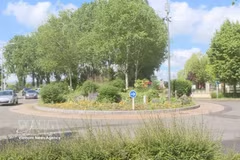
A view of Place Ho Chi Minh in Persan, France. (Photo: VNA)

Place preserving memories of President Ho Chi Minh in France

Although there is little publicly available documentation confirming exactly when Place Ho Chi Minh was established, French urban historians suggest that most streets and public spaces named after the Vietnamese leader in France emerged between the 1960s and 1980s, during the height of anti-war movements and solidarity campaigns supporting Vietnam across working-class towns and left-leaning suburbs around Paris.

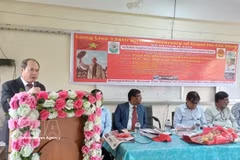
Vietnamese Ambassador to Bangladesh Nguyen Manh Cuong speaks at the seminar. (Photo: VNA)

President Ho Chi Minh’s thought on national unity remains relevant today

President Ho Chi Minh's ideology of national unity continues to carry profound significance amid growing global challenges, including conflicts, social divisions and economic instability. His message of solidarity, consensus and placing national interests above sectional differences remains a valuable lesson for many developing nations.

Assoc. Prof. Dr. Nguyen Duc Son presents the decision establishing the Vietnamese Language Proficiency Test Council in Japan to a representative of the Vietnam Studies Centre in Japan. (Photo: VNA)

Japan hosts first standardised Vietnamese language proficiency test

As bilateral ties between Vietnam and Japan continue to expand, demand for Vietnamese language learning in Japan has also grown rapidly among OVs, educational institutions, businesses and Japanese people interested in Vietnam. Against this backdrop, the introduction of a standardised proficiency test is expected to provide an official and widely recognised benchmark for Vietnamese language skills.

The “I Love My Fatherland" Journey 2026 kicks off in Nghe An province on May 16. (Photo: VNA)

"I Love My Fatherland” journey features diverse activities

The “I Love My Fatherland” journey will span seven stages across historical and cultural sites and “red addresses” nationwide. There will be a combination of education on traditions, field-based programmes, and digital communications.

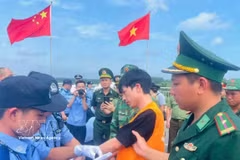
At the handover of 33 Chinese nationals who had violated Vietnamese law to Chinese authorities in Quang Ninh on May 15, 2026. (Photo: VNA)

Vietnam hands over 33 law violators to China

Investigations found that the individuals had violated Vietnamese laws relating to illegal entry and unlawful residence in Vietnam. The handover was conducted safely and in compliance with Vietnamese law and international practice.

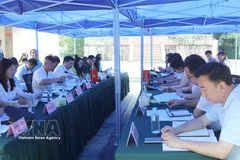
At the talks between authorities of the northern province of Lang Son and Pingxiang city in the Guangxi Zhuang Autonomous Region of China (Photo: VNA)

Vietnam, China seek to build modern, smart border gates

Authorities of the northern province of Lang Son and Pingxiang city in the Guangxi Zhuang Autonomous Region of China held talks on May 15 at Tan Thanh (Vietnam) – Po Chai (China) clearance point near markers 1090–1091 in Hoang Van Thu commune of Lang Son to promote trade, develop smart border gates and expand cross-border tourism cooperation.

The Vietnam Association for Victims of Agent Orange (VAVA) has carried out various activities to support Agent Orange/dioxin victims. (Photo: VNA)

Over 9.3 billion VND raised for AO/dioxin victims in 2025

VAVA President Lieutenant General Nguyen Huu Chinh said that although the war ended more than 50 years ago, the consequences of toxic chemicals remain severe and long-lasting, with millions of people affected during the war and hundreds of thousands continuing to suffer serious physical impacts in peacetime.