President Ho Chi Minh’s thought on national unity remains relevant today

President Ho Chi Minh's ideology of national unity continues to carry profound significance amid growing global challenges, including conflicts, social divisions and economic instability. His message of solidarity, consensus and placing national interests above sectional differences remains a valuable lesson for many developing nations.

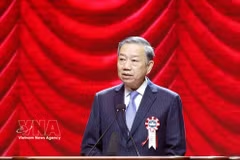
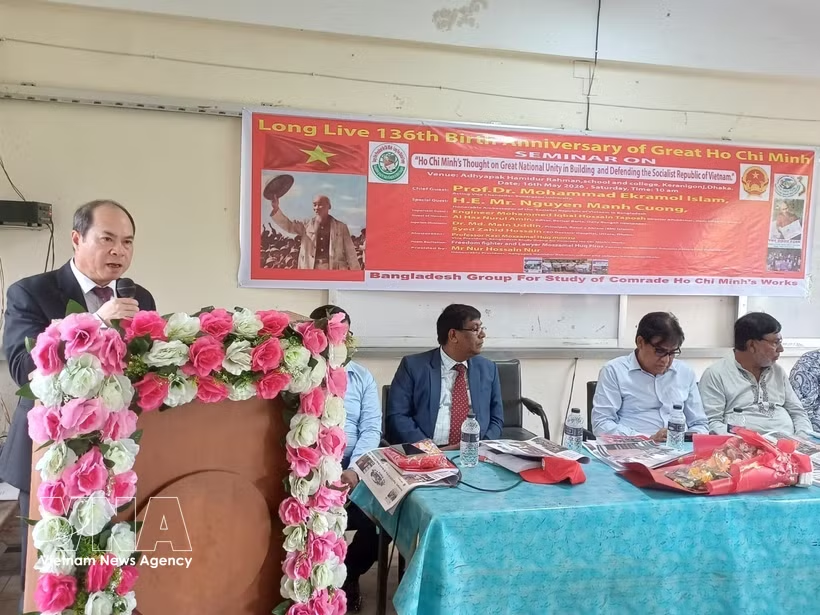
Vietnamese Ambassador to Bangladesh Nguyen Manh Cuong speaks at the seminar. (Photo: VNA)

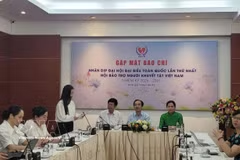
Hanoi (VNA) – The Vietnamese Embassy in Bangladesh, in coordination with a research group on President Ho Chi Minh, recently organised a seminar on the late leader's thought on great national unity in the cause of Vietnam’s national construction and defence, on the occasion of his 136th birth anniversary (May 19, 1890-2026).

The event, held in the capital city of Dhaka, was attended by Ambassador Nguyen Manh Cuong, along with professors, scholars, university lecturers and a large number of students interested in the life and legacy of President Ho Chi Minh.

At the seminar, participants reflected on the immense contributions of President Ho Chi Minh, a national liberation hero and world cultural figure, to Vietnam’s struggle for independence and national reunification, as well as to global movements for national liberation. Discussions focused on clarifying his ideology of great national unity in the cause of safeguarding and developing the nation, and examining the contemporary relevance and applicability of his thought in Bangladesh and other parts of the world today.

In his opening remarks, Dr. M Jahangir Khan, head of the research group, stressed that President Ho Chi Minh was not only a visionary leader of the Vietnamese nation, but also a symbol of peace, national independence and international solidarity. He introduced historical images and documents highlighting the late Vietnamese leader’s revolutionary journey in countries such as Thailand and China during his quest for national salvation.

Bangladeshi scholars noted that his ideology of national unity continues to carry profound significance amid growing global challenges, including conflicts, social divisions and economic instability. Delegates agreed that his message of solidarity, consensus and placing national interests above sectional differences remains a valuable lesson for many developing nations.

Recalling President Ho Chi Minh’s famous saying, “Solidarity, solidarity, great solidarity. Success, success, great success,” Ambassador Cuong emphasised that the ideology of unity had been one of the key foundations enabling Vietnam to overcome the most difficult periods in its history. He affirmed that the value of solidarity remains highly relevant to Vietnam’s current national development efforts, stressing that it creates strength and represents not only the gathering of forces, but also harmony in goals, interests and aspirations for national progress.

The seminar also featured documentary screenings on the late President’s life and revolutionary career, helping Bangladeshi participants gain deeper insight into his enduring legacy, and further strengthening mutual understanding and the traditional friendship between the two nations./.

VNA
See more

The copyright crackdown is broadly viewed as an inevitable step in Vietnam’s cultural industry development. (Illustrative photo: VNA)

Healthy digital content market in the making

The sharper crackdown is rapidly redrawing how online entertainment is distributed and consumed, while gradually reshaping public awareness and responsibility toward copyright protection.

A view of Place Ho Chi Minh in Persan, France. (Photo: VNA)

Place preserving memories of President Ho Chi Minh in France

Although there is little publicly available documentation confirming exactly when Place Ho Chi Minh was established, French urban historians suggest that most streets and public spaces named after the Vietnamese leader in France emerged between the 1960s and 1980s, during the height of anti-war movements and solidarity campaigns supporting Vietnam across working-class towns and left-leaning suburbs around Paris.

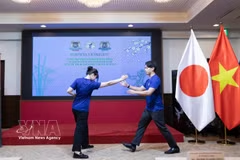
Assoc. Prof. Dr. Nguyen Duc Son presents the decision establishing the Vietnamese Language Proficiency Test Council in Japan to a representative of the Vietnam Studies Centre in Japan. (Photo: VNA)

Japan hosts first standardised Vietnamese language proficiency test

As bilateral ties between Vietnam and Japan continue to expand, demand for Vietnamese language learning in Japan has also grown rapidly among OVs, educational institutions, businesses and Japanese people interested in Vietnam. Against this backdrop, the introduction of a standardised proficiency test is expected to provide an official and widely recognised benchmark for Vietnamese language skills.

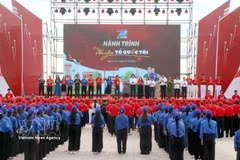
The “I Love My Fatherland" Journey 2026 kicks off in Nghe An province on May 16. (Photo: VNA)

"I Love My Fatherland” journey features diverse activities

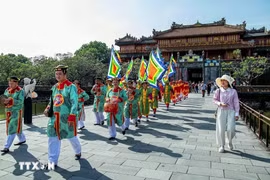
The “I Love My Fatherland” journey will span seven stages across historical and cultural sites and “red addresses” nationwide. There will be a combination of education on traditions, field-based programmes, and digital communications.

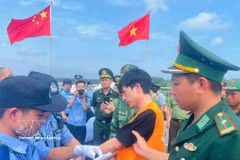
At the handover of 33 Chinese nationals who had violated Vietnamese law to Chinese authorities in Quang Ninh on May 15, 2026. (Photo: VNA)

Vietnam hands over 33 law violators to China

Investigations found that the individuals had violated Vietnamese laws relating to illegal entry and unlawful residence in Vietnam. The handover was conducted safely and in compliance with Vietnamese law and international practice.

At the talks between authorities of the northern province of Lang Son and Pingxiang city in the Guangxi Zhuang Autonomous Region of China (Photo: VNA)

Vietnam, China seek to build modern, smart border gates

Authorities of the northern province of Lang Son and Pingxiang city in the Guangxi Zhuang Autonomous Region of China held talks on May 15 at Tan Thanh (Vietnam) – Po Chai (China) clearance point near markers 1090–1091 in Hoang Van Thu commune of Lang Son to promote trade, develop smart border gates and expand cross-border tourism cooperation.