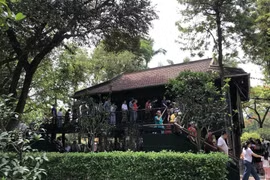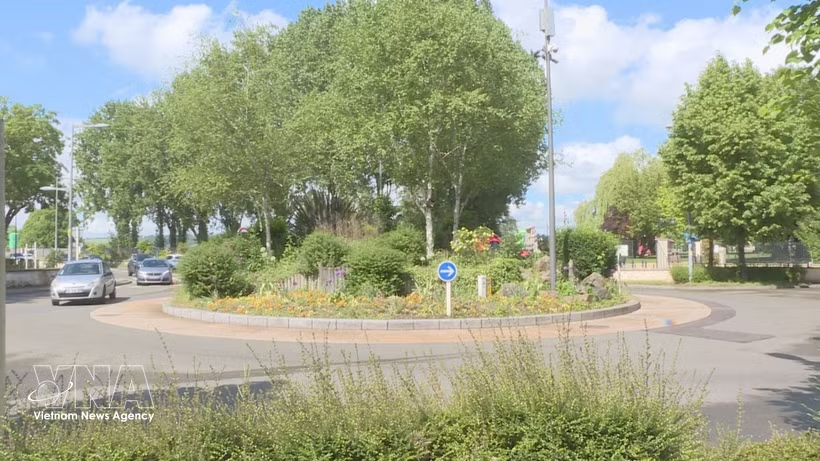
Paris (VNA) – Persan, a city in the Val-d’Oise department of the Île-de-France region around 40 km north of Paris, has quietly preserved a unique tribute to late President Ho Chi Minh – the founder of modern Vietnam – through a small square bearing his name.
Home to more than 14,000 residents, Persan lies along the Oise River and on a transport route linking Paris with northern France. Beyond its industrial identity, the city also carries a strong historical association with workers’ movements and left-wing politics. For decades after the Second World War, Persan formed part of the so-called “red belt” surrounding Paris – areas known for their concentration of workers, trade unions and socialist and communist political influence. Historians believe this historical context contributed to the decision to include Ho Chi Minh’s name in the town’s urban landscape.
Although there is little publicly available documentation confirming exactly when Place Ho Chi Minh was established, French urban historians suggest that most streets and public spaces named after the Vietnamese leader in France emerged between the 1960s and 1980s, during the height of anti-war movements and solidarity campaigns supporting Vietnam across working-class towns and left-leaning suburbs around Paris.
According to historians, the 1954 victory of the battle of Dien Bien Phu in the Southeast Asian nation, opposition to the Vietnam War and the growing influence of left-wing organisations in France created a distinctive political and social climate during that period. In that context, many municipalities chose to name streets, squares and public buildings after international figures regarded as symbols of peace, independence and resistance. Place Ho Chi Minh emerged from that broader historical movement.
Speaking to the Vietnam News Agency's correspondents in France, Tran Thu Dung, author of a book on French-Vietnamese imprints through street names, noted that the European country has a long tradition of naming streets in ways that preserve memory and convey historical messages. According to her, street names and plaques together form a “cultural picture” reflecting the values society wishes to honour.
Her research shows that Ho Chi Minh is among the very few Vietnamese figures commemorated through place names in France. His name currently appears on eight streets and squares, including five in mainland France and three in overseas territories.
The continued presence of his name in French public spaces decades later reflects not only Vietnam’s distinctive historical imprint on the 20th century, but also the respect held by some French citizens for the ideals of national independence and peace that he symbolised. That quiet yet enduring presence has also become part of the local identity in cities where streets or squares bear his name.
For Martine Panitier, a 68-year-old resident who has lived in Persan for many years, Place Ho Chi Minh is more than a familiar local landmark. She sees it as a symbol of remembrance and respect for a figure who left a mark on history. Although she does not claim deep knowledge of the late president or Vietnamese history, she believes the decision to name a public place after him in France must have stemmed from admiration for the values he represented.
Today, Place Ho Chi Minh is far from a ceremonial or overtly political square. It is simply an ordinary part of daily life in Persan, where children walk to school each morning, residents take leisurely evening strolls and commuter trains continue to connect the suburbs with Paris. Yet for many Vietnamese living in France, the quiet presence of such name in the heart of France still carries profound meaning.
With more than half a century passing, in a peaceful corner of Persan, the name Ho Chi Minh endures as a quiet reminder of history, solidarity between peoples and the universal aspiration for peace./.
See more
Software launched to streamline temporary residence declarations for foreigners
Under the new system, accommodation establishments will no longer need to use multiple platforms as before. Instead, they can use a single unified software platform to declare temporary residence for foreigners and notify lodging information for Vietnamese citizens.
Fishermen urged to join fight against IUU fishing, safeguard maritime sovereignty
The Coast Guard Region 2 Command and the Quang Ngai provincial Party Committee’s Board for Information, Education and Mass Mobilisation on May 19 held a communication conference in Sa Huynh ward to raise awareness about combating illegal, unreported and unregulated (IUU) fishing.
Ca Mau determined to eliminate illegal, unreported and unregulated fishing
The province currently has 5,158 fishing vessels, including 1,914 boats measuring 15 metres or longer, all of which have been equipped with VMS connected directly to the national fisheries management network.
Healthy digital content market in the making
The sharper crackdown is rapidly redrawing how online entertainment is distributed and consumed, while gradually reshaping public awareness and responsibility toward copyright protection.
Japan selects Vietnamese workers for first foreign bus driver training programme
Sapporo city in Japan’s Hokkaido prefecture has launched a new initiative to train foreign drivers before recruiting them to work in the city, with Vietnam selected as the first trainee supplier.
President Ho Chi Minh’s thought on national unity remains relevant today
President Ho Chi Minh's ideology of national unity continues to carry profound significance amid growing global challenges, including conflicts, social divisions and economic instability. His message of solidarity, consensus and placing national interests above sectional differences remains a valuable lesson for many developing nations.
Bilingual school promotes President Ho Chi Minh’s moral example among younger generations in Laos
President Ho Chi Minh’s ideology, morality and style remain invaluable spiritual assets of the Vietnamese nation and continue to inspire today and future generations.
Vietnamese youth in Australia carry forward President Ho Chi Minh’s legacy in building prosperous, happy nation
Every contribution by Vietnamese youth abroad — whether through scientific research, technological projects, community initiatives, or simply through living responsibly and studying diligently while always looking toward the homeland — helps continue the journey initiated by President Ho Chi Minh toward a strong, prosperous, civilised, and happy Vietnam.
Government issues decree guiding implementation of civil judicial assistance law
The decree sets out regulations on procedures, costs and responsibilities of relevant agencies in carrying out Vietnam’s mutual legal assistance activities in civil matters.
Japan hosts first standardised Vietnamese language proficiency test
As bilateral ties between Vietnam and Japan continue to expand, demand for Vietnamese language learning in Japan has also grown rapidly among OVs, educational institutions, businesses and Japanese people interested in Vietnam. Against this backdrop, the introduction of a standardised proficiency test is expected to provide an official and widely recognised benchmark for Vietnamese language skills.
Basic salary to increase to 2.53 million VND per month from July
The Government will adjust the basic salary after reporting to the National Assembly for consideration and decision, in line with the State budget’s capacity, the consumer price index and the country’s economic growth rate.
STEM scholarships seen as boost for talent attraction, high-quality workforce development
Under the proposal, undergraduate students could receive between 3.7 million VND and 5.5 million VND (140–210 USD) per month while master’s and doctoral students could receive up to 8.4 million VND (318 USD) per month.
Da Lat to host 15 experiential activities during Vesak 2026
According to organisers, this year’s Vesak Celebrations are designed as an “experiential journey”, blending solemn spiritual ceremonies with public-oriented cultural, artistic and social welfare activities.
Strong science-technology capacity key to building elite university: Scholar
According to Duc, the core message in the top leader’s remarks was that VNU-Hanoi must become a truly elite institution that serves as a national academic pillar, a pioneer in science, technology and innovation, and a leading centre for training high-quality human resources.
Vietnam could tighten local oversight of foreigners as arrivals hit record highs
Vietnam currently offers e-visas to citizens from all countries and territories, while visa exemption policies have also been expanded in recent years as part of efforts to revive tourism and attract international business following the pandemic.
Criminal proceedings launched against copyright infringement
Authorities are continuing to expand the investigation to clarify the alleged offences committed by the accused and related violations by other individuals, while seeking measures to fully recover assets linked to the cases.
"I Love My Fatherland” journey features diverse activities
The “I Love My Fatherland” journey will span seven stages across historical and cultural sites and “red addresses” nationwide. There will be a combination of education on traditions, field-based programmes, and digital communications.
Friendship tree campaign promotes green growth, international solidarity
The event marked the 136th birth anniversary of President Ho Chi Minh (May 19, 1890–2026) and looked ahead to the 50th anniversary of Saigon-Gia Dinh being officially renamed Ho Chi Minh City (July 2, 1976–2026).
Vietnam National University, Hanoi must rise as symbol of Vietnamese intellect: Top leader
Vietnam National University, Hanoi must rise even further, becoming a leading academic pillar, a major hub of innovation, and a pioneering force in Vietnam’s higher education system; while also serving as a distinguished and reputable representative of Vietnamese intellect on the international stage.
Disability support association to chart new course at first congress
Vietnam currently has more than 7 million people with disabilities, highlighting the need for stronger community engagement and broader participation from social organisations in care provision, job creation, and social inclusion efforts.