Japan selects Vietnamese workers for first foreign bus driver training programme

Sapporo city in Japan’s Hokkaido prefecture has launched a new initiative to train foreign drivers before recruiting them to work in the city, with Vietnam selected as the first trainee supplier.

Tokyo (VNA) – Sapporo city in Japan’s Hokkaido prefecture has launched a new initiative to train foreign drivers before recruiting them to work in the city, marking the first time a Japanese local government has directly supported training for overseas bus drivers, with Vietnam selected as the first trainee supplier.

Official data showed that Sapporo operated 7,153 bus trips per day in 2024, down 24% compared to 2019, largely due to a severe driver shortage.

The city’s three main bus operators – Hokkaido Chuo Bus, JR Hokkaido Bus and Jotetsu – employed around 1,500 drivers in 2024, approximately 300 fewer than in 2020. About 70% of drivers are currently in their 50s or 60s, raising concerns over a wave of retirement in the coming years.

To maintain local bus operations, the Sapporo administration has turned to foreigner recruitment. Under the initial phase of the programme, 10 trainees will be trained in their home country before relocating to Sapporo to work as bus drivers.

Vietnam has been selected as the first recruitment market, with hiring scheduled to begin in May 2026. From July 2026 to October 2027, trainees will study in Vietnam to obtain driving licences, learn Japanese and familiarise themselves with Japanese culture and customs. The training will then shift to Japan, where participants will undergo one year of practical driving training at driving schools starting in autumn 2027 to maintain certification requirements.

The three local bus operators will serve as employers, with the drivers expected to begin work in 2028. The Sapporo administration will cover Japanese language training costs in Vietnam as well as travel expenses to Japan.

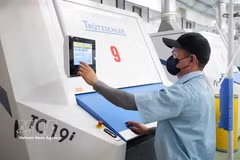
The project has been assigned to Tetra Shift, a Tokyo-based company specialising in foreign workforce recruitment support.

In 2024, the Japanese Government added the automobile transport sector to the list of industries eligible for the Specified Skilled Worker visa programme, allowing the recruitment of foreign workers for medium- and long-term employment.

While some bus operators in Japan have already started hiring foreign drivers, direct involvement and support from a local government in implementing such a programme remains highly uncommon./.
VNA

See more

Visitors to an exhibition and test-drive programme for electric vehicles organised in Cau Giay ward, Hanoi, on May 16 by the municipal People's Commitee and relevant agencies. (Photo: VNA)

Hanoi proposes subsidies to accelerate shift to electric vehicles

Under a draft resolution currently open for public feedback by the municipal People’s Committee, residents with permanent or temporary residence registration in Hanoi for at least two consecutive years, who own petrol-powered motorbikes registered before the resolution takes effect, will be eligible for support when purchasing electric motorbikes priced at 10 million VND or more.

The copyright crackdown is broadly viewed as an inevitable step in Vietnam’s cultural industry development. (Illustrative photo: VNA)

Healthy digital content market in the making

The sharper crackdown is rapidly redrawing how online entertainment is distributed and consumed, while gradually reshaping public awareness and responsibility toward copyright protection.

A view of Place Ho Chi Minh in Persan, France. (Photo: VNA)

Place preserving memories of President Ho Chi Minh in France

Although there is little publicly available documentation confirming exactly when Place Ho Chi Minh was established, French urban historians suggest that most streets and public spaces named after the Vietnamese leader in France emerged between the 1960s and 1980s, during the height of anti-war movements and solidarity campaigns supporting Vietnam across working-class towns and left-leaning suburbs around Paris.

Vietnamese Ambassador to Bangladesh Nguyen Manh Cuong speaks at the seminar. (Photo: VNA)

President Ho Chi Minh’s thought on national unity remains relevant today

President Ho Chi Minh's ideology of national unity continues to carry profound significance amid growing global challenges, including conflicts, social divisions and economic instability. His message of solidarity, consensus and placing national interests above sectional differences remains a valuable lesson for many developing nations.

The “I Love My Fatherland" Journey 2026 kicks off in Nghe An province on May 16. (Photo: VNA)

"I Love My Fatherland” journey features diverse activities

The “I Love My Fatherland” journey will span seven stages across historical and cultural sites and “red addresses” nationwide. There will be a combination of education on traditions, field-based programmes, and digital communications.