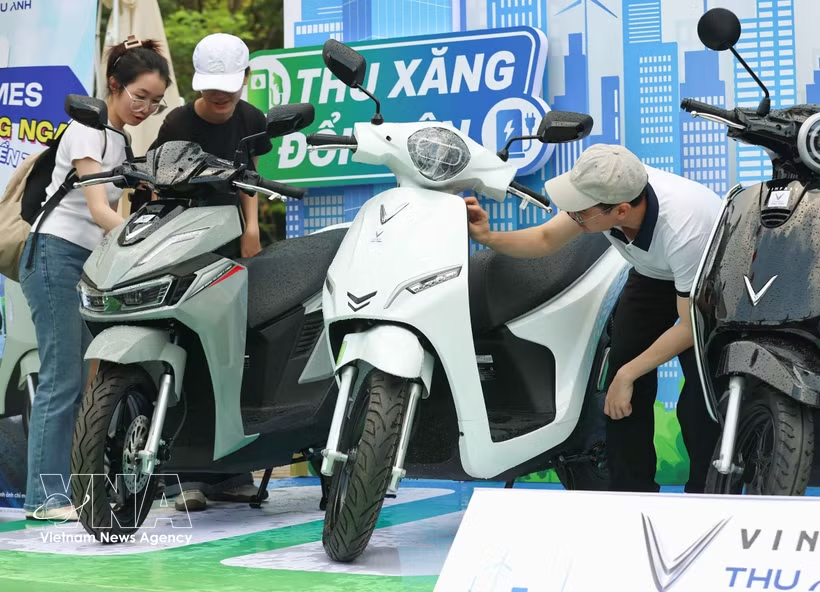
Hanoi (VNA) – Hanoi plans to support residents in switching from petrol-powered motorbikes to electric ones, with subsidies of up to 20 million VND (759 USD), while gradually restricting fossil fuel-powered vehicles.
Under a draft resolution currently open for public feedback by the municipal People’s Committee, residents with permanent or temporary residence registration in Hanoi for at least two consecutive years, who own petrol-powered motorbikes registered before the resolution takes effect, will be eligible for support when purchasing electric motorbikes priced at 10 million VND or more.
Each individual will be entitled to support once for one vehicle and may choose one of two support schemes. Under the direct cash support option, the city plans to subsidise 20% of the electric motorbike’s value, capped at 5 million VND per vehicle. Poor households may receive support equal to 100% of the vehicle’s value, up to 20 million VND, while near-poor households may receive 80%, capped at 15 million VND.
Residents who do not opt for cash support may instead receive public transport tickets worth 5 million VND. Hanoi is also considering a 50% reduction in registration and licence plate fees for electric motorbikes, while poor and near-poor households would be exempt from these fees entirely.
The draft also proposes free public transport fares for several groups, including those who have rendered service to the nation, persons with disabilities, the elderly, pupils, students, industrial park workers, and poor households. All passengers would also enjoy free public transport during holidays, Tet (Lunar New Year), and major city events.
Beyond financial support, the draft aims to lay the foundation for a green transport transition through the development of charging infrastructure, fee incentives, and a roadmap to gradually limit petrol-powered vehicles in Hanoi.
EV market heats up amid green transition
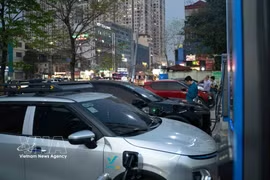
Persistently high fuel prices, together with Hanoi’s roadmap to restrict fossil fuel-powered vehicles, are giving a strong boost to the electric vehicle (EV) market. Demand for hybrid cars, battery electric vehicles (BEVs), and electric motorbikes has surged, reflecting a growing shift towards greener and more cost-efficient transportation.
According to the Vietnam Automobile Manufacturers’ Association (VAMA)’s sales report for April, electrified vehicles continued to post the fastest growth. Hybrid vehicle sales reached 1,723 units in April, up 53% year-on-year. In the first four months of 2026, hybrid sales totalled 6,848 units, soaring 86% from the same period last year, making it the fastest-growing automobile segment in the market.
The BEV segment also showed positive signs, with 49 units sold in April, bringing total sales since the beginning of the year to 50 units. Although the figure remains modest, it marks a notable improvement as VAMA recorded no BEV sales during the same period last year.
The electric motorbike market is also accelerating rapidly. Surveys at dealerships showed the number of customers seeking information and purchasing electric motorbikes has increased three to fourfold compared to previous periods.
A latest report from VinFast showed demand is rising sharply. The company’s dealership network has received more than 135,000 deposits nationwide and delivered around 93,000 vehicles to customers, while production is being ramped up to fulfil over 40,000 remaining orders.
Hanoi’s plan to gradually restrict petrol-powered vehicles in inner-city areas from July 1, 2026, is further accelerating the shift towards EVs. Many residents said switching to green transport would help reduce fuel costs and allow them to adapt early to upcoming policies.
Experts forecast Vietnam’s electric motorbike market will continue booming in 2026, with sales expected to reach 1.2-1.3 million units, up around 150% year-on-year. Competition among major brands such as Honda, VinFast, Dat Bike and TMT Motors is also making the market more vibrant with a wider range of models across both mass-market and premium segments./.