Software launched to streamline temporary residence declarations for foreigners

Under the new system, accommodation establishments will no longer need to use multiple platforms as before. Instead, they can use a single unified software platform to declare temporary residence for foreigners and notify lodging information for Vietnamese citizens.

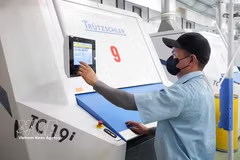
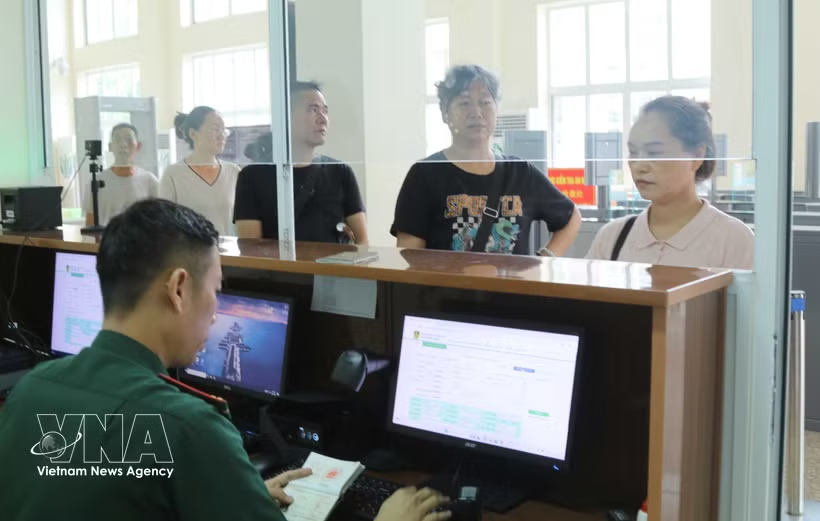
A border guard at the Tan Thanh check point, Lang Son province, enters passenger data for entry and exit. (Photo: VNA)

Hanoi (VNA) – The Immigration Department under the Ministry of Public Security on May 19 held a conference in Hanoi to launch the ministry’s shared software system for temporary residence declarations for foreigners and lodging notifications for Vietnamese citizens.

Colonel Pham Hoang Diep, Deputy Director of the Immigration Department, said the rollout of the shared platform marks an important step toward a more synchronised and modern approach to residence and foreigner management.

The system is expected to facilitate accommodation providers and residents in fulfilling declaration obligations, while improving data connectivity, sharing and utilisation for State management of security and public order, in line with efforts to accelerate the application of science, technology and digital transformation within the public security force.

Under the new system, accommodation establishments will no longer need to use multiple platforms as before. Instead, they can use a single unified software platform to declare temporary residence for foreigners and notify lodging information for Vietnamese citizens. The system will automatically classify and transfer data to relevant units for management and use in accordance with their responsibilities.

khai-bao.png
Vietnamese citizens and foreigners can make temporary residence declarations at https://tbltkbtt.bocongan.gov.vn/ (Screenshot of the site)

According to Diep, the software has been piloted in several localities and has initially delivered positive results, largely meeting operational requirements and facilitating use by grassroots police forces and accommodation providers.

For foreigner temporary residence declarations, the software has been integrated into pilot procedures for foreigner management in the police departments of Ho Chi Minh City and Quang Ninh and Thanh Hoa provinces. Some stages of the workflow have been built on the platform’s data-processing capabilities.

The nationwide rollout of the shared system is therefore expected to serve as an important foundation for local police units to proactively prepare for the official implementation of the foreigner management process in Vietnam once approved by the ministry’s leadership from June 15, 2026.

At the event, representatives from Division 5 under the Immigration Department introduced the Ministry of Public Security’s shared software system and addressed difficulties, recommendations and proposals raised by police units and local authorities regarding its deployment and operation.

The conference also provided guidance on operating and utilising the system, while addressing challenges arising during implementation.

In the coming period, police units and local authorities are expected to continue studying the guidance materials, proactively discuss difficulties and propose solutions to ensure the software is uniformly deployed from May 21 and operates smoothly and effectively ahead of July 1 as scheduled./.
VNA

See more

The copyright crackdown is broadly viewed as an inevitable step in Vietnam’s cultural industry development. (Illustrative photo: VNA)

Healthy digital content market in the making

The sharper crackdown is rapidly redrawing how online entertainment is distributed and consumed, while gradually reshaping public awareness and responsibility toward copyright protection.

A view of Place Ho Chi Minh in Persan, France. (Photo: VNA)

Place preserving memories of President Ho Chi Minh in France

Although there is little publicly available documentation confirming exactly when Place Ho Chi Minh was established, French urban historians suggest that most streets and public spaces named after the Vietnamese leader in France emerged between the 1960s and 1980s, during the height of anti-war movements and solidarity campaigns supporting Vietnam across working-class towns and left-leaning suburbs around Paris.

Vietnamese Ambassador to Bangladesh Nguyen Manh Cuong speaks at the seminar. (Photo: VNA)

President Ho Chi Minh’s thought on national unity remains relevant today

President Ho Chi Minh's ideology of national unity continues to carry profound significance amid growing global challenges, including conflicts, social divisions and economic instability. His message of solidarity, consensus and placing national interests above sectional differences remains a valuable lesson for many developing nations.

Assoc. Prof. Dr. Nguyen Duc Son presents the decision establishing the Vietnamese Language Proficiency Test Council in Japan to a representative of the Vietnam Studies Centre in Japan. (Photo: VNA)

Japan hosts first standardised Vietnamese language proficiency test

As bilateral ties between Vietnam and Japan continue to expand, demand for Vietnamese language learning in Japan has also grown rapidly among OVs, educational institutions, businesses and Japanese people interested in Vietnam. Against this backdrop, the introduction of a standardised proficiency test is expected to provide an official and widely recognised benchmark for Vietnamese language skills.

The “I Love My Fatherland" Journey 2026 kicks off in Nghe An province on May 16. (Photo: VNA)

"I Love My Fatherland” journey features diverse activities

The “I Love My Fatherland” journey will span seven stages across historical and cultural sites and “red addresses” nationwide. There will be a combination of education on traditions, field-based programmes, and digital communications.