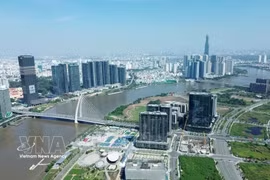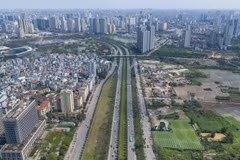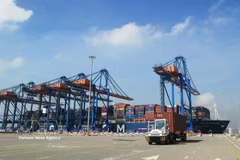
Hanoi (VNA) – Smart city development is expected to become a major driver of Vietnam’s economic growth by improving productivity, expanding development space, and accelerating national digital transformation, while creating new growth poles powered by data, innovation, and modern governance.
Urban areas currently contribute around 70% of Vietnam’s GDP. However, rapid urbanisation has also increased pressure on transport infrastructure, the environment, energy supply, and resident management. Experts warned that if cities continue to develop under traditional models, room for their growth will gradually narrow.
Assoc. Prof. Dr. Tran Dinh Thien, former Director of the Vietnam Institute of Economics, said Vietnam must create new development spaces based on technology and innovation to achieve high growth targets. Urban areas, he noted, are where data, knowledge, and labour productivity are concentrated most strongly.
“Smart urban development is not simply about installing technology. It is about transforming the growth model and operating cities through data and modern governance,” Thien said.
One of the key requirements set out in Politburo Resolution No. 57 on breakthroughs in science – technology development, innovation, and national digital transformation is the standardisation of digital infrastructure and the development of national digital data. This is considered a prerequisite for sustainable smart city development.
This year, the Ministry of Science and Technology will continue promoting standardisation in core areas of the digital economy. A total of 53 new standards are expected to focus on data and data centres, online public services, urban data models, e-transactions, and information security. Notably, standards for smart cities account for a significant share, including those related to data sharing, cybersecurity, and information and communications technology infrastructure.
Experts said standardising data will help avoid fragmented development and weak connectivity among localities.
Dr. Vo Tri Thanh, Director of the Institute for Brand and Competitiveness Strategy, said the greatest advantage of smart cities lies in their ability to connect and utilise data to improve governance efficiency. In the digital economy, data has become a new resource, and cities with better data governance will gain stronger competitive advantages.
Experts observed that while transport infrastructure serves as the “backbone” of traditional cities, data and digital infrastructure function as the “nervous system” of smart ones.
In late 2025, the Ministry of Construction launched the National Smart City Information Portal at smartcities.gov.vn to support urban management, moinitoring, and digital transformation nationwide.
Le Hoang Trung, Deputy Director of the ministry's Urban Development Agency, said the system is expected to become a national data platform connecting and integrating urban data sources and, at the same time, support data-based decision-making and public – private partnerships.
Despite initial achievements, Vietnam’s smart city development still faces challenges, including fragmented data, limited interconnectivity, weak inter-sectoral coordination, and shortages of high-quality human resources.
Assoc. Prof. Dr. Nguyen Vu Phuong, Deputy Director of the Academy of Construction Strategy and Cadres Training, said many localities still rely on traditional administrative management methods while smart cities require data-driven governance capacity.
To address bottlenecks, the Ministry of Construction advised the Government to issue Decree No. 269/2025/ND-CP on smart city development, providing regulations on the standardisation of digital infrastructure, technical infrastructure, and data to ensure uniformity, connectivity, and interoperability among systems.
Experts said the decree provides an important foundation to prevent localities from developing isolated systems that could waste resources and limit future expansion.
In the long term, smart city development is viewed not only as a technological issue but also as a process of restructuring the urban development model. As data becomes the cornerstone of governance and public services are digitised, cities' competitiveness is expected to improve significantly, contributing to Vietnam’s goal of achieving double-digit growth in the digital era./.