Vietnamese shrimp sector seeks distinct path in global race

Nguyen Duy Hoa, Deputy Technical Director of Cargill Vietnam, said Vietnam cannot compete with Ecuador on costs nor match India in scale. Instead, the country should focus on value rather than volume or price competition, prioritising quality improvement, technology adoption and value-added products.

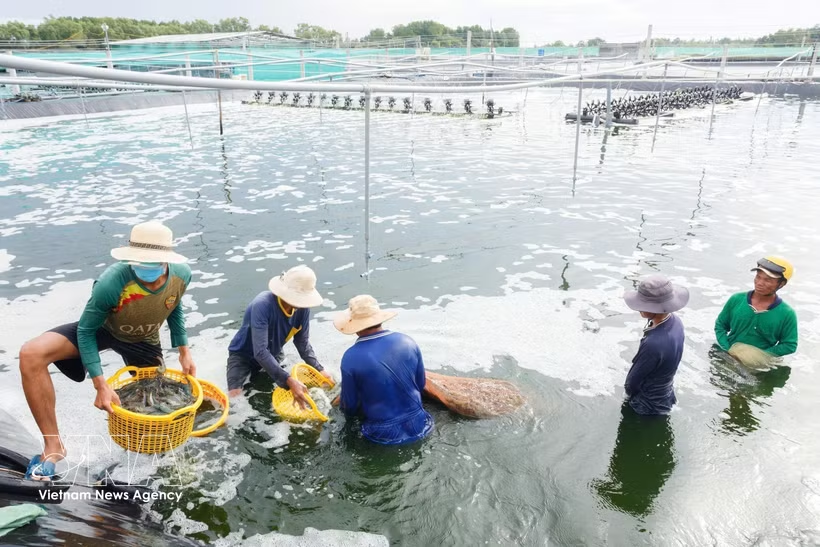
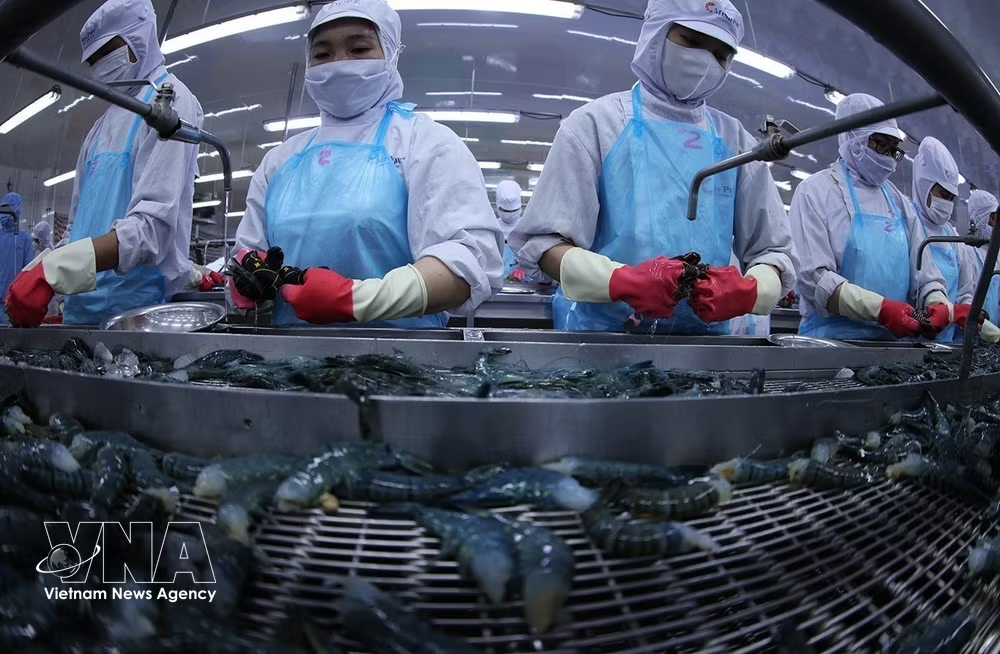
Shrimp harvesting in Ca Mau province (Photo: VNA)

Hanoi (VNA) – Amid intensifying competition from leading producers such as Ecuador and India, the shrimp industry of Vietnam is under growing pressure to reposition its strategy, shifting from price-based competition to higher value, stronger technology application and deeper supply chain integration.

Vietnam is among the world’s largest shrimp suppliers, exporting to more than 100 markets and accounting for over 40% of the country’s seafood export turnover. However, recently, Ecuador has emerged with a clear low-cost advantage, while India maintains leadership in production scale.

Nguyen Duy Hoa, Deputy Technical Director of Cargill Vietnam, said Vietnam cannot compete with Ecuador on costs nor match India in scale. Instead, the country should focus on value rather than volume or price competition, prioritising quality improvement, technology adoption and value-added products.

Feed costs remain one of the industry’s biggest challenges, accounting for 50–60% of production expenses. According to Hoa, feed should no longer be viewed merely as a cost, but as a profit-generation tool. Optimising feed conversion ratios (FCR), increasing the use of domestic raw materials and diversifying nutritional sources, including plant-based ingredients such as soybeans, could help ease cost pressures and improve efficiency.

However, the sector’s challenges extend beyond input costs. Production remains fragmented and weakly linked, while high-density farming complicates disease control. Product quality is uneven, and the value chain spanning broodstock, feed, farming, processing and distribution remains loosely connected. These structural weaknesses continue to limit the industry’s sustainable competitiveness.
vnanet-tom2.jpg
Shrimp processing for export at Minh Phu Seafood Group's factory in Ly Van Lam ward of Ca Mau province. (Photo: VNA)

Experts therefore called for a comprehensive strategy built around clear pillars. Improving shrimp genetics to develop disease-free, disease-resistant breeds is considered a top priority. “Survival rate matters more than productivity” has increasingly become a guiding principle, reflecting a shift from volume-driven growth toward efficiency and risk reduction.

At the same time, technology adoption is becoming indispensable. Models such as Biofloc and Eco-RAS systems, alongside the integration of IoT and artificial intelligence, are helping producers better manage farming conditions, reduce fluctuations and improve survival rates. Beyond technical benefits, these technologies also strengthen production governance.

Trinh Trung Phi, Deputy General Director for Technology and Commercial Shrimp at Viet-Uc Group, said shrimp farming is no longer simply about pond management, but about managing risks across the entire value chain. Broodstock quality, hatcheries, biosecurity, environmental control and early detection systems all need to be managed in an integrated manner.

The industry’s goal, he noted, is no longer just to produce shrimp that survive and grow, but shrimp that are healthy, uniform, cost-efficient, traceable and capable of meeting increasingly strict international standards. Achieving this will require coordinated changes from farmers, businesses and regulators alike.

Experts also advised producers to pay greater attention to processing and branding, which are also seen as crucial to increasing value. Market strategies also need clearer segmentation, they added.

The Vietnam Association of Seafood Exporters and Producers (VASEP) said that as Ecuador and India continue expanding low-cost production, Vietnam’s shrimp industry must rely on quality, traceability, deep processing and premium positioning. In 2026, the sector’s resilience will depend on its ability to maintain stable markets, manage risks in the US market and move further up the global value chain.

Nguyen Van Long, Director of the Department of Science and Technology under the Ministry of Agriculture and Environment, said investment in breeding research, input material self-sufficiency and environmental treatment solutions would form the foundation for sustainable growth.

He added that many countries are rapidly applying AI in aquaculture to monitor growth, detect risks early and optimise production, a direction Vietnam needs to accelerate as part of its digital transformation.

Alongside farming improvements, harvesting and processing technologies also need upgrading to enhance added value. When shrimp products evolve from raw materials into branded goods with standards, traceability and compelling stories, Vietnamese shrimp will not only maintain market share but also strengthen its position on the global seafood map./.

VNA

See more

Wind turbine No. 3 at the V1-3 site of the Duyen Hai Wind Power Plant in Truong Long Hoa ward, Vinh Long province.(Photo: VNA)

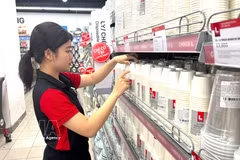
Retail market seen driving double-digit growth

Domestic consumption is being regarded as one of the key drivers for sustaining economic growth. Following the Government’s Resolution No. 88/NQ-CP on promoting the domestic market and stimulating consumption, many retailers have accelerated the expansion of distribution systems, invested in technology and improved supply chains.

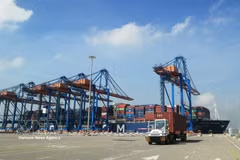
Cargo containers are handled at Gemalink International Port, Ho Chi Minh City. (Illustrative photo: VNA)

Government delegation for international economic, trade negotiations established

The delegation is tasked with assisting the Prime Minister in directing ministries, sectors and localities in the negotiation, signing, coordination of ratification and approval, as well as implementation of international treaties and agreements on economic and trade matters involving the Vietnamese State and Government.

Lotte Mart Vietnam is currently distributing around 900 private-label products manufactured in Vietnam under the retailer’s strict quality control. (Photo: VNA)

RoK steps up trade cooperation with Vietnam, Malaysia

The Korean business delegation's trip aims to provide Korean firms with information on import – export trends across the ASEAN region and developments in local markets, while also offering opportunities to explore the latest industry trends and technologies.

An overview of the Vietnam-China Green Industry Cooperation and Exchange Programme held in Beijing.(Photo: VNA)

Vietnam, China boost cooperation in green industry development

The Vietnamese Embassy in China, in coordination with the International Cooperation Centre under China’s National Development and Reform Commission (NDRC), on May 18 organised the Vietnam–China Green Industry Cooperation and Exchange Programme in Beijing to strengthen policy exchanges, share experience, and promote substantive cooperation in green industry amid climate change and growing global environmental challenges.

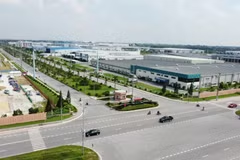
The infrastructure of Thang Long 3 Industrial Park in Phu Tho province is comprehensive and modern, creating favourable conditions for businesses and investors. (Photo: VNA)

Strong economic conglomerates drive domestic economic growth

In manufacturing, THACO has built one of Southeast Asia’s largest automobile and mechanical engineering ecosystems in Quang Nam province, while VinFast has become Vietnam’s first electric vehicle producer, establishing a major factory in Hai Phong, listing on Nasdaq and expanding into North America, Europe and Southeast Asia.

Producing garments for export to the EU market at TDT Thai Nguyen Garment Company. (Photo: VNA)

Vietnam’s textile industry draws high-tech FDI amid green, smart shift

With export turnover rising steadily in recent years and a target of 50 billion USD by 2026, Vietnam remains among the world’s top three textile exporters. Beyond its traditional appeal as a low-cost manufacturing base, the country is now positioning itself as a strategic hub for high-value and technology-driven investment.

An FDI enterprise invests in factory facilities at Chau Duc Industrial Park, a project spanning approximately 2,290 ha. (Photo: VNA)

Ho Chi Minh City targets next-generation, high-value FDI

The southern economic hub attracted nearly 3.3 billion USD in FDI during the first four months of 2026, marking a sharp year-on-year increase of 227.1%. The total included 539 newly licensed projects with registered capital exceeding 791.8 million USD and 58 existing projects adding 259.3 million USD in supplementary investment.

The VinFast electric vehicle charging station at the CT1 apartment complex of 103 Hospital in Hanoi. (Photo: VNA)

Vietnam accelerates drive to master EV technologies

By the end of 2025, Vietnam had established 28 standards and technical regulations related to charging stations, charging equipment and batteries. The legal framework is expected to be fully completed in the third quarter of 2026.

Duyen Hai Wind Power Plant in Truong Long Hoa ward, Vinh Long province. (Photo: VNA)

Energy sector seen as key pillar for Vietnam’s green, double-digit growth ambitions

Chairman of the Vietnam National Industry-Energy Group (Petrovietnam) Le Ngoc Son said Vietnam’s energy demand will continue rising sharply, creating enormous pressure on power generation investment. To sustain GDP growth of around 10%, electricity demand is expected to increase by 12-15% annually, requiring an additional 7,000-8,000 MW of new capacity each year.

A view of the Lien Chieu Container Port construction project in Da Nang city (Photo: VNA)

Logistics set to drive Vietnam’s rise in global supply chains

Amid sweeping restructuring in global trade driven by digitalisation, green transition and geopolitical shifts, logistics is no longer a back-end function. It is increasingly a decisive factor in economic performance, especially as Vietnam deepens integration into international supply chains. The challenge now extends beyond faster delivery to building a modern and interconnected logistics ecosystem capable of organising supply chains at a regional scale.

Coupang.com, one of the Republic of Korea's leading online retail corporations, has actively cooperated with the Vietnamese Embassy in handling issues related to products and items with wrong information of Vietnam. (Screenshot of the site)

Coordinated efforts help safeguard healthy online marketplaces

As the digital environment continues to evolve rapidly, stronger coordination among authorities, platform operators and user communities is becoming increasingly important to build a healthy cyberspace that respects cultural identity while helping reinforce friendship and mutual understanding among people worldwide.

Vietnam will host the 21st Asian-Australasian Association of Animal Production Societies (AAAP) Animal Science Congress (AAAP 21) from October 28 - 31 in Hanoi. (Photo: aaap2026.org)

Vietnam to host 21st AAAP animal science congress

According to the Animal Husbandry Association of Vietnam (AHAV), the event is expected to gather between 1,300 - 1,500 delegates, including around 500 leading international scientists, experts and businesses in the livestock sector.