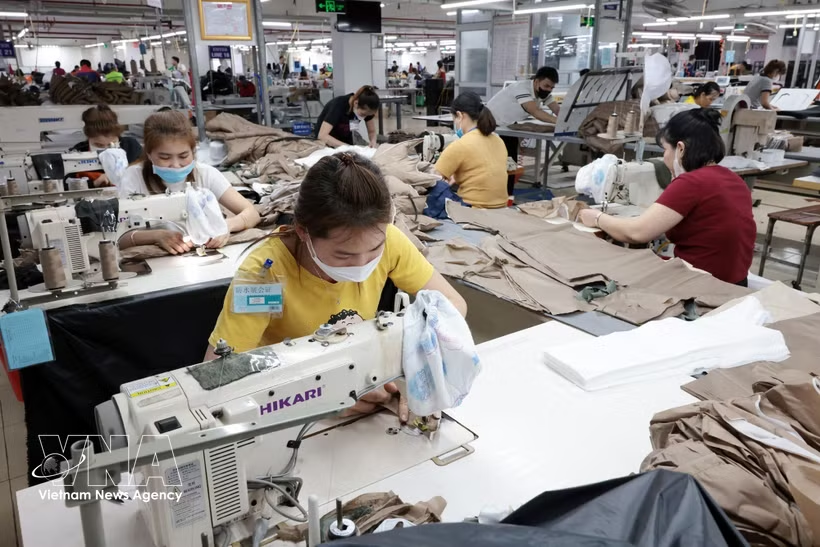
Hanoi (VNA) - Vietnam’s textile and garment industry is increasingly drawing hi-tech foreign direct investment (FDI), as global producers shift toward greener and smarter production to capitalise on the country’s extensive network of new-generation free trade agreements (FTAs).
With export turnover rising steadily in recent years and a target of 50 billion USD by 2026, Vietnam remains among the world’s top three textile exporters. Beyond its traditional appeal as a low-cost manufacturing base, the country is now positioning itself as a strategic hub for high-value and technology-driven investment.
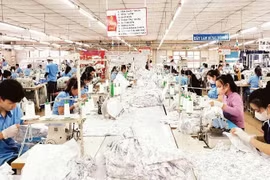
FDI enterprises continue to serve as a key growth engine, accounting for roughly 60–62% of the textile sector’s total export value. Major investors from the Republic of Korea (RoK), Taiwan (China) and Japan are not only bringing capital but also accelerating a shift toward green production and smart technologies.
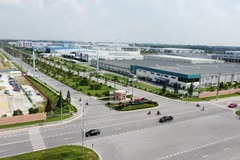
This trend is evident in the expansion of large-scale supporting industrial and manufacturing firms. Phon Thinh – Tae Gwang Co., Ltd., a Vietnam – RoK joint venture and a leading supplier of garment equipment, has established an integrated headquarters in Hanoi, combining logistics, materials distribution and a high-tech technical centre to better connect with global partners.

Its Chairman Yeo Gwang Tae said Vietnam’s textile sector is entering a period of strong growth, prompting the company to expand its nationwide network, with branches in key industrial hubs from Ninh Binh and Thanh Hoa to Ho Chi Minh City and Can Tho.
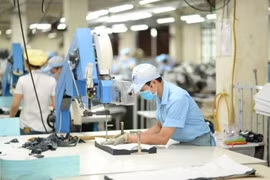
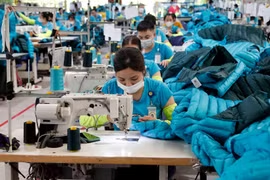
Park Jung Soon, General Director of Youngone Nam Dinh Co., Ltd – a subsidiary of Youngone Group - one of the RoK’s largest textile and garment conglomerates, said the company has deployed advanced sewing technologies across its factories both in Vietnam and abroad to ensure consistent product quality for global markets.
Despite strong prospects, insiders warn of mounting challenges for domestic businesses.
Vu Duc Giang, Chairman of the Vietnam Textile and Apparel Association, identified three major pressures - global geopolitical uncertainties and evolving trade policies in importing countries, which create risks for export activities; the need for domestic firms to rapidly upgrade technology, governance and market access capabilities in response to fast-changing global demands; and the sharp rise in production costs, partly driven by prolonged tensions in the Middle East that have pushed up input prices.
In this context, the industry’s core advantage is no longer defined by output volume alone, but by the efficiency, flexibility and intelligence of production systems. Enterprises are therefore being urged to accelerate the adoption of advanced technologies, including automation, robotics and artificial intelligence, to remain competitive.
Investment in modern factory infrastructure meeting international standards is becoming increasingly urgent. New-generation sewing equipment, integrated with digital control systems and Internet of Things (IoT) connectivity, is helping manufacturers improve precision, reduce defects and boost productivity.
As global fashion supply chains rapidly transition toward full automation, technology solution providers are playing an increasingly pivotal role in driving digital transformation and upgrading production capabilities of garment factories.
According to Giang, Vietnamese textile firms have made breakthrough efforts in recent years to adapt to global shifts, enabling the industry to maintain steady growth and retain its position among the world’s top exporters. However, to enhance competitiveness in the future, Giang said the sector must deepen international cooperation, expand investment in automation and commit to greener production, paving the way for developing a more sustainable and environmentally friendly fashion industry in the future./.