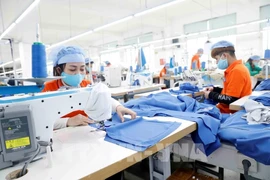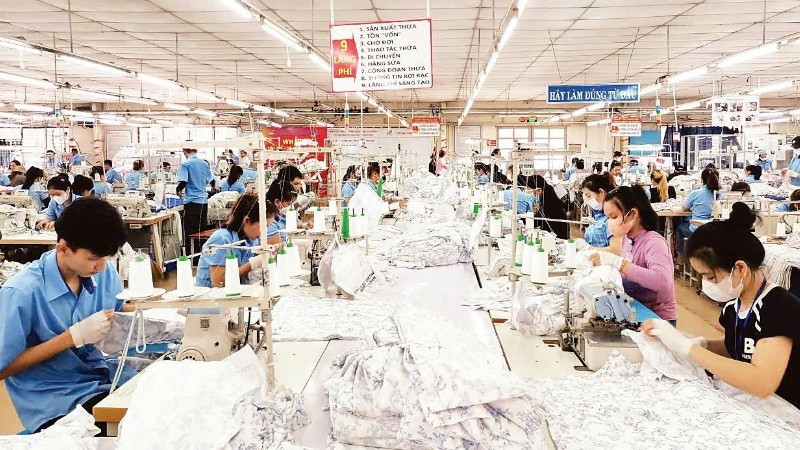
Hanoi (VNA) - The flexibility of the business community has enabled the textile and garment sector to achieve its targets and strengthen its position in the global supply chain, with products exported to 138 countries and territories worldwide.
By diversifying markets, products and customers, the sector has mitigated risks and responded proactively to market fluctuations, despite numerous challenges such as disrupted supply chains, rising shipping costs, and rapidly changing purchasing policies in many markets.
Confronting mounting pressure
Nguyen Ngoc Binh, General Director of Hoa Tho Garment JS Corporation, reported that while the textile and garment sector continued its recovery in 2025 amid weak demand and volatile markets influenced by shifting trade policies and US trade defence measures, the company raked in 5.53 trillion VND (over 210.3 million USD) in revenue - 110% of its annual target, with exports reaching 268 million USD and consolidated profits exceeding 400 billion VND, driven by the workforce’s proactive and flexible approach.
In the coming period, the firm plans to implement key measures, including restructuring customers and core product lines for each garment factory; developing high-value-added yarn products; optimising returns from factory upgrade projects; focusing on workforce development by raising employee incomes; and strengthening financial management, risk control, and working capital efficiency, he said.
Vu Ngoc Tuan, General Director of Nam Dinh Textile JS Corporation, stated that amid a mix of opportunities and challenges, the company achieved its targets in 2025, with revenue reaching 1.23 trillion VND, equivalent to 112% of the set plan for the year, pre-tax profit totaling nearly 2.6 billion VND.
In 2026, the company aims for 1.2 trillion in revenue and 12.2 billion VND in profit, Tuan said, stressing that the firm will focus on improving management and operations, reviewing and developing competitive income, salary and welfare mechanisms linked to productivity, quality and work efficiency to retain staff while attracting new talent, especially skilled and highly qualified workers.
The Vietnam National Textile and Garment Group (Vinatex) had a successful year, recording a total revenue of 18.89 trillion VND and a profit of 1.35 trillion VND, the second-highest in its 30-year history after 2021, according to Vinatex General Director Cao Huu Hieu.
In 2026, Vinatex sets to earn 20 trillion VND in revenue and 1.2 – 1.5 trilllion in profit, Hieu said.
Expanding into distinctive offerings
According to Vu Duc Giang, Chairman of Vietnam Textile and Apparel Association (VITAS), 2025 marks a remarkable recovery for the sector, with export turnover reaching 46 billion USD, up 5.6% from 2024, and a trade surplus of 21 billion USD, reaffirming its role as a pillar of the national trade balance.
The domestic value-added ratio of around 52% highlighted significant progress in securing local raw materials. Despite these achievements, the industry faces challenges including disrupted global supply chains, rising shipping costs, increasingly stringent requirements of partners and customer, and rapidly changing purchasing policies in major markets.
To achieve the 2026 export target of around 48–49 billion USD, and ultimately reach 64.5 billion USD by 2030, the sector is focusing on three key pillars - further diversifying markets, products and customers, while boosting investment and strengthening supply chain linkages to quickly address supply shortfalls.
Attention will be also paid to developing human resources in connection with promoting science and technology, and fostering the ambition to bring Vietnamese brands to the global market.
Vietnam has already started producing several differentiated products and is finalising the last stages to bring them to the market soon. This new direction is expected to create breakthroughs and deliver high added value in the near future, Giang said.
Accoding to Hieu, member companies of Vinatex have orders secured until February 2026, with many having orders through the first quarter. However, challenges and risks remain, so businesses must proactively adapt to market fluctuations, strengthen management, and expand markets and customer bases to ensure employment for workers and improve business efficiency./.