Fight against counterfeit goods fostered amid rising digital-era fraud

Dr. Bui Van Quyen, Director of the Anti-Commercial Fraud and Counterfeiting Institute, warned that counterfeit goods have become a global challenge, exacerbated by the rise of online platforms and digital technologies. While these innovations drive economic growth, they also create fertile ground for fraudulent activities.
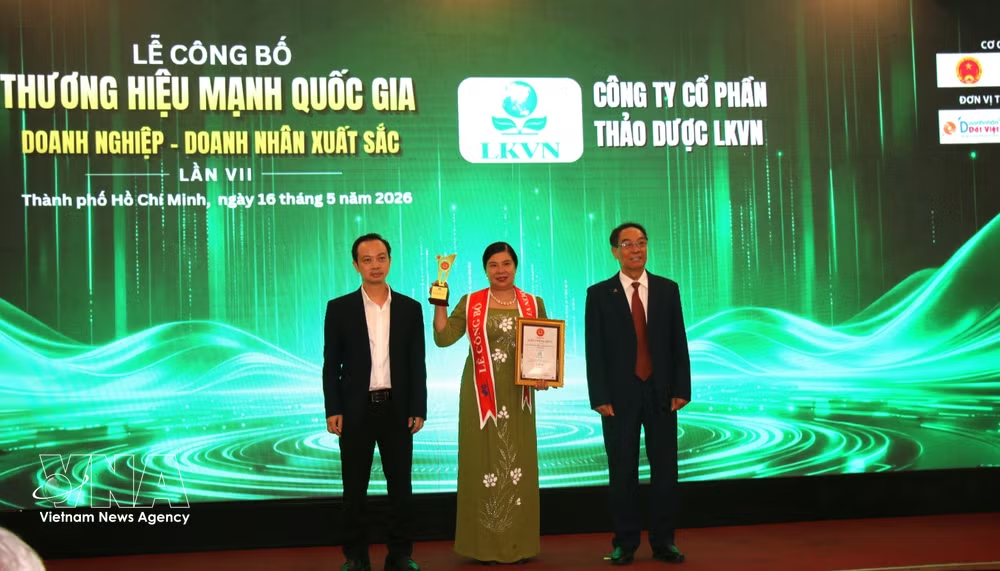
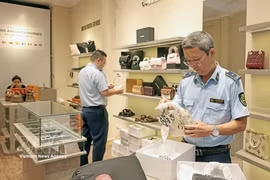
Yen Huong Xua company introduces solutions to combat counterfeit and imitation goods (Photo: VNA)

Ho Chi Minh City (VNA) - As e-commerce, the digital economy and artificial intelligence (AI) develop rapidly, increasingly sophisticated trade fraud and intellectual property (IP) violations are posing serious risks to the business environment, consumer health and the credibility of legitimate firms, prompting calls for stronger, more coordinated countermeasures.

The issue was highlighted at a training programme on combating trade fraud, counterfeit goods and IP infringement held in Ho Chi Minh City on May 16.

Dr. Bui Van Quyen, Director of the Anti-Commercial Fraud and Counterfeiting Institute, warned that counterfeit goods have become a global challenge, exacerbated by the rise of online platforms and digital technologies. While these innovations drive economic growth, they also create fertile ground for fraudulent activities.

vnanet-dn2.jpg
Enterprises with strong national brands announced on May 16 in Ho Chi Minh City (Photo: VNA).

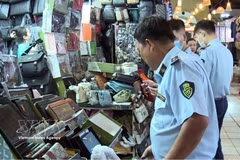
According to Lieutenant Colonel Nguyen Duy Khoa, from the Ho Chi Minh City Department of Public Security, offenders are employing increasingly complex tactics. A common method is to use legally registered companies as cover for producing and distributing fake goods. These entities often have full business licences, invoices and legal documentation, enabling them to disguise illicit operations and circulate counterfeit products in the market.

In many cases, production is organised in closed, decentralised chains, with different stages spread across multiple localities to evade inspection. Goods may be manufactured in one region, transported elsewhere, and then redistributed back to major cities, making tracing and enforcement more difficult.

The rapid growth of e-commerce and social media has further complicated enforcement. Fraudulent sellers are shifting entirely online, using platforms such as Facebook and TikTok Shop without registered warehouses or fixed business addresses, hindering detection and investigation.

A wide range of products - from infant milk and dietary supplements to traditional medicines and treatments for chronic diseases - are aggressively marketed online with exaggerated claims, increasing the risk of consumer deception. Authorities have also uncovered cases of food fraud, including the substitution of lower-quality or unsafe ingredients, which could pose long-term health risks.

Businesses, particularly those producing high-value goods, are increasingly vulnerable to counterfeiting. Many have invested in production standards, branding and IP protection, but say the growing sophistication of fake products remains a major challenge, requiring more advanced technological solutions.

Experts emphasised that in the age of AI, combating counterfeit goods requires not only technology adoption but also its responsible and effective use. Stronger collaboration among enterprises, improved governance capacity and closer coordination with authorities are seen as essential.

Delegates also stressed that tackling counterfeit goods and IP violations demands a whole-of-society approach. Greater coordination among police, market surveillance, customs and IP agencies is needed, alongside stricter management of online business activities and tougher penalties for large-scale counterfeit networks.

At the same time, consumers should be more vigilant against misleading online advertising, prioritise products with clear origins and avoid supporting counterfeit and substandard goods, they said./.
VNA

See more

The fuel storage tank area of the Nghi Son Refinery and Petrochemical Plant is located in the Nghi Son Economic Zone in Nghi Son ward, Thanh Hoa province. (Photo: VNA)

Nghi Son refinery receives over 950,000 barrels of Congo crude oil

Diversifying crude oil supply sources is considered crucial for Nghi Son Refinery and Petrochemical LLC (NSRP) in ensuring stable feedstock supplies and safeguarding domestic fuel supply, particularly as traditional crude imports from Kuwait have been affected by tensions in the Middle East.

Production of electronic components at Star Engineers Vietnam Co., Ltd. in Binh Xuyen I Industrial Park, Phu Tho province (Photo: VNA)

Vietnam looks to expand fiscal space to support double-digit growth

Experts emphasise that fiscal policy should move beyond a supportive role to actively lead growth. Continued and selectively expanded tax and fee reductions could directly ease cost pressures on businesses, enabling them to sustain operations and expand investment.

Ngo Quang Hung, representative of the Vietnam Trade Office in Malaysia, introduces Vietnamese products at the Melaka International Halal Fair, held from May 16-19, 2026. (Photo: VNA)

Vietnam, Malaysia promote smart business connectivity

Malaysia is paying close attention to Vietnam’s Doi Moi (Renewal) reforms, particularly in land policies, rice production technologies and seafood industry development, as both sides seek to expand practical cooperation.

The exchange of greenhouse gas emission quotas and carbon credits is conducted on the domestic carbon credit exchange through the carbon trading system, which is interconnected with the national registration system. (Photo congly.vn)

Ministry establishes monitoring framework for carbon market

Under a new circular, the exchange of greenhouse gas emission quotas and carbon credits is conducted on the domestic carbon credit exchange through the carbon trading system, which is interconnected with the national registration system.

Le Son Phong, Deputy Director of the Da Nang Department of Science and Technology, speaks at the press conference announcing the Da Nang Venture and Angel Summit 2026. (Photo: VNA)

Da Nang to host international venture capital forum later this month

Le Son Phong, Deputy Director of the Da Nang Department of Science and Technology, said DAVAS 2026 is not merely an investment-matching event for startups, but also demonstrates the city’s commitment to promoting innovation, developing the knowledge-based economy and creating a favourable environment for technology enterprises and startups.

Visitors explore southern Vietnam's products (Photo: vNA)

Vietnam, Cambodia boost supply chain connectivity

Total two-way trade neared 10.1 billion USD in 2024, up 17.5% year-on-year and jumping to more than 11 billion USD in 2025. Vietnam’s key exports to Cambodia include apparel, iron and steel, petroleum, machinery and equipment, chemicals, and processed food. Its main imports are cashew nuts, rubber, farm produce, and industrial raw materials.

Cao Thanh Dinh, founder and CEO of ANPz Co., Ltd (All Nippon Partners) in Japan (Photo: VNA)

Resolution 68 boosts investor confidence in Vietnam’s long-term outlook

Cao Thanh Dinh, Founder and CEO of ANPz Co., Ltd (All Nippon Partners) in Japan, said that after one year of implementation, Resolution No. 68-NQ/TW of the Politburo on private sector development has sent a positive signal to investors by affirming the private sector as a key driver of sustainable and long-term development.

To promote the local lychee brand, expand consumption markets and enhance the fruit's value, Bac Ninh province is organising various trade promotion activities and experiential tourism programmes during the 2026 lychee season. (Photo: VNA)

Bac Ninh promotes lychee tourism with 36 model orchards

According to the Bac Ninh Centre for Culture and Tourism Promotion, the orchards must comply with VietGAP, GlobalGAP or organic production standards while offering suitable conditions for experiential tourism activities. They are also required to connect with nearby tourist attractions, craft villages and historical sites to form integrated tour routes.

Ha Long-Mong Cai Expressway (Illustrative photo: VNA)

Quang Ninh takes lead in public investment disbursement

As of May 13, the northern province had disbursed more than 5.64 trillion VND (213.9 million USD) in public investment capital, fulfilling 24.2% of its annual target and 54% of its disbursement target of 10.56 trillion VND for the year's first half.