Sustained reforms key to maintaining Vietnam’s growth momentum: WB

Despite mounting short-term external challenges, Vietnam’s medium-term economic outlook remains highly positive, with the country expected to continue as one of the region’s growth bright spots.

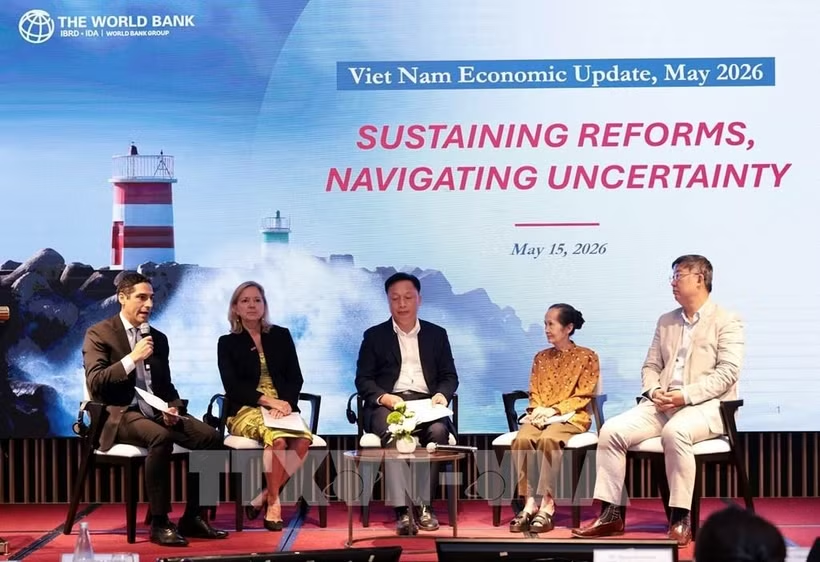
Speakers at the press conference (Photo: VNA)

Hanoi (VNA) – Despite mounting short-term external challenges, Vietnam’s medium-term economic outlook remains highly positive, with the country expected to continue as one of the region’s growth bright spots, according to the World Bank (WB)’s latest Vietnam Economic Update.

Speaking at a press conference to release the report on May 15, WB Division Director for Vietnam, Cambodia and Laos Mariam J. Sherman said Vietnam entered 2026 from a position of strength, outperforming other economies in the Association of Southeast Asian Nations (ASEAN).

Despite global trade headwinds, Vietnam’s gross domestic product (GDP) expanded by 8% in 2025, the highest growth rate in ASEAN, driven by strong export performance, a resilient services sector, and rising foreign direct investment (FDI) inflows and public investment. The momentum has also been supported by an ambitious reform agenda aimed at restructuring the state apparatus, described as the most far-reaching since the Doi moi (Renewal) period.

According to Tamina Khan, WB Lead Economist for Vietnam, Cambodia and Laos, Vietnam is also benefiting from the global artificial intelligence (AI) investment boom, with exports of AI-related products now accounting for nearly 30% of GDP.

However, the external environment has become more challenging in 2026. Global trade uncertainty persists, while US tariffs remain higher than pre-2025 levels, putting pressure on highly open economies such as Vietnam. At the same time, conflict in the Middle East has triggered severe oil supply disruptions.

The WB said these pressures are exposing four structural weaknesses in Vietnam’s growth model.

First, the gap between domestic enterprises and FDI firms is widening. Since the announcement of US reciprocal tariffs, exports from the FDI sector have surged by 42%, while exports from domestic firms have contracted due to a weaker capacity to absorb tariff shocks.

Second, despite strong trade growth, Vietnam’s foreign exchange accumulation remains limited, resulting in thinner reserves and prolonged exchange rate pressure.

Third, Vietnam’s corporate leverage ratio is among the highest in the region, while liquidity strains persist in the banking sector. Khan noted that Vietnam’s credit-to-GDP ratio reached 145% in 2025, the highest in ASEAN, while Vietnamese banks maintain thinner capital buffers than regional peers.

Fourth, concerns remain over the efficiency of public investment. With a planned investment package of 320 billion USD for 2026–2030, the challenge for Vietnam is not how much to spend, but how to spend effectively to generate productivity gains.

Against this backdrop, the WB projected Vietnam’s economic growth to moderate to 6.8% in 2026 before recovering in 2027–2028 as oil supply shocks ease and domestic growth drivers strengthen. Average inflation in 2026 is forecast at 4.2%, assuming second-round inflationary impacts remain under control.

Despite heightened short-term risks, Khan stressed that Vietnam’s medium-term outlook remains positive. She said effective implementation of reforms would help the country overcome external challenges and maintain strong growth momentum.

The WB recommended that Vietnam ensure rigorous appraisal and effective implementation of its 320-billion-USD public investment portfolio, diversify long-term financing sources beyond the banking system, and improve the quality of FDI by strengthening linkages with domestic firms and promoting knowledge transfer.

Sherman noted that Vietnam is pursuing some transformative reforms, but stressed that their full impact would depend on effective implementation, making policy execution and commitment to the reform agenda crucial at this stage./.
VNA

See more

Visitors explore southern Vietnam's products (Photo: vNA)

Vietnam, Cambodia boost supply chain connectivity

Total two-way trade neared 10.1 billion USD in 2024, up 17.5% year-on-year and jumping to more than 11 billion USD in 2025. Vietnam’s key exports to Cambodia include apparel, iron and steel, petroleum, machinery and equipment, chemicals, and processed food. Its main imports are cashew nuts, rubber, farm produce, and industrial raw materials.

Cao Thanh Dinh, founder and CEO of ANPz Co., Ltd (All Nippon Partners) in Japan (Photo: VNA)

Resolution 68 boosts investor confidence in Vietnam’s long-term outlook

Cao Thanh Dinh, Founder and CEO of ANPz Co., Ltd (All Nippon Partners) in Japan, said that after one year of implementation, Resolution No. 68-NQ/TW of the Politburo on private sector development has sent a positive signal to investors by affirming the private sector as a key driver of sustainable and long-term development.

To promote the local lychee brand, expand consumption markets and enhance the fruit's value, Bac Ninh province is organising various trade promotion activities and experiential tourism programmes during the 2026 lychee season. (Photo: VNA)

Bac Ninh promotes lychee tourism with 36 model orchards

According to the Bac Ninh Centre for Culture and Tourism Promotion, the orchards must comply with VietGAP, GlobalGAP or organic production standards while offering suitable conditions for experiential tourism activities. They are also required to connect with nearby tourist attractions, craft villages and historical sites to form integrated tour routes.

Ha Long-Mong Cai Expressway (Illustrative photo: VNA)

Quang Ninh takes lead in public investment disbursement

As of May 13, the northern province had disbursed more than 5.64 trillion VND (213.9 million USD) in public investment capital, fulfilling 24.2% of its annual target and 54% of its disbursement target of 10.56 trillion VND for the year's first half.

Can Tho, Belarus eye trade, investment opportunities

Can Tho, Belarus eye trade, investment opportunities

Belarusian Consul General in Ho Chi Minh City Alexander Sidoruk said his working visit to Can Tho city exposes ample untapped economic potential. The Belarus side brings strengths in exporting fertilisers, crop protection chemicals, agricultural equipment, and high-tech products, and is interested in importing Vietnamese rice, coffee, rubber, seafood, and dairy products.

Retail fuel prices are simultaneously reduced from 15:00 on May 14. (Photo: VNA)

Retail fuel prices cut from May 14 afternoon

Retail fuel prices were simultaneously reduced from 15:00 on May 14 following the latest adjustment by the Ministry of Industry and Trade (MoIT) and and the Ministry of Finance, with E5RON92 biofuel recording the sharpest decline.

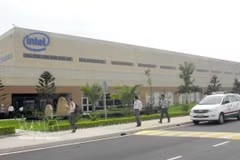
A chip assembly and testing plant of Intel at the Saigon Hi-Tech Park in Ho Chi Minh City (Photo: VNA)

Intel deepens engagement in Vietnam’s semiconductor industry

According to the Saigon Hi-Tech Park (SHTP) management board, Intel has relocated part of its production line from Costa Rica to SHTP as part of its global manufacturing restructuring strategy aimed at improving efficiency and competitiveness.

A customer purchase E10 biofuel petrol at a PVOIL filling station on Thai Thinh street in Hanoi. (Photo: VNA)

Biofuel ready for nationwide rollout

For biofuels, particularly E10, to develop successfully, stronger and more coordinated policies are needed, especially pricing mechanisms capable of creating a sufficiently attractive gap between E10 and mineral-based petrol, an expert has said.