Vietnam’s real estate sector faces pressure to meet international operating standards

As Vietnam continues to strengthen its position as one of the leading growth hubs in the Asia-Pacific region, the adoption of integrated management solutions and operational standardisation will play an increasingly important role in improving the adaptability and global competitiveness of the country’s real estate market.

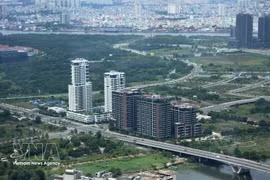
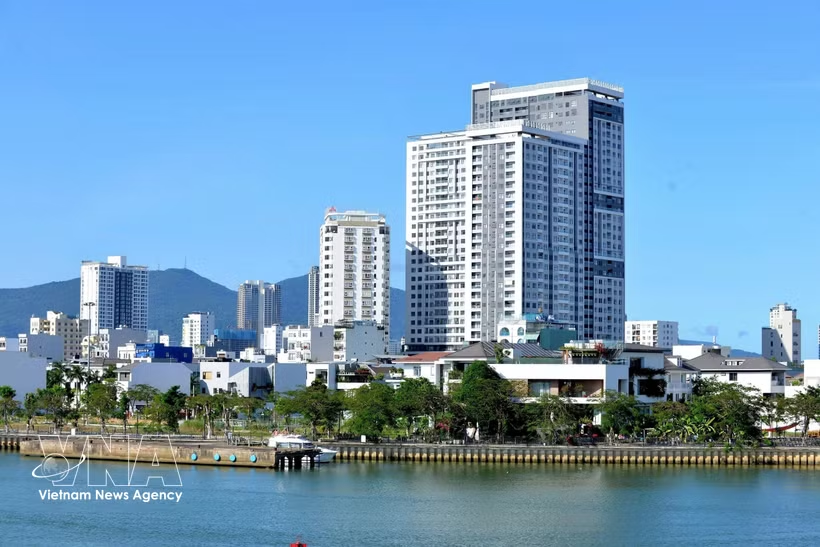
Apartment buildings in the central city of Da Nang (Photo: VNA)

Ho Chi Minh City (VNA) – Vietnam’s inclusion among the top 20 growth hubs in the Asia-Pacific (APAC) region is expected to accelerate the standardisation of the country’s real estate operations in line with increasingly stringent international requirements.

Against this backdrop, Integrated Facilities Management (IFM) is emerging as a strategic solution to help reduce carbon emissions, optimise operating costs and improve workplace experiences for tenants.

According to the latest assessment by Savills World Research on the world’s fastest-growing and most sustainable economies, Vietnam has officially entered the top 20 growth hubs in APAC.

The report evaluates the economic prospects of 245 cities through 2035 based on key indicators including GDP growth, personal wealth accumulation, demographic dependency ratios and migration flows.

Vietnam’s strong performance reflects a combination of high-quality foreign direct investment inflows, sustainable infrastructure development and demographic advantages. In the regional rankings, Ho Chi Minh City was identified as the second fastest-growing city, while Hanoi ranked fifth, supported by strong infrastructure investment strategies and the rapid expansion of the middle class.

The results reinforce Vietnam’s rising competitiveness and highlight the long-term growth prospects of various real estate segments.

Experts from Savills Vietnam said the country’s inclusion among APAC’s fastest-growing hubs further strengthens its attractiveness to international businesses, encouraging regional and global tenants to expand their office footprints and business operations in Vietnam.

However, alongside expansion opportunities comes greater operational complexity. As tenants manage increasingly large and geographically dispersed property portfolios, demands related to environmental, social and governance (ESG) compliance, cost transparency, service consistency and reliable operational data are becoming more pressing.

As a result, operational efficiency is emerging as a core priority, not only to support growth but also to ensure offices meet international standards in a rapidly developing market.

The IFM model consolidates all operational management activities into a unified system, with a single partner taking responsibility for overall performance, coordinating vendors from end to end and delivering transparent reporting across multiple locations. This allows office tenants to gain better visibility, stronger control and greater confidence when scaling up operations.

According to National Business Development Director for Integrated Facilities Management Services at Savills Vietnam Luca Vadala, operational management should now be viewed as a strategic investment rather than merely a technical support function.

For fast-growing markets like Vietnam, the challenge for tenants is no longer simply finding office space, but ensuring that workplaces can operate at the speed and standards required by business growth, Vadala said.

He added that as office portfolios expand, operational capability becomes a key differentiator. Integrated models such as IFM enable businesses to move away from reactive management at individual sites toward a more consistent, transparent and scalable approach across their entire system.

Industry experts believe that as Vietnam continues to strengthen its position as one of the leading growth hubs in the Asia-Pacific region, the adoption of integrated management solutions and operational standardisation will play an increasingly important role in improving the adaptability and global competitiveness of the country’s real estate market./.

VNA
See more

The exchange of greenhouse gas emission quotas and carbon credits is conducted on the domestic carbon credit exchange through the carbon trading system, which is interconnected with the national registration system. (Photo congly.vn)

Ministry establishes monitoring framework for carbon market

Under a new circular, the exchange of greenhouse gas emission quotas and carbon credits is conducted on the domestic carbon credit exchange through the carbon trading system, which is interconnected with the national registration system.

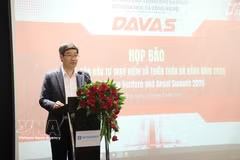
Le Son Phong, Deputy Director of the Da Nang Department of Science and Technology, speaks at the press conference announcing the Da Nang Venture and Angel Summit 2026. (Photo: VNA)

Da Nang to host international venture capital forum later this month

Le Son Phong, Deputy Director of the Da Nang Department of Science and Technology, said DAVAS 2026 is not merely an investment-matching event for startups, but also demonstrates the city’s commitment to promoting innovation, developing the knowledge-based economy and creating a favourable environment for technology enterprises and startups.

Visitors explore southern Vietnam's products (Photo: vNA)

Vietnam, Cambodia boost supply chain connectivity

Total two-way trade neared 10.1 billion USD in 2024, up 17.5% year-on-year and jumping to more than 11 billion USD in 2025. Vietnam’s key exports to Cambodia include apparel, iron and steel, petroleum, machinery and equipment, chemicals, and processed food. Its main imports are cashew nuts, rubber, farm produce, and industrial raw materials.

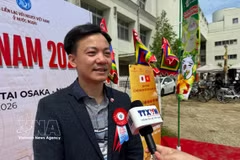
Cao Thanh Dinh, founder and CEO of ANPz Co., Ltd (All Nippon Partners) in Japan (Photo: VNA)

Resolution 68 boosts investor confidence in Vietnam’s long-term outlook

Cao Thanh Dinh, Founder and CEO of ANPz Co., Ltd (All Nippon Partners) in Japan, said that after one year of implementation, Resolution No. 68-NQ/TW of the Politburo on private sector development has sent a positive signal to investors by affirming the private sector as a key driver of sustainable and long-term development.

To promote the local lychee brand, expand consumption markets and enhance the fruit's value, Bac Ninh province is organising various trade promotion activities and experiential tourism programmes during the 2026 lychee season. (Photo: VNA)

Bac Ninh promotes lychee tourism with 36 model orchards

According to the Bac Ninh Centre for Culture and Tourism Promotion, the orchards must comply with VietGAP, GlobalGAP or organic production standards while offering suitable conditions for experiential tourism activities. They are also required to connect with nearby tourist attractions, craft villages and historical sites to form integrated tour routes.

Ha Long-Mong Cai Expressway (Illustrative photo: VNA)

Quang Ninh takes lead in public investment disbursement

As of May 13, the northern province had disbursed more than 5.64 trillion VND (213.9 million USD) in public investment capital, fulfilling 24.2% of its annual target and 54% of its disbursement target of 10.56 trillion VND for the year's first half.

Can Tho, Belarus eye trade, investment opportunities

Can Tho, Belarus eye trade, investment opportunities

Belarusian Consul General in Ho Chi Minh City Alexander Sidoruk said his working visit to Can Tho city exposes ample untapped economic potential. The Belarus side brings strengths in exporting fertilisers, crop protection chemicals, agricultural equipment, and high-tech products, and is interested in importing Vietnamese rice, coffee, rubber, seafood, and dairy products.

Retail fuel prices are simultaneously reduced from 15:00 on May 14. (Photo: VNA)

Retail fuel prices cut from May 14 afternoon

Retail fuel prices were simultaneously reduced from 15:00 on May 14 following the latest adjustment by the Ministry of Industry and Trade (MoIT) and and the Ministry of Finance, with E5RON92 biofuel recording the sharpest decline.

A chip assembly and testing plant of Intel at the Saigon Hi-Tech Park in Ho Chi Minh City (Photo: VNA)

Intel deepens engagement in Vietnam’s semiconductor industry

According to the Saigon Hi-Tech Park (SHTP) management board, Intel has relocated part of its production line from Costa Rica to SHTP as part of its global manufacturing restructuring strategy aimed at improving efficiency and competitiveness.