Vietnam looks to expand fiscal space to support double-digit growth

Experts emphasise that fiscal policy should move beyond a supportive role to actively lead growth. Continued and selectively expanded tax and fee reductions could directly ease cost pressures on businesses, enabling them to sustain operations and expand investment.

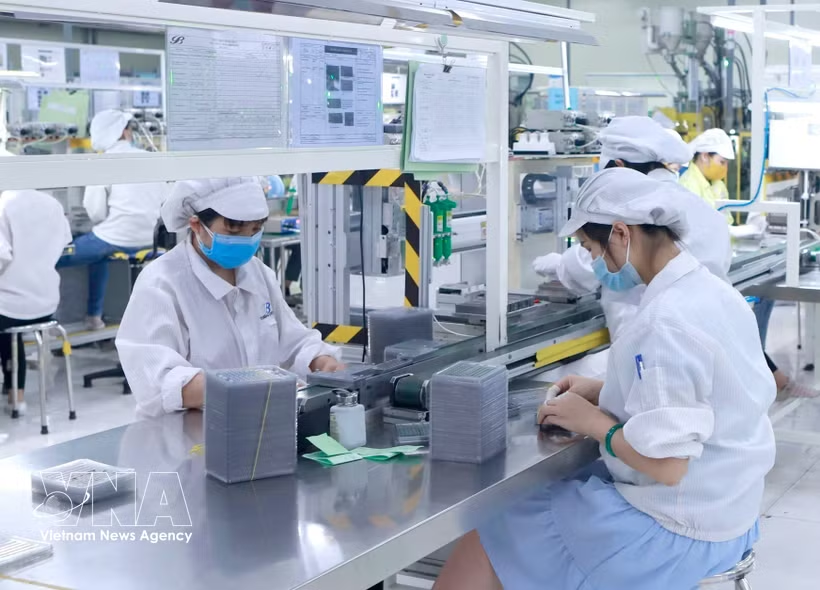
Production of electronic components at Star Engineers Vietnam Co., Ltd. in Binh Xuyen I Industrial Park, Phu Tho province (Photo: VNA)

Hanoi (VNA) – As Vietnam targets economic growth of at least 10% in 2026, fiscal policy is expected to shift from a traditional budget-balancing role to a more proactive driver of growth, with spending efficiency emerging as the decisive factor.

State budget revenue in the first four months of 2026 was estimated at 1.11 quadrillion VND (42.1 billion USD), equal to 44% of the projection, up 15.2% year-on-year, indicating still-positive fiscal space. However, economists say the key issue is no longer how much the State collects, but how effectively it spends to generate spillover effects, boost investment, expand production capacity, and sustain sustainable economic growth momentum.

Vietnam’s GDP grew 7.83% in the first quarter, a solid result amid global uncertainties, but still below the government’s target scenario. To achieve full-year growth of 10%, the remaining quarters will need to accelerate significantly, with growth projected at over 10.5% in the second quarter and rising further in the second half of the year.
vnanet-kt1.jpg
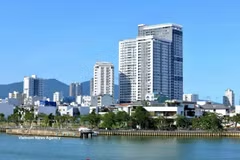
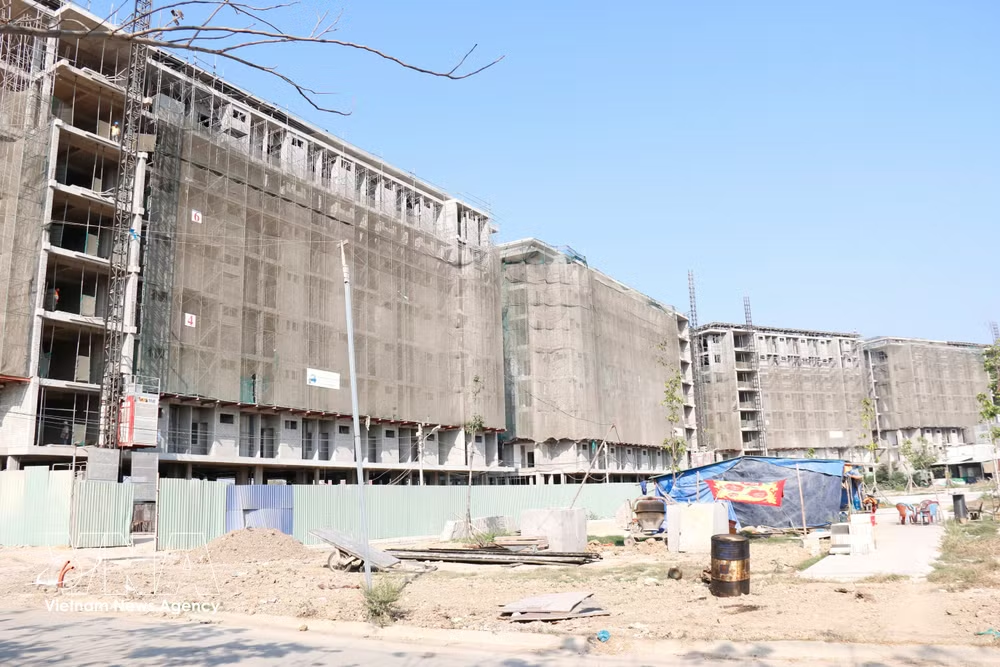
The Ca Ty Riverside apartment project in Lam Dong province, with a total investment of 798 billion VND, is being accelerated in construction (Photo: VNA)

According to Deputy Director of the Ministry of Finance's state budget department Dinh Xuan Ha, fiscal policy in 2026 must serve a dual purpose - supporting growth while expanding fiscal space. Key priorities include tackling revenue losses, transfer pricing, and tax evasion, while diversifying funding sources for development investment as spending demand rises.

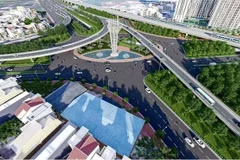
Public investment is expected to remain a key growth driver, acting as “seed capital” to unlock long-term productive capacity. Major projects such as Long Thanh International Airport, high-speed railways, ring roads, expressways, and the Olympic sports urban area are set to receive substantial funding, with strong anticipated spillover effects.

Studies suggest that each unit of public investment could generate 1.5–2 units of indirect added value by reducing logistics costs, improving connectivity, and expanding business space.

However, uneven disbursement and delays remain a bottleneck, limiting the effectiveness of capital flows. This underscores the need for continued administrative reform and stricter implementation discipline.

On the revenue side, policy is shifting toward broadening the tax base rather than raising rates, while closing loopholes that lead to revenue losses. E-commerce, estimated at 31 billion USD, has emerged as a key area requiring tighter management due to its fragmented and hard-to-track transactions.

The informal economy, accounting for around 30% of GDP, also presents significant untapped potential if gradually formalised. Despite having about 5 million household businesses nationwide, the rate of conversion into formal enterprises remains limited, constraining tax base expansion.

At the same time, tax authorities are stepping up efforts to control transfer pricing in the FDI sector and refining tax incentives to prioritise high value-added industries such as semiconductors, green economy, and high technology.

Support measures, including VAT reductions, land rent relief, and higher revenue thresholds for household businesses, will continue to be implemented to stimulate demand and support enterprises, while tax administration is being modernised through digital transformation.

Experts emphasise that fiscal policy should move beyond a supportive role to actively lead growth. Continued and selectively expanded tax and fee reductions could directly ease cost pressures on businesses, enabling them to sustain operations and expand investment.

In the context of rising investment needs, public debt and budget deficits are also being managed more flexibly. A reasonable level of deficit is considered acceptable if investment efficiency is high enough to generate growth and offset debt increases.

Alongside long-term government bond issuance, Vietnam is expanding access to international concessional finance for green transition and large-scale infrastructure projects, while exploring new avenues such as carbon credit markets and digital asset exchanges to enhance long-term fiscal capacity.

Economists note that such growth is not a short-term goal but the result of sustained accumulation over time, requiring each unit of public spending to function as an investment that creates added value for the economy./.
VNA

See more

Yen Huong Xua company introduces solutions to combat counterfeit and imitation goods (Photo: VNA)

Fight against counterfeit goods fostered amid rising digital-era fraud

Dr. Bui Van Quyen, Director of the Anti-Commercial Fraud and Counterfeiting Institute, warned that counterfeit goods have become a global challenge, exacerbated by the rise of online platforms and digital technologies. While these innovations drive economic growth, they also create fertile ground for fraudulent activities.

The fuel storage tank area of the Nghi Son Refinery and Petrochemical Plant is located in the Nghi Son Economic Zone in Nghi Son ward, Thanh Hoa province. (Photo: VNA)

Nghi Son refinery receives over 950,000 barrels of Congo crude oil

Diversifying crude oil supply sources is considered crucial for Nghi Son Refinery and Petrochemical LLC (NSRP) in ensuring stable feedstock supplies and safeguarding domestic fuel supply, particularly as traditional crude imports from Kuwait have been affected by tensions in the Middle East.

Ngo Quang Hung, representative of the Vietnam Trade Office in Malaysia, introduces Vietnamese products at the Melaka International Halal Fair, held from May 16-19, 2026. (Photo: VNA)

Vietnam, Malaysia promote smart business connectivity

Malaysia is paying close attention to Vietnam’s Doi Moi (Renewal) reforms, particularly in land policies, rice production technologies and seafood industry development, as both sides seek to expand practical cooperation.

The exchange of greenhouse gas emission quotas and carbon credits is conducted on the domestic carbon credit exchange through the carbon trading system, which is interconnected with the national registration system. (Photo congly.vn)

Ministry establishes monitoring framework for carbon market

Under a new circular, the exchange of greenhouse gas emission quotas and carbon credits is conducted on the domestic carbon credit exchange through the carbon trading system, which is interconnected with the national registration system.

Le Son Phong, Deputy Director of the Da Nang Department of Science and Technology, speaks at the press conference announcing the Da Nang Venture and Angel Summit 2026. (Photo: VNA)

Da Nang to host international venture capital forum later this month

Le Son Phong, Deputy Director of the Da Nang Department of Science and Technology, said DAVAS 2026 is not merely an investment-matching event for startups, but also demonstrates the city’s commitment to promoting innovation, developing the knowledge-based economy and creating a favourable environment for technology enterprises and startups.

Visitors explore southern Vietnam's products (Photo: vNA)

Vietnam, Cambodia boost supply chain connectivity

Total two-way trade neared 10.1 billion USD in 2024, up 17.5% year-on-year and jumping to more than 11 billion USD in 2025. Vietnam’s key exports to Cambodia include apparel, iron and steel, petroleum, machinery and equipment, chemicals, and processed food. Its main imports are cashew nuts, rubber, farm produce, and industrial raw materials.

Cao Thanh Dinh, founder and CEO of ANPz Co., Ltd (All Nippon Partners) in Japan (Photo: VNA)

Resolution 68 boosts investor confidence in Vietnam’s long-term outlook

Cao Thanh Dinh, Founder and CEO of ANPz Co., Ltd (All Nippon Partners) in Japan, said that after one year of implementation, Resolution No. 68-NQ/TW of the Politburo on private sector development has sent a positive signal to investors by affirming the private sector as a key driver of sustainable and long-term development.

To promote the local lychee brand, expand consumption markets and enhance the fruit's value, Bac Ninh province is organising various trade promotion activities and experiential tourism programmes during the 2026 lychee season. (Photo: VNA)

Bac Ninh promotes lychee tourism with 36 model orchards

According to the Bac Ninh Centre for Culture and Tourism Promotion, the orchards must comply with VietGAP, GlobalGAP or organic production standards while offering suitable conditions for experiential tourism activities. They are also required to connect with nearby tourist attractions, craft villages and historical sites to form integrated tour routes.

Ha Long-Mong Cai Expressway (Illustrative photo: VNA)

Quang Ninh takes lead in public investment disbursement

As of May 13, the northern province had disbursed more than 5.64 trillion VND (213.9 million USD) in public investment capital, fulfilling 24.2% of its annual target and 54% of its disbursement target of 10.56 trillion VND for the year's first half.