Culture budget commitment of 2% expected to drive long-term development

Resolution 80 affirms that investment in culture is investment in the country’s future and sustainable growth, while calling for a fundamental shift in the mobilisation of resources for cultural development, with the State taking a leading role.

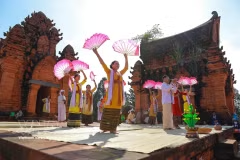
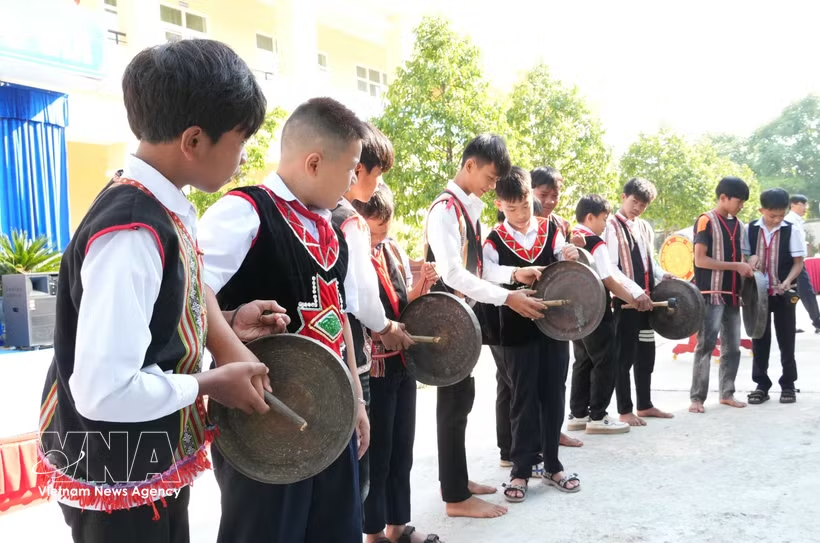
Quang Ngai introduces gong culture and xoang dance into schools, helping preserve, promote and spread the value of traditional cultural heritage. (Photo: VNA)

Hanoi (VNA) – The Politburo’s Resolution No. 80-NQ/TW on the development of Vietnamese culture is a significant policy breakthrough, with its commitment to allocate at least 2% of annual state budget expenditure to create new momentum for sustainable national development.

Policy breakthrough for cultural development

Resolution 80 affirms that investment in culture is investment in the country’s future and sustainable growth, while calling for a fundamental shift in the mobilisation of resources for cultural development, with the State taking a leading role.

A key target outlined in the resolution is to ensure adequate funding for culture by earmarking at least 2% of the total annual state budget expenditure for the sector, with allocations set to increase gradually in line with practical demands. The move demonstrates the State’s role not only as a funding provider but also as a driver of the broader cultural investment ecosystem.

For the first time, a Party resolution has introduced a specific spending threshold for culture, marking a shift from investment that is tied to a binding financial commitment. The policy reflects the view that culture should stand alongside the economy as a pillar of national development.

Public investment priorities under the resolution include grassroots cultural activities, heritage preservation, innovation, human resource development, cultural industries and digital technology applications.Vietnam also plans to continue upgrading cultural infrastructure, prioritising national-scale institutions such as museums, theatres and arts centres, while improving the effectiveness of grassroots cultural and sports facilities suited to different regions and ethnic groups.

At its first session, the 16th National Assembly adopted a resolution on Vietnamese cultural development, reaffirming the minimum 2% budget allocation and encouraging greater mobilisation of social resources for the sector.

According to Minister of Culture, Sports and Tourism Lam Thi Phuong Thanh, the NA resolution helps institutionalise three key breakthroughs identified in Resolution 80, namely improving mechanisms to mobilise cultural resources, nurturing cultural and artistic talent, and promoting science, technology, innovation and digital transformation to generate new drivers for cultural growth.

Focus on effective spending

Discussing the 2% allocation policy, National Assembly deputy from Ninh Binh province Tran Van Khai said the policy is necessary, but that implementation will depend on how resources are distributed.

He stressed that attention should be paid to funding allocations for grassroots cultural institutions, heritage conservation, digital transformation, digital cultural security and digital workforce training. Without clear priorities, the policy risks meeting spending targets without delivering strategic impact, he warned.

Associate Professor Dr Bui Hoai Son, a standing member of the NA’s Committee for Cultural and Social Affairs, described the minimum 2% commitment as a major step forward in policymaking, reflecting a more comprehensive understanding of culture’s role in national development.

However, he emphasised that higher spending alone would not automatically translate into better outcomes. The decisive factors, he said, are how resources are managed, which priorities are selected and how oversight mechanisms are enforced.

“If resources are spread too evenly without focus, it will be difficult to create breakthroughs,” Son said, calling for a results-oriented approach to cultural investment governance.

He proposed three priority areas for investment. The first is people, including artists, artisans, grassroots cultural workers, managers, cultural-industry personnel, and young creative talent. The second is essential cultural infrastructure, especially in the digital sphere, such as libraries, museums, theatres, creative spaces, data infrastructure and heritage digitisation platforms.

The third priority is strategic programmes with broad social impact, including safeguarding endangered heritage, commissioning major cultural works, supporting key cultural industries and promoting Vietnam’s cultural brand globally.

According to Son, concentrating resources on areas with strong spillover effects would generate far greater impact than equal distribution across sectors.

He also highlighted the need to rethink how cultural investment is measured. Success, he said, should be assessed not only by completed projects or disbursed funds, but also by broader benefits such as improved public access to culture, stronger community ties, better heritage protection, greater market reach for cultural products, and enhanced Vietnam’s national image.

In his view, the 2% allocation should be regarded not simply as public spending, but as a strategic investment in soft power, human development and the country’s long-term sustainability.To maximise effectiveness, he called for transparent allocation criteria, clear accountability, and the use of State funding as seed capital to attract additional social investment./.
VNA

See more

Soldier Tran Thanh, a member of the Hoang Dieu Citadel National Salvation Youth Union, carries a lunge mine to destroy enemy tank on the streets of Hanoi on December 23, 1946, during the early days of the nationwide resistance war. (File photo: VNA)

Nghe An to host exhibition featuring President Ho Chi Minh’s call for national resistance

This is an important political and cultural event that celebrates the lasting historical significance of President Ho Chi Minh's call for national resistance, while highlighting the vision, determination, and intellectual strength of the Party and the Vietnamese people during a pivotal moment in history. The exhibition also aims to celebrate the late President’s 136th birth anniversary (May 19, 1890 - 2026).

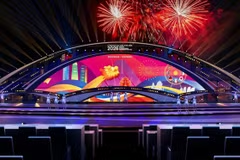
Tthe DIFF 2026 stage has been designed around the concept of convergence, inspired by the image of converging horizons where cultures, time, and emotions meet (Source: DIFF)

DIFF 2026 set to mark breakthrough in stage scale, performance technology

The DIFF 2026 stage has been designed around the concept of convergence, inspired by the image of converging horizons where cultures, time, and emotions meet. With a width of up to 100 metres and a total area of nearly 1,200sq.m, the stage is considered the largest in the history of DIFF.

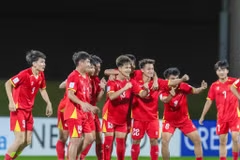
Vietnam's national U17 football team defeat United Arab Emirates national U17 football team 3-2 in the final Group C match of the AFC U17 Asian Cup 2026 in Saudi Arabia on early May 14. (Photo: VFF)

Vietnam secure berth at FIFA U17 World Cup 2026 for first time

Vietnam national U17 football team secured a place at the FIFA U17 World Cup 2026 for the first time after defeating United Arab Emirates national U17 football team 3-2 on in the final Group C match of the AFC U17 Asian Cup 2026 in Saudi Arabia on early May 14 (Vietnam time).

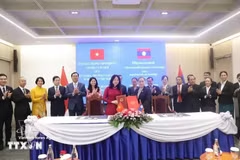
Vietnamese Minister of Culture, Sports and Tourism Lam Thi Phuong Thanh and Lao Minister of Culture and Tourism Suonsavan Vignaket exchange the signed culture and tourism cooperation scheme for 2026–2030. (Photo: VNA)

Vietnam, Laos ink 2026–2030 culture-tourism cooperation plan

Both sides pointed to substantive, positive outcomes in cultural and tourism cooperation from 2021-2025, citing successful cultural weeks in each country, cultural and art activities marking important occasions of the two Parties and countries, and the effective delivery of agreements reached by leaders that further fostered the special Vietnam–Laos relationship.

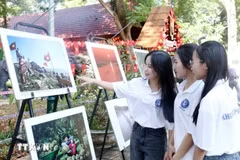
Students visit the photo exhibition. (Photo: VNA)

Vietnam, RoK photo exhibition highlights cultural connections

Among the displayed works, 60 photographs introduce the modern RoK with its rich cultural depth and spectacular natural landscapes, while 40 others vividly portray the beauty, cultural identity and ongoing development of Dak Lak and Vietnam’s Central Highlands region.

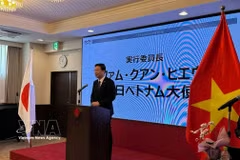
Vietnamese Ambassador to Japan Pham Quang Hieu speaks at the press conference on May 12. (Photo: VNA)

Vietnam Festival in Tokyo eyes higher turnout

The Vietnam Festival in Japan will serve as both a showcase of Vietnamese culture, cuisine and traditional arts and a vivid symbol of friendship and close bonds between the two nations, said Vietnamese Ambassador to Japan Pham Quang Hieu.

Gia Lai hosts 2026 International U14 Football Festival

Gia Lai hosts 2026 International U14 Football Festival

Through the tournament, Gia Lai aims to promote its image as a friendly, culturally rich and dynamic destination while boosting tourism, sports development and cultural exchanges among participating countries, Chairman of the Gia Lai provincial People’s Committee Pham Anh Tuan said at the opening ceremony.

Tran Minh Tri is one of five Vietnamese athletes at the Asian Weightlifting Championships 2026 in India. (Photo: VNA)

Weightlifters hunt Asian medals in India

Vietnamese athletes are seeking for their top three finishes from the Asian Weightlifting Championships 2026 in India, a key preparation for the 20th Asian Games in the next few months.

An athlete in the VNG IRONMAN 70.3 Da Nang event (Photo: baovanhoa.vn)

Southeast Asia’s largest multisport event week concludes in Da Nang

Held from May 7 to 11, Southeast Asia’s largest multisport event week in Da Nang featured the inaugural full-distance VNG IRONMAN Vietnam 2026, consisting of a 3.8-kilometre swim, 180-kilometre cycling segment and a full 42-kilometre marathon. The week also included the VNG IRONMAN 70.3 Da Nang, comprising a 1.9-kilometre swim, 90-kilometre cycling course and 21-kilometre run.

The Wolfoo animation franchise is among top 10 finalists for 7th De Men Awards for Children 2026. (Photo: Organising board)

Top 10 finalists for 7th De Men Awards for Children 2026 announced

Founded and organised annually since 2020 by the Vietnam News Agency’s The thao và Van hoa (Sports & Culture) newspaper, the De Men (Cricket) Awards for Children honour outstanding artistic and literary works either “by children” or “for children.” The awards include a grand prize called the Cricket Knight Award, and several Cricket Desire Awards of equal standing.

Vietnamese Minister Counsellor Nguyen Thi Thai Binh and Song Mun Yeong, director of the Seongnam multicultural family support centre, pose with Vietnamese brides and Vietnamese students in Seongnam during the 15th Global Harmony Festival. (Photo: VNA)

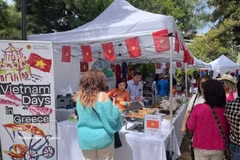
Vietnam shines at Seongnam global culture festival

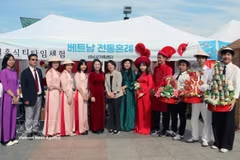
Organised by the associations of Vietnamese brides and students in Seongnam, the stall featured traditional art performances, distinctive cultural products and a variety of dishes reflecting Vietnam’s rich cultural identity.