Ho Chi Minh City’s international financial centre opens new opportunities for businesses

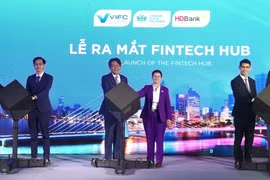
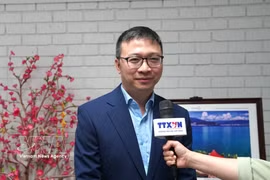
Assoc. Prof. and Dr. Nguyen Huu Huan, Vice Chairman of the VIFC-HCMC Executive Board, said the centre is envisioned as an integrated finance-technology-trade ecosystem operating under international standards.

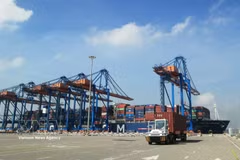
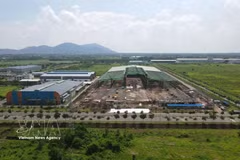
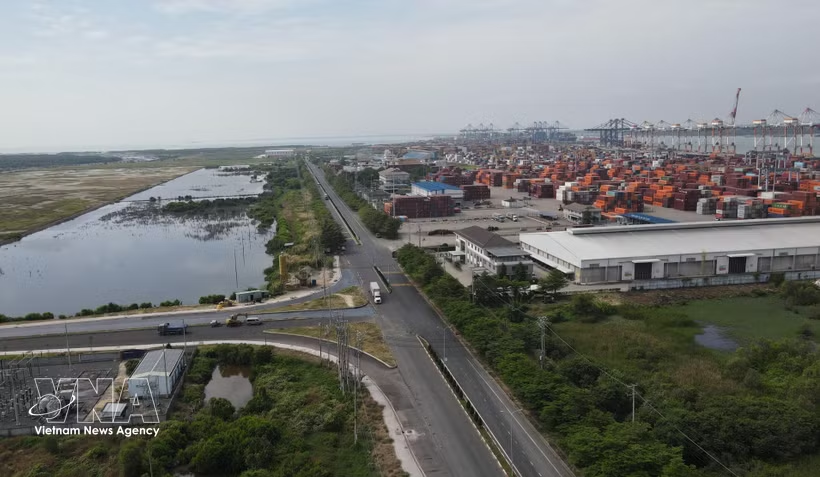
Ho Chi Minh City promotes the implementation of the Cai Mep Ha Free Trade Zone, attracting strategic investors, boosting growth for the megacity and the entire southern key economic region. (Photo: VNA)

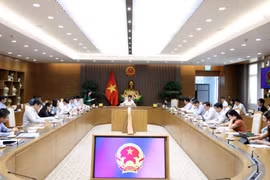
Ho Chi Minh City (VNA) – The establishment of the Vietnam International Financial Centre in Ho Chi Minh City (VIFC-HCMC), together with a series of special mechanisms and policies, is expected to create new momentum for economic growth and open up fresh opportunities for businesses to access global capital flows, heard a business forum held in Ho Chi Minh City last weekend.

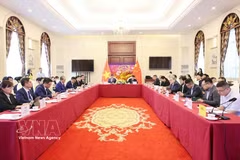
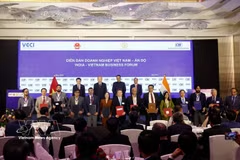
Themed “Vietnam International Financial Centre in Ho Chi Minh City – Opportunities for Businesses,” the May 16 forum was organised by the Ho Chi Minh City Business Association (HUBA).

Nguyen Ngoc Hoa, Chairman of HUBA, said Ho Chi Minh City is entering a new development phase that requires strategic growth drivers for the economy.

To seize opportunities in the new era, businesses must embrace science and technology, innovation and digital transformation. However, he noted that the biggest challenge remains whether enterprises have sufficient financial and human resources to absorb and apply new technologies effectively.

In recent years, several key policies have been issued to support business development, including the Politburo’s Resolution No. 57-NQ/TW on breakthroughs in science, technology, innovation and national digital transformation, Resolution No. 68-NQ/TW on private economic development, and Resolution No. 59-NQ/TW on international integration in the new context.

Ho Chi Minh City has also benefited from Resolution No. 260/2025/QH15, which amends and supplements special mechanisms under Resolution No. 98/2023/QH15 on the city’s development.

Despite these supportive policies, access to capital remains the biggest bottleneck for small- and medium-sized enterprises (SMEs), Hoa said.

“The State is promoting policies that allow businesses to participate in major national projects through bidding mechanisms, supply chain cooperation and subcontracting networks. Large corporations also need ecosystems of SMEs to support large-scale projects. But to participate, enterprises must have sufficient capital to invest in machinery, technology, workforce and production capacity,” he noted.

Hoa expressed his concern that as major corporations increase capital mobilisation for strategic national projects, SMEs may face growing difficulties in accessing credit, particularly as interest rates show signs of rising again.

Against this backdrop, the Vietnam International Financial Centre is expected to become an effective capital channel to address businesses’ financing needs.

Assoc. Prof. and Dr. Nguyen Huu Huan, Vice Chairman of the VIFC-HCMC Executive Board, said the centre is envisioned as an integrated finance-technology-trade ecosystem operating under international standards.

It will feature flexible legal frameworks, sandbox mechanisms for fintech and digital assets, as well as specialised international arbitration and court systems to support cross-border financial transactions.

As Vietnam’s demand for capital to support growth, digital transformation and green transition continues to surge, the international financial centre is expected to improve the country’s ability to attract and connect global capital flows, develop capital markets, foster innovation and strengthen economic competitiveness.

VIFC-HCMC is also expected to drive the development of specialised financial sectors where Vietnam still has significant room for growth, such as maritime finance, aviation finance, green finance, carbon trading, wealth management and fintech.

For businesses, especially private enterprises, the centre will create opportunities to access more diversified capital sources and modern financial services. Enterprises will be able to participate in emerging markets such as international securities, commodity derivatives, carbon credits, digital assets and supply chain finance platforms.

According to Huan, Ho Chi Minh City holds major advantages in developing into an international financial hub thanks to its economy, which accounts for around 25% of the nation’s GDP, strong growth momentum, strategic location connecting international maritime routes, and operating costs estimated at only one-fifth of those in Singapore, Hong Kong or Dubai.

Dr. Can Van Luc, chief economist at BIDV and member of the National Financial and Monetary Policy Advisory Council, said Vietnam aims to achieve average GDP growth of more than 10% during 2026-2030, while increasing the digital economy’s contribution to around 30% of GDP.

To realise these targets, Vietnam is estimated to require annual development capital of 260-280 billion USD through 2030.

Luc described the international financial centre and related free trade zone mechanisms as a “golden opportunity” for businesses to participate in large-scale infrastructure, logistics, port and financial service projects.

Nevertheless, he warned that significant challenges remain, including incomplete legal frameworks, the non-convertibility of the Vietnamese dong, cyber security risks and increasing international competition.

To take full advantage of the new opportunities, Luc said businesses should proactively restructure markets, diversify supply chains, accelerate green and digital transformation, strengthen risk management capacity and adopt modern financial instruments aligned with global “green and digital” trends./.
VNA

See more

Cargo containers are handled at Gemalink International Port, Ho Chi Minh City. (Illustrative photo: VNA)

Government delegation for international economic, trade negotiations established

The delegation is tasked with assisting the Prime Minister in directing ministries, sectors and localities in the negotiation, signing, coordination of ratification and approval, as well as implementation of international treaties and agreements on economic and trade matters involving the Vietnamese State and Government.

Lotte Mart Vietnam is currently distributing around 900 private-label products manufactured in Vietnam under the retailer’s strict quality control. (Photo: VNA)

RoK steps up trade cooperation with Vietnam, Malaysia

The Korean business delegation's trip aims to provide Korean firms with information on import – export trends across the ASEAN region and developments in local markets, while also offering opportunities to explore the latest industry trends and technologies.

An overview of the Vietnam-China Green Industry Cooperation and Exchange Programme held in Beijing.(Photo: VNA)

Vietnam, China boost cooperation in green industry development

The Vietnamese Embassy in China, in coordination with the International Cooperation Centre under China’s National Development and Reform Commission (NDRC), on May 18 organised the Vietnam–China Green Industry Cooperation and Exchange Programme in Beijing to strengthen policy exchanges, share experience, and promote substantive cooperation in green industry amid climate change and growing global environmental challenges.

The infrastructure of Thang Long 3 Industrial Park in Phu Tho province is comprehensive and modern, creating favourable conditions for businesses and investors. (Photo: VNA)

Strong economic conglomerates drive domestic economic growth

In manufacturing, THACO has built one of Southeast Asia’s largest automobile and mechanical engineering ecosystems in Quang Nam province, while VinFast has become Vietnam’s first electric vehicle producer, establishing a major factory in Hai Phong, listing on Nasdaq and expanding into North America, Europe and Southeast Asia.

Producing garments for export to the EU market at TDT Thai Nguyen Garment Company. (Photo: VNA)

Vietnam’s textile industry draws high-tech FDI amid green, smart shift

With export turnover rising steadily in recent years and a target of 50 billion USD by 2026, Vietnam remains among the world’s top three textile exporters. Beyond its traditional appeal as a low-cost manufacturing base, the country is now positioning itself as a strategic hub for high-value and technology-driven investment.

An FDI enterprise invests in factory facilities at Chau Duc Industrial Park, a project spanning approximately 2,290 ha. (Photo: VNA)

Ho Chi Minh City targets next-generation, high-value FDI

The southern economic hub attracted nearly 3.3 billion USD in FDI during the first four months of 2026, marking a sharp year-on-year increase of 227.1%. The total included 539 newly licensed projects with registered capital exceeding 791.8 million USD and 58 existing projects adding 259.3 million USD in supplementary investment.

The VinFast electric vehicle charging station at the CT1 apartment complex of 103 Hospital in Hanoi. (Photo: VNA)

Vietnam accelerates drive to master EV technologies

By the end of 2025, Vietnam had established 28 standards and technical regulations related to charging stations, charging equipment and batteries. The legal framework is expected to be fully completed in the third quarter of 2026.

Duyen Hai Wind Power Plant in Truong Long Hoa ward, Vinh Long province. (Photo: VNA)

Energy sector seen as key pillar for Vietnam’s green, double-digit growth ambitions

Chairman of the Vietnam National Industry-Energy Group (Petrovietnam) Le Ngoc Son said Vietnam’s energy demand will continue rising sharply, creating enormous pressure on power generation investment. To sustain GDP growth of around 10%, electricity demand is expected to increase by 12-15% annually, requiring an additional 7,000-8,000 MW of new capacity each year.

A view of the Lien Chieu Container Port construction project in Da Nang city (Photo: VNA)

Logistics set to drive Vietnam’s rise in global supply chains

Amid sweeping restructuring in global trade driven by digitalisation, green transition and geopolitical shifts, logistics is no longer a back-end function. It is increasingly a decisive factor in economic performance, especially as Vietnam deepens integration into international supply chains. The challenge now extends beyond faster delivery to building a modern and interconnected logistics ecosystem capable of organising supply chains at a regional scale.

Coupang.com, one of the Republic of Korea's leading online retail corporations, has actively cooperated with the Vietnamese Embassy in handling issues related to products and items with wrong information of Vietnam. (Screenshot of the site)

Coordinated efforts help safeguard healthy online marketplaces

As the digital environment continues to evolve rapidly, stronger coordination among authorities, platform operators and user communities is becoming increasingly important to build a healthy cyberspace that respects cultural identity while helping reinforce friendship and mutual understanding among people worldwide.

Vietnam will host the 21st Asian-Australasian Association of Animal Production Societies (AAAP) Animal Science Congress (AAAP 21) from October 28 - 31 in Hanoi. (Photo: aaap2026.org)

Vietnam to host 21st AAAP animal science congress

According to the Animal Husbandry Association of Vietnam (AHAV), the event is expected to gather between 1,300 - 1,500 delegates, including around 500 leading international scientists, experts and businesses in the livestock sector.