Hanoi (VNA) – The Politburo’s Resolution No. 68-NQ/TW on the private economic sector development, issued in May 2025, targets 2 million enterprises by 2030, including at least 20 major corporations participating in global value chains.
Meanwhile, Resolution No. 79-NQ/TW on the State-owned economic sector development, issued in January 2026, aims to place 50 State-owned enterprises among Southeast Asia’s 500 largest companies by 2030, with one to three entering the world’s top 500 firms.
The resolution also calls for building several large and competitive state-owned corporations with modern technology and international competitiveness to lead domestic firms deeper into global production and supply chains, particularly in strategic sectors.
According to Dau Anh Tuan, Vice President of the Vietnam Chamber of Commerce and Industry, after 40 years of “Doi Moi” (Renewal) scheme from 1986 to 2026, Vietnam has seen the rise of major economic groups across many sectors.
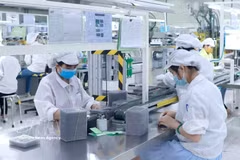
In manufacturing, THACO has built one of Southeast Asia’s largest automobile and mechanical engineering ecosystems in Quang Nam province, while VinFast has become Vietnam’s first electric vehicle producer, establishing a major factory in Hai Phong, listing on Nasdaq and expanding into North America, Europe and Southeast Asia.
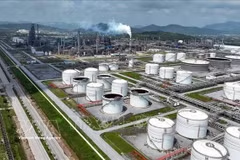
In heavy industry, Hoa Phat Group has grown from a small furniture workshop into one of Southeast Asia’s leading steelmakers, producing millions of tonnes annually and competing in export markets.
In technology, FPT Corporation has expanded into dozens of countries, providing digital transformation services to multinational corporations. In consumer goods, Vinamilk now exports to more than 50 countries, while Masan Group has built a consumer ecosystem spanning food, beverages and retail.
These companies, Tuan noted, prove Vietnamese private enterprises can build nationally recognised brands with regional competitiveness.
In infrastructure and real estate, Vingroup has launched projects on an unprecedented scale for Vietnam’s private sector, from urban developments and hospitals to electric vehicle manufacturing. Sun Group and BRG Group have also invested billions of US dollars in tourism infrastructure, resorts and airports.
By the end of 2025, Vietnam had nearly 1.1 million active enterprises. However, Tuan said the business community remains “large in quantity but not yet strong, broad but not yet deep”.
Nguyen Duc Hien, Vice Chairman of the Party Central Committee’s Commission for Policies and Strategies, noted that many enterprises still depend heavily on capital, while Vietnam’s ambition to become a modern industrialised nation by 2045 requires strong industrial conglomerates.
Economic expert Tran Dinh Thien said countries aspiring to become economic powers need globally competitive corporations capable of leading the economy and weathering global fluctuations.
He argued Vietnam should move away from fragmented support policies, comparing the old approach to “scattering grain for sparrows”, which creates many small firms but few major corporations. Instead, policies should focus on businesses capable of creating spillover effects across production chains.
Thien also stressed that mastering technology is essential for becoming an economic power, though choosing priority industries requires careful planning.
Sharing international experience, Nguyen Canh Cuong from the National University-Hanoi said Japan succeeded by identifying strategic industries and maintaining long-term investment. The Republic of Korea built flagship conglomerates such as Samsung and Hyundai Motor Company, while China leveraged its market size and strong policy support to develop industrial clusters and move up global value chains.
Together, Resolutions 68 and 79 are creating a more comprehensive policy framework for the growth of Vietnamese enterprises. Opportunities and foundations are now in place, with the key challenge lying in effective implementation and consistent long-term strategy.
Experts held that if Vietnam capitalises on this period effectively, the next decade could see the emergence of regional-scale conglomerates capable of strengthening the country’s position in global industrial value chains and advancing its economic ambitions./.
See more
Hanoi emerges as attractive destination for hospitality real estate investment
Hanoi is regarded as one of the most promising markets for hospitality investment, thanks to rising visitor numbers and its ability to sustain demand.
Seven new airports to be put into operation by 2030
These include two flagship airports, Long Thanh and Gia Binh, and five others, namely Quang Tri, Phan Thiet, Sa Pa, Tho Chu and Thanh Son.
Vinachem makes Fortune Southeast Asia 500 for the first time
According to Fortune’s latest list, Vinachem ranked 148th among Southeast Asia’s top 500 companies in 2026. The ranking is compiled using key financial indicators including revenue, profit and total assets, and covers enterprises from seven regional economies, namely Vietnam, Indonesia, Thailand, Malaysia, Singapore, Philippines and Cambodia.
Lien Khuong Airport expected to reopen in August
The project is invested by ACV, with a total investment of over 1 trillion VND (38 million USD), including the repair of the entire runway, taxiways, safety strips, and technical infrastructure and equipment to ensure flight operations.
Workshop discusses support for businesses through better use of RCEP
Vietnam's total trade turnover with RCEP member economies reached nearly 503 billion USD in 2025, of which exports accounted for approximately 171 billion USD, up more than 30% compared with 2022, when the agreement came into force.
Ho Chi Minh City moves to ease tax hurdles for FDI firms
The Ho Chi Minh City tax agency said it will maintain regular dialogue with businesses, push ahead with administrative reform and digital transformation, and identify implementation bottlenecks to recommend policy adjustments, facilitating investment and business activities for FDI enterprises.
Growing Halal market offers opportunities for Vietnamese businesses
The Halal market is becoming a promising avenue for businesses in Ho Chi Minh City. With its well-developed manufacturing, trade and service ecosystem and dynamic business community, the city is well positioned to strengthen its role in regional and global Halal supply chains.
Over 16,000 tonnes of fresh lychees exported to China through Kim Thanh border gate
More than 16,000 tonnes of fresh lychees worth nearly 11 million USD were exported to China through Kim Thanh International Border Gate No. 2 from the start of the harvest season through June 14.
Vietnam seeks to position itself as leading destination for foreign investment
A significant shift in the recently issued Resolution 10 is the move from a strategy of attracting “more capital” towards attracting “higher-quality FDI”. The objective is no longer limited to investment volume but extends to absorbing advanced technologies, increasing domestic value creation, strengthening innovation capacity and accelerating modernisation in the economy.
76 premium “.vn” domain names to be auctioned in second round
The auctions will be conducted in a public and transparent manner through an online bidding platform. Each domain name will have a starting price of 10 million VND (380 USD).
Vietnam tightens rules on corporate bond issuance
Under Decree No 200/2026/ND-CP, enterprises issuing bonds will continue to operate under the principle of self-borrowing, self-repayment and self-responsibility, meaning issuers are fully accountable for the efficiency of capital use, debt repayment capacity and any disputes arising from bond issuance, use of funds, and payment of principal and interest.
Hanoi adopts framework to boost night-time economy development
The resolution encourages a wide range of cultural, artistic and tourism activities, including performances, exhibitions, film screenings, presentations of traditional and intangible cultural heritage, and other programmes held in public spaces, pedestrian streets, heritage sites, theatres, cinemas and cultural venues.
Ample room remains for Vietnam–India logistics cooperation
The GTTCI expert noted that alongside logistics and integrated warehousing, e-commerce is expected to be a particularly high-growth sector in the coming years. He described it as a multi-billion-dollar market with significant untapped opportunities for cooperation between Vietnam and India.
Vietnam’s five-month trade surges despite global uncertainties
Despite geopolitical uncertainties, disruptions to global supply chains, stricter import standards in many markets and rising shipping costs, exports and imports continued to expand at a robust pace.
Reference exchange stays stable on June 16
The State Bank of Vietnam set the daily reference exchange rate at 25,165 VND/USD on June 16, unchanged from the previous day.
Kim Long Motor partners with Germany’s ZF Group in automotive technology
Under the agreement, the two sides will pursue broad cooperation in integrating ZF Group’s core components into both internal combustion engine vehicles and electric vehicles (EVs) manufactured by Kim Long Motor.
Vietnam’s textile industry faces pressure from EU's new rules from 2028
The European Union’s planned implementation of the Digital Product Passport (DPP) from 2028 is pushing Vietnam’s textile and garment industry to begin building the data infrastructure needed to meet the new requirements.
Vietnam, EU enhance cooperation in green finance
Minister of Finance Ngo Van Tuan called on the EU to help facilitate Vietnamese firms' access to green finance, expand technical and financial assistance for green transition, and enhance cooperation in strategic technologies, innovation, digital finance and high-tech human resources development.
Vietnam seeks new export pathways to Middle East, South Asia
With a long-term market development strategy and effective utilisation of FTA benefits, Vietnamese enterprises will be well-positioned to deepen their integration into global value chains and distribution networks.
Vietnam, ADB to advance strategic projects with strong economic impact
ADB has identified a pipeline of 27 projects for Vietnam through 2029, with total planned financing of approximately 4.6 billion USD. The projects focus on sectors that are among Vietnam’s priorities, including infrastructure, energy, urban development, agriculture and public sector management.