Private economic sector poised for breakthrough growth

More than a year after the Politburo's Resolution No. 68-NQ/TW on private sector development came into effect, expectations now extend beyond increasing the number of enterprises. The goal is to build a stronger business community with greater resilience, larger ambitions and the capacity to compete in global supply chains.

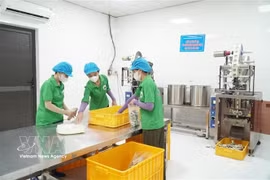
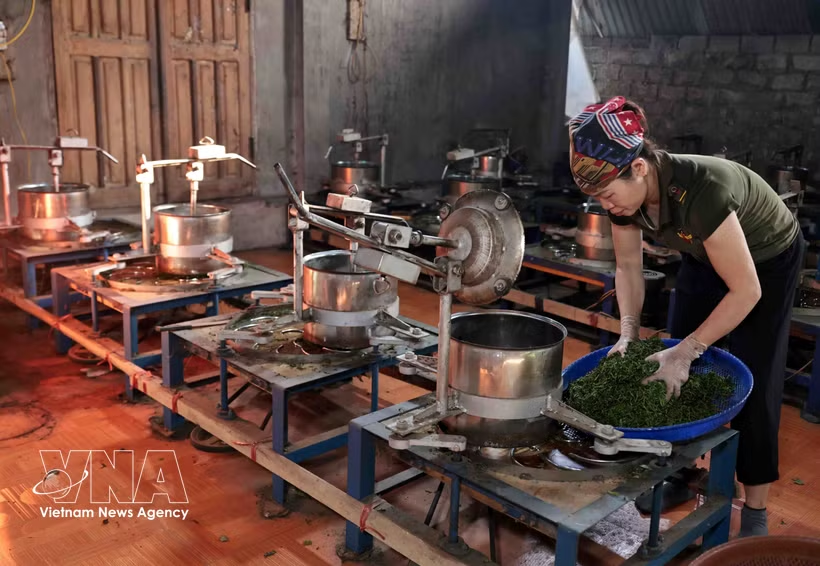
Lien Minh Agricultural Cooperative in Thai Nguyen province, provides stable employment for hundreds of its members. (Photo: VNA)

Hanoi (VNA) – The private economic sector is entering a crucial window of opportunity as development policies become clearer, reform efforts more decisive, and the sector increasingly positioned at the centre of national growth strategies.

However, in order to turn the opportunities into reality, experts stressed the need for solutions to longstanding bottlenecks related to institutions, the business environment, access to resources and enterprise capacity are addressed in a substantive manner. The priority now is to create conditions that enable the private sector to grow stronger in both scale and quality.

Bridging gap between policy, execution

Deputy General Secretary of the Vietnam Chamber of Commerce and Industry (VCCI) Dau Anh Tuan described the private economic sector as “large in number, but not yet strong.”

The sector currently accounts for 96.6% of all active enterprises, with more than one million businesses nationwide. However, over 80% employ fewer than 50 workers, while more than 70% have registered capital below 10 billion VND (379,355 USD).

These figures reflect the dominance of small-scale firms with limited financial resilience, family-based management models and modest capacity to withstand market shocks. Even relatively minor disruptions such as declining orders, rising costs, cash-flow pressure or prolonged administrative procedures can significantly affect operations.

The report also highlighted mounting pressure on businesses. About 60.2% of enterprises identified customer acquisition as their biggest challenge - the highest level in five years. The figure rose to 64.4% in manufacturing and 60.4% in agriculture, forestry and fisheries. Meanwhile, 75.5% said they could not access bank loans without collateral.

These indicators point to a dual challenge - unstable market demand and continued difficulty accessing finance. Many enterprises possess viable products and operational capability but lack the capital needed to expand production, invest in technology or scale up operations.

Despite a range of State support policies, the gap between policy design and implementation remains a major concern. Businesses continue to report repeated requests for additional documents, prolonged approvals due to inconsistent interpretations among authorities and cumbersome procedures despite official simplification efforts.

VCCI President Ho Sy Hung warned that while such issues may not immediately trigger major disruptions, prolonged inefficiencies gradually erode investor confidence, delay expansion plans and weaken incentives for innovation.

According to Hung, Vietnam does not lack reform-oriented policies. The challenge lies in ensuring implementation is effective and resources are fully unlocked. When institutions remain inefficient, procedures complicated and access to land, capital and information constrained, “golden opportunities” cannot easily become drivers of growth.

VCCI has therefore called for more substantive consultation with businesses and a legal framework that is easier to understand, access and implement, helping create a more favourable environment for production and investment.

Accelerating reforms to remove bottlenecks


Recognising these challenges, the Government issued eight resolutions at the beginning of its new term focused on cutting and decentralising administrative procedures while simplifying business conditions. The reforms target amendments to 163 legal documents in a coordinated manner.
vnanet-anh-ttxvn.jpg
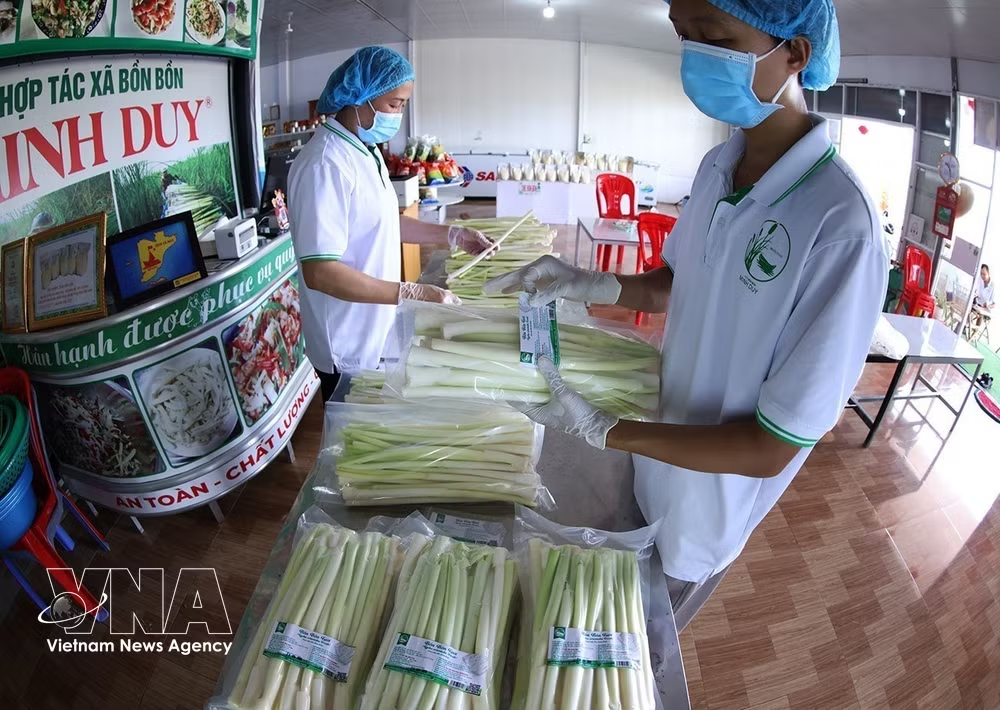
Processing and packaging of water spinach products at Minh Duy Water Spinach Cooperative in Hung My commune, Ca Mau province (Photo: VNA)

The Government aims to reduce at least 30% of administrative procedures, cut processing times and compliance costs by 50%, lower 30% of business conditions and eliminate unnecessary procedures altogether. To date, 184 procedures have been abolished, 134 decentralised to local authorities and 349 simplified. At the same time, 890 business conditions have been removed, while governance has gradually shifted from pre-inspection to post-inspection.

Nguyen Duy Hung, representative of Tan Hiep Phat Group, said businesses do not seek preferential treatment but rather a transparent, fair and predictable business environment.

Hung held that reform should be measured not by the number of documents revised or meetings held, but by the time businesses save, the costs reduced and the confidence restored.

Experiences from provinces with strong PCI performance also show that reform cannot remain merely a slogan. Vice Chairman of the Quang Ninh provincial People’s Committee Bui Van Khang noted that Quang Ninh has remained among the country’s top PCI performers for 13 consecutive years.

However, he stressed that improving the business environment is not a short-term campaign or a race based on investment incentives. More important are institutional quality, governance capacity, innovation and the ability to build trust among enterprises.

As growth expectations rise and competition intensifies, Vietnam’s private sector increasingly needs a genuine development ecosystem in which authorities not only advocate reform but actively help businesses reduce risks, identify opportunities and build confidence for long-term investment.

More than a year after the Politburo's Resolution No. 68-NQ/TW on private sector development came into effect, expectations now extend beyond increasing the number of enterprises. The goal is to build a stronger business community with greater resilience, larger ambitions and the capacity to compete in global supply chains.

Achieving this will require more decisive efforts to remove bottlenecks, improve institutional transparency, strengthen policy predictability and ensure fairer access to resources. Alongside State support, businesses themselves must accelerate innovation and improve competitiveness to become a key driver of Vietnam’s ambition for double-digit economic growth in the years ahead./.

VNA

See more

A view of the second Asia Agri Food International 2026 in Ho Chi Minh City on May 19 (Photo: VNA)

India pushes stronger agri-food cooperation with Vietnam

Experts noted that Vietnam has established itself as one of Southeast Asia’s leading agricultural product exporters, while India remains a major global supplier of agricultural and food products. By combining India’s production capacity and technological strengths with Vietnam’s dynamic processing and export ecosystem, the two countries can build more resilient supply chains in the region.

A panel discussion at the Meet Australia 2026 programme on May 19 (Photo: VNA)

Meet Australia 2026 promotes sustainable partnership opportunities

Meet Australia 2026 is not only a trade and investment promotion event but also a forum connecting trust, vision and action between Vietnam and Australia, as well as between national-level cooperation orientations and development needs of localities and businesses from both countries.

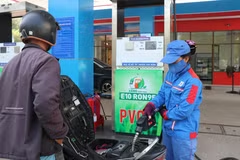
A customer purchases E10 biofuel petrol at a PVOIL station on Thai Thinh street in Hanoi. (Photo: VNA)

Authorities ordered to closely monitor rollout of E10 biofuel from June 1

According to the agency, the move is aimed at ensuring the effective and synchronised implementation of the E10 transition roadmap under Circular No. 50/2025/TT-BCT, issued by the Ministry of Industry and Trade on November 7, 2025. The plan seeks to avoid delays or supply disruptions that could affect the domestic fuel market.

Vietnamese Trade Counsellor in India Bui Trung Thuong speaks at the forum. (Photo: VNA)

Vietnam, India promote digital economy cooperation towards 25 bln USD trade target

With the strengthened Comprehensive Strategic Partnership, the rapid growth of digital economies in both countries and complementary strengths in technology, manufacturing and markets, Vietnam and India are well positioned to build a deeply connected digital trade ecosystem and enhance their participation in global value chains.

“Vietnam Economic Day” in St. Petersburg attracts crowds (Photo: VNA)

Vietnam showcases economic potential, investment opportunities in St. Petersburg

Vietnamese Ambassador to Russia Dang Minh Khoi stressed that economic cooperation between Vietnam and Russia is entering a new phase with promising opportunities for growth. He praised this year’s programme for combining a business roundtable, a youth business forum and traditional cultural and culinary activities, creating both an academic platform for dialogue and an opportunity to deepen mutual understanding between the two countries' people.

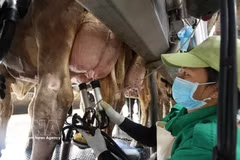
Milk collection at a dairy farm operated by Vinamilk at the Nhon Tan concentrated farming zone in An Nhon Tay commune, Gia Lai province. (Photo: VNA)

Self-reliance in raw materials fuels Vietnam’s dairy growth

The strategy targets annual industry growth of 12-14% by 2030, with processed liquid milk output reaching 4.2 billion litres annually. Domestic fresh milk production is projected to hit 2.6 billion litres per year, meeting 60-65% of processing demand, while milk powder output is expected to reach 245,000 tonnes annually. Per capita milk consumption is targeted at 40 litres per year.

Quang Ninh gives in principle approval to first offshore wind power plant

Quang Ninh gives in principle approval to first offshore wind power plant

Covering an area of 11.95 ha of land and water surface, the project is expected to have a designed capacity of 50 MW and will be implemented in nearshore waters of the Co To special zone. Its key components include wind turbines, a substation, a 110kV transmission line, and related auxiliary facilities.

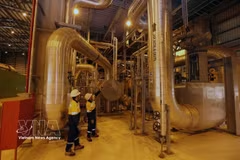
At Nghi Son 2 thermal power plant in Thanh Hoa province. (Photo: VNA)

Vietnam’s national standards strategy for 2026–2035 approved

The strategy envisions a modern, open standards system welded to international norms, serving as a piece of soft institutional infrastructure, a policy tool and a technical backbone for state governance. It also casts standards as an engine of innovation, digital transformation, green transition and sustainable development.

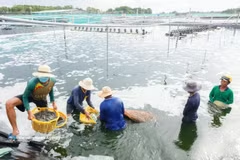
Shrimp harvesting in Ca Mau province (Photo: VNA)

Vietnamese shrimp sector seeks distinct path in global race

Nguyen Duy Hoa, Deputy Technical Director of Cargill Vietnam, said Vietnam cannot compete with Ecuador on costs nor match India in scale. Instead, the country should focus on value rather than volume or price competition, prioritising quality improvement, technology adoption and value-added products.

Wind turbine No. 3 at the V1-3 site of the Duyen Hai Wind Power Plant in Truong Long Hoa ward, Vinh Long province.(Photo: VNA)

Retail market seen driving double-digit growth

Domestic consumption is being regarded as one of the key drivers for sustaining economic growth. Following the Government’s Resolution No. 88/NQ-CP on promoting the domestic market and stimulating consumption, many retailers have accelerated the expansion of distribution systems, invested in technology and improved supply chains.

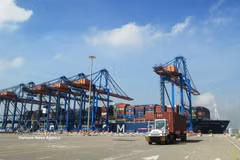
Cargo containers are handled at Gemalink International Port, Ho Chi Minh City. (Illustrative photo: VNA)

Government delegation for international economic, trade negotiations established

The delegation is tasked with assisting the Prime Minister in directing ministries, sectors and localities in the negotiation, signing, coordination of ratification and approval, as well as implementation of international treaties and agreements on economic and trade matters involving the Vietnamese State and Government.

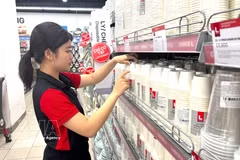
Lotte Mart Vietnam is currently distributing around 900 private-label products manufactured in Vietnam under the retailer’s strict quality control. (Photo: VNA)

RoK steps up trade cooperation with Vietnam, Malaysia

The Korean business delegation's trip aims to provide Korean firms with information on import – export trends across the ASEAN region and developments in local markets, while also offering opportunities to explore the latest industry trends and technologies.