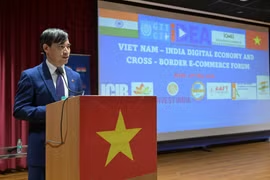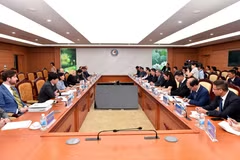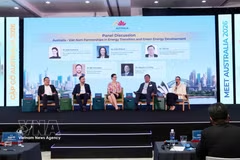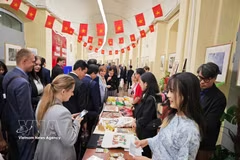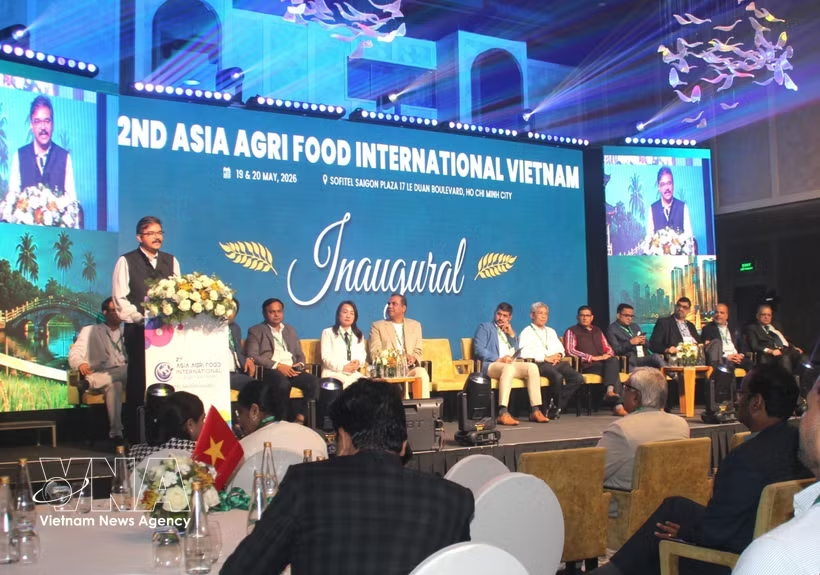
Ho Chi Minh City (VNA) – The second Asia Agri Food International 2026, taking place in Ho Chi Minh City on May 19–20, has brought together representatives of businesses, policymakers and experts to discuss ways to deepen India–Vietnam cooperation in agriculture and food, with a focus on sustainable supply chains, technology and market connectivity.
Organised by the Indian Business Chamber in Vietnam (INCHAM) and partners, the event features seminars, product showcases and business matchmaking activities aimed at strengthening regional linkages.
In his opening remarks, INCHAM Chairman Jayprakash Shriram Mishra described the seminar as a important platform to foster partnerships among India, Vietnam and other regional economies. On the foundation of their comprehensive strategic partnership, India and Vietnam are well positioned to pursue sustainable growth and navigate global challenges such as geopolitical tensions, tariffs and supply chain disruptions, he noted.
Amid global economic uncertainties, food security, resilient supply chains and agricultural cooperation have become strategic priorities for many countries, he said, adding that growing high-level exchanges and expanding bilateral ties are creating fresh momentum for business connectivity, investment expansion and value chain integration in the agri-food sector.
The two-day event has drawn wide participation from enterprises, traders and experts across Southeast Asia and India. Discussions cover agricultural trade, food processing, logistics, supply chains and technological innovation, offering stakeholders opportunities to exchange market insights, share experience and promote collaboration among management agencies, industry associations and businesses.
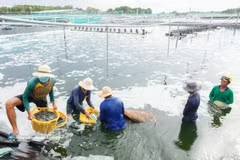
Experts noted that Vietnam has established itself as one of Southeast Asia’s leading agricultural product exporters, while India remains a major global supplier of agricultural and food products. By combining India’s production capacity and technological strengths with Vietnam’s dynamic processing and export ecosystem, the two countries can build more resilient supply chains in the region.
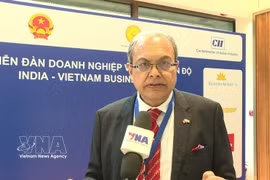
Indian economist G. Chandrashekhar highlighted that the elevation of bilateral ties to a comprehensive strategic partnership not only targeted increasing two-way trade to 25 billion USD by 2030, but also opened a new phase of cooperation in trade, investment, technology, healthcare and renewable energy. For businesses and investors, this signals expanding opportunities in manufacturing, infrastructure, digital economy, pharmaceuticals, logistics and cross-border services, he said.
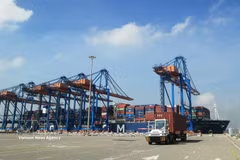
The trade structure between the two countries is largely complementary, with Vietnam exporting industrial and high-tech goods, while India supplies raw materials, agricultural products and certain manufactured items. Vietnam is also emerging as an attractive destination for Indian investment in energy, mineral exploration, agro-processing, information technology and auto components.
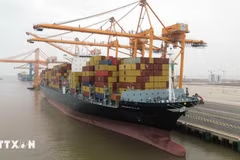
With its political stability, large population and strategic location along major shipping routes, Vietnam is increasingly seen as a promising partner for India, he said, adding that Indian businesses are actively exploring opportunities in renewable energy and port development.
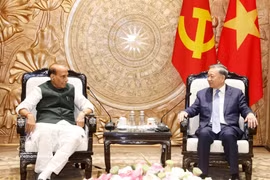
Dr. Vipra Pandey, Indian Consul General in Ho Chi Minh City, said the two countries are entering a “new golden era” in the bilateral relations, underpinned by the shared goal of raising two-way trade to 25 billion USD by 2030.
He pledged to continue supporting business connections, investment promotion and institutional cooperation between the two nations, while encouraging enterprises from both sides to pursue joint ventures, technology transfer and long-term partnerships in the agri-food sector, and other potential industries./.