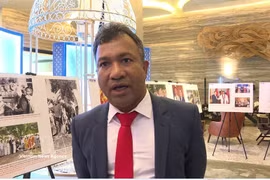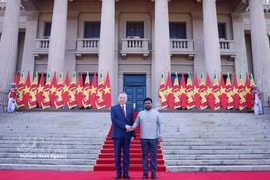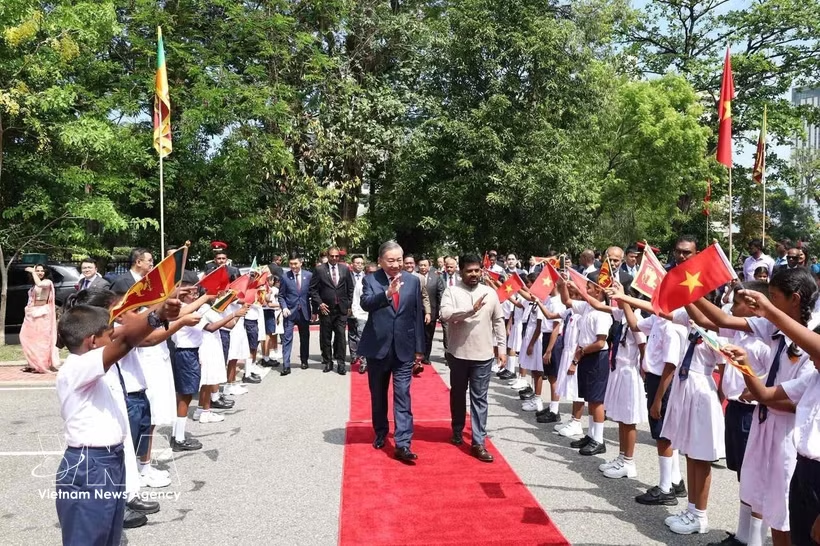
Hanoi (VNA) – The recent state visit to Sri Lanka by Party General Secretary and State President To Lam has served as a “strong catalyst” for advancing cooperation in science, technology and digital transformation between the two countries, Sri Lankan Minister of Science and Technology Chrishantha Abeysena has said.
In an interview granted to the Vietnam News Agency, Abeysena described the visit as a major milestone in bilateral relations, noting that it not only carried diplomatic significance but also generated fresh momentum for practical and innovation-driven cooperation.
A concrete outcome of the visit was the signing of a memorandum of understanding (MoU) on science and technology cooperation, reflecting a shared vision and strong political commitment to building a future based on knowledge, innovation and mutual prosperity. The document establishes an official and systematic framework for joint research, expert exchanges and the co-development of technological solutions tailored to each country's development needs.
The official said the visit elevated bilateral cooperation to a new level, opening up opportunities in key fields such as biotechnology, agriculture and food technology, climate change adaptation, electronics, automation and information technology—areas central to the sustainable development strategies of both Sri Lanka and Vietnam.
Abeysena stressed that Sri Lanka is committed to the swift and effective implementation of the MoU, emphasising that it is not merely symbolic but intended to deliver concrete benefits for both economies and their peoples. The two ministries of science and technology will jointly develop a detailed roadmap and implementation timeline.
On priority areas, Sri Lanka proposed Vietnamese support in freeze-drying technology for fruits and vegetables and MATCHA-related beverage processing technologies, which are considered highly promising for Sri Lanka’s agro-processing and export sectors. It also expressed interest in cooperation in satellite technology, electronics and electrical engineering through the Arthur C Clarke Institute for Modern Technologies (ACCIMT), as well as lightning protection systems and climate resilience planning.
The two sides agreed to organise joint technical workshops, promote collaborative research projects and strengthen long-term partnerships between universities and research institutes. They also plan to establish co-funding mechanisms to support joint research and development initiatives, according to the minister.
He expressed confidence that science, technology and digital transformation will become a key driver in shifting bilateral ties from traditional friendship to a partnership grounded in innovation and inclusive economic growth.
He noted that both countries are now at a critical stage of development, where sharing experience and expertise in digitalisation could accelerate progress in agriculture, health care, education and public services. Vietnam’s advances in digital infrastructure, he said, offer valuable lessons for Sri Lanka, whose strengths in IT services and the knowledge-based economy could also benefit Vietnam.
On research cooperation, Abeysena said the MoU provides a formal platform for scientists and institutions from both countries to jointly address shared challenges, particularly in biotechnology, climate adaptation and food technology. This will strengthen research capacity and build sustainable links between the two scientific communities.
Regarding human resources, he highlighted that exchanges of scientists, engineers and technical experts will help both sides access advanced ideas, methodologies and practical models.
The minister reaffirmed that innovation-driven economic growth is a common objective, expressing confidence that linking science and technology partnership with national development priorities will help generate new industries, create high-quality jobs and improve living standards in both countries./.
See more
Ho Chi Minh City eyes to attract high-tech capital with improved digital infrastructure
According to Deputy Director of the municipal Department of Science and Technology Nguyen Huu Yen, Ho Chi Minh City will continue investing in digital infrastructure and smart governance in 2026, with a target of expanding 5G coverage to 70-80% of the population.
Vietnam promotes cooperation with United Nations on crime prevention
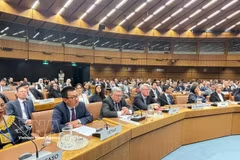
Vietnam highly values the support of the United Nations Office on Drugs and Crime (UNODC) in strengthening national capacity in crime prevention and criminal justice, drug control, and addressing emerging challenges, particularly cybercrime, said Ambassador Vu Le Thai Hoang.
VIPC Summit 2026 highlights Vietnam’s ambitions in strategic technologies
Through the VIPC Summit 2026, Vietnam aims to reaffirm its commitment to building a transparent, competitive and internationally integrated investment environment, while promoting new financial mechanisms and institutions to make science, technology, innovation and digital transformation strategic growth motivation in the coming years.
Forum discusses digital trust in finance during AI era
Deputy Minister of Public Security Sen. Lieut. Gen Pham The Tung told the forum that Vietnam’s financial and banking industry is racing through a digital overhaul, creating major opportunities as the country aims for double-digit growth in 2026 and beyond.
All citizen-government transactions to go fully digital by 2035
Looking ahead to 2035, Vietnam envisions becoming a comprehensive and sustainable digital nation where all transactions between citizens and government agencies are conducted online. National databases, with population data at the core, will be interconnected and efficiently utilised to support smart governance and real-time decision-making.
Experts hope for expanded Vietnam-India innovation cooperation
Indian experts voiced confidence that the state visit by Party General Secretary and State President To Lam would create fresh momentum for Vietnam-India cooperation in innovation, digital technology and startups, contributing to the more substantive and effective development of the two countries’ Enhanced Comprehensive Strategic Partnership.
Vietnam, Austria promote cooperation in AI, cybersecurity
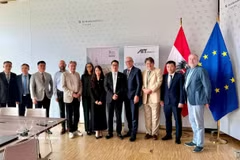
The NCA proposed strengthening its strategic partnership with the AIT through several key orientations, including the protection of critical digital infrastructure, data security and trusted digital ecosystems, the application of AI and data analytics in cybersecurity, high-quality human resources training, expert exchanges, and the co-organisation of annual international forums and conferences.
PM demands breakthrough tech results, warns against superficial action
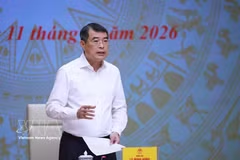
Prime Minister Le Minh Hung praised ministries and agencies for their proactive steps since the beginning of this year and especially from early April to follow the Politburo’s Resolution 57 and Conclusion 18, with clear, positive progress.
Vietnamese UAV firms showcase capabilities at world’s largest autonomy expo in US
Three Vietnamese companies are presenting their technologies at XPONENTIAL 2026 from May 11-14 in Detroit, the US: Gremsy, specialising in camera and gimbal systems; Realtime Robotics, focusing on military UAVs; and Saolatek, developing integrated drones and training solutions.
SMEs urged to strengthen cybersecurity amid digital transformation
In the digital era, the line between opportunity and risk is becoming increasingly blurred. For SMEs, digital transformation is an inevitable path, but building a strong “digital shield” will be essential for sustainable growth and stronger contributions to the national digital economy.
Vietnam advances space technology with breakthrough in composite materials
Vietnam has taken a significant step toward mastering space technology with the successful development of advanced composite materials for satellite applications, contributing to its long-term goal of building autonomous and reliable remote sensing capabilities.
Hue rolls out red carpet to draw high-quality human resources
Hue’s “red carpet” approach should extend beyond financial incentives to include the creation of a high-quality living environment, with strong healthcare systems, international-standard education and green urban spaces.
Vietnam's ratification of Hanoi Convention shows strong commitment to int'l integration: Diplomat
Vietnam’s recent ratification of the United Nations Convention against Cybercrime (Hanoi Convention) underscores the strong political commitment of the Party and State to international integration, as stipulated in Politburo Resolution No. 59-NQ/TW issued on January 24, 2025, Ambassador Vu Le Thai Hoang has emphasized in an interview with the Vietnam News Agency.
Vietnamese firm showcases range of products at SAHA 2026 defence exhibition
This marks the first time a Vietnamese enterprise has participated in and conducted trade promotion activities at SAHA, underscoring Viettel’s growth prospects and business opportunities in the regional defence industry market.
Vietnam to facilitate list of 10 strategic technology groups from July 1
Under the decision, Vietnam’s strategic technology framework comprises 10 major technology groups covering key sectors critical to the country’s long-term development and competitiveness.
Vietnam attends SAHA 2026 defence, aerospace exhibition in Türkiye
Vietnam’s participation in SAHA 2026 International Defence & Aerospace Exhibition in Istanbul reflects the country’s consistent policy of enhancing international defence integration and promoting defence industry cooperation towards self-reliance, self-strengthening, modernisation and dual-use development.
Vietnam enters the group of regional leaders in broadband telecommunications infrastructure
The evolution from 5G towards 6G is opening up a wide range of new applications, including virtual reality in healthcare, education and entertainment, as well as large-scale Internet of Things connectivity for smart cities, smart grids, autonomous vehicles and smart factories.
Vietnam, Austria seek deeper cooperation in cybersecurity
The Austria-Vietnam Cybersecurity Forum was held in a hybrid format in Vienna on May 5, bringing together policymakers, businesses, and experts to explore opportunities for bilateral cooperation while advancing policy dialogue on cybersecurity.
Education ministry demands sweeping tech curricula revamp in strategic fields
The education ministry demanded a complete review of existing curricula, covering goals, learning outcomes, structure, content, teaching and assessment methods, and how emerging technologies like AI, semiconductors, automation, data science, and cybersecurity are embedded.
Resolution 57 delivers tangible gains in digital life of citizens
The resolution has generated not only strategic momentum but also practical impact, as digital technologies are increasingly embedded in daily activities, driving socio-economic development and laying a solid foundation for rapid and sustainable growth in the new phase.