Vietnam enters the group of regional leaders in broadband telecommunications infrastructure

The evolution from 5G towards 6G is opening up a wide range of new applications, including virtual reality in healthcare, education and entertainment, as well as large-scale Internet of Things connectivity for smart cities, smart grids, autonomous vehicles and smart factories.

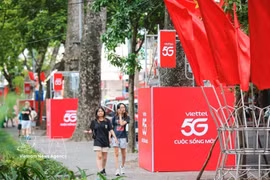
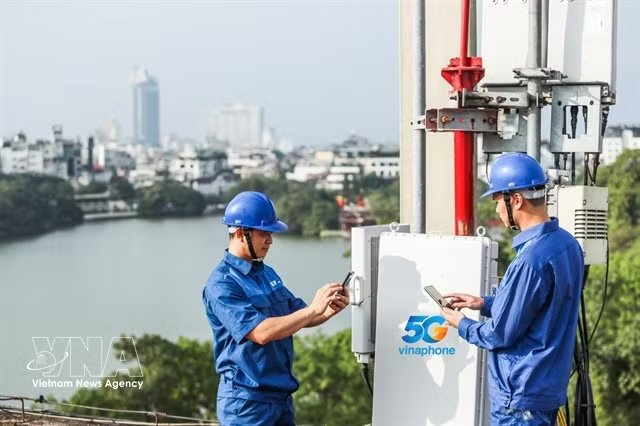
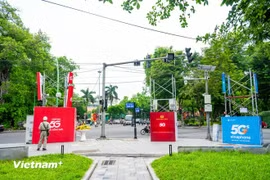
As of early 2026, more than 4,000 BTS stations had been installed nationwide, covering 90% of the population (Photo: VNA)

Hanoi (VNS/VNA) – Vietnam has entered the group of regional leaders in broadband telecommunications infrastructure, driven by strong progress in 5G deployment, rapid broadband expansion and effective spectrum planning policies.

The evolution from 5G towards 6G is opening up a wide range of new applications, including virtual reality in healthcare, education and entertainment, as well as large-scale Internet of Things connectivity for smart cities, smart grids, autonomous vehicles and smart factories.

Another key trend is the integration of terrestrial networks with satellite systems to extend coverage, particularly in remote and rural areas.

The Ministry of Science and Technology (MoST) forecasts that spectrum demand will continue to rise sharply in the coming years.

For 5G Advanced, each operator may require around 200 MHz, while 6G could require up to 400 MHz, making long-term spectrum planning essential.

Accordingly, the MoST’s Vietnam Telecommunications Authority has developed a comprehensive roadmap covering three strategic frequency bands. In the high-frequency range, Vietnam has already planned 3.2 GHz in the mmWave band from 24.25 to 27.5 GHz for terrestrial mobile networks.

As of early 2026, more than 4,000 BTS stations had been installed nationwide, covering 90% of the population, with nearly 23 million 5G subscribers and average download speeds of 188 Mbps, ranking 14th globally.

Fixed broadband speeds reached 288 Mbps, ranking ninth worldwide, with 23.8 million households connected via fibre optic networks. These results reflect the effectiveness of spectrum planning and licensing policies, helping Vietnam move into the group of leading countries in the region for broadband telecommunications infrastructure.

Looking ahead, international trends show that 6G technologies are expected to be tested around 2028 before commercialisation. Vietnam has proactively established steering committees and assigned research tasks to enterprises and universities to study 6G, aiming to keep pace with global developments and ensure readiness for future deployment./.

VNA
See more

The Vietnamese delegation attends the SAHA 2026 International Defence & Aerospace Exhibition in Istanbul. (Photo: qdnd.vn)

Vietnam attends SAHA 2026 defence, aerospace exhibition in Türkiye

Vietnam’s participation in SAHA 2026 International Defence & Aerospace Exhibition in Istanbul reflects the country’s consistent policy of enhancing international defence integration and promoting defence industry cooperation towards self-reliance, self-strengthening, modernisation and dual-use development.

Vietnam, Austria seek deeper cooperation in cybersecurity

Vietnam, Austria seek deeper cooperation in cybersecurity

The Austria-Vietnam Cybersecurity Forum was held in a hybrid format in Vienna on May 5, bringing together policymakers, businesses, and experts to explore opportunities for bilateral cooperation while advancing policy dialogue on cybersecurity.

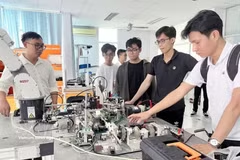
Students engage in hands-on learning through the application of digital technology software. (Illustrative photo: VNA)

Resolution 57 delivers tangible gains in digital life of citizens

The resolution has generated not only strategic momentum but also practical impact, as digital technologies are increasingly embedded in daily activities, driving socio-economic development and laying a solid foundation for rapid and sustainable growth in the new phase.

The Duc Giang General Hospital and Vietnam Post Corporation jointly launch a model applying drones to medical transport services. (Photo: hanoimoi.vn)

Vietnam charts UAV strategy as Hanoi eyes low-altitude economy

Vietnam is accelerating a national strategy to develop unmanned aerial vehicles (UAVs) as a cornerstone of its emerging low-altitude economy, with Hanoi positioning itself to pilot new governance models, regulatory sandboxes and early-stage applications in controlled airspace.

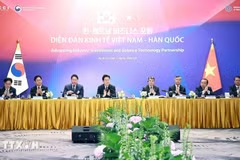
Vietnamese Prime Minister Le Minh Hung and the Republic of Korea's President Lee Jae Myung attend an economic forum in Hanoi on April 23. (Photo: VNA)

SK Group partners to build AI ecosystem in Vietnam

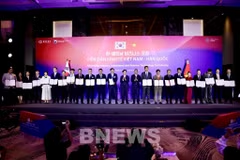
SK Innovation and SK Telecom signed MoUs with Nghe An province and the National Innovation Centre of Vietnam to advance AI ecosystem development and support the country’s long-term growth strategy.

CMC signs an AI cooperation deal with Korean partner FuriosaAI (Photo: CMC)

CMC signs AI cooperation deal with Korean partner

Under the agreement, CMC Global - a member of CMC Corporation - and FuriosaAI will collaborate on developing AI application software, leveraging their respective technological strengths and customer ecosystems to roll out joint projects in the coming period.

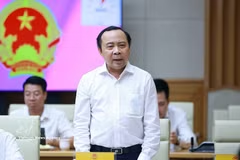
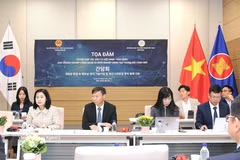
Vietnamese Deputy Prime Minister Ho Quoc Dung (R) and Deputy Prime Minister and Minister of Science and ICT of the Republic of Korea (RoK) Bae Kyung Hoon in Hanoi on April 22, 2026. (Photo: VNA)

Vietnam, RoK promote science, technology cooperation

Deputy Prime Minister Ho Quoc Dung encouraged Korean enterprises to scale up investment in Vietnam, particularly in priority sectors such as infrastructure development, high-tech electronics manufacturing, semiconductors, big data, biotechnology, and smart urban development.

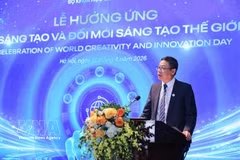
Deputy Minister of Science and Technology Le Xuan Dinh delivers opening remarks at the launching ceremony of the Scientific Innovation Competition 2026 on April 21. (Photo: VNA)

Scientific Innovation Competition opens to OVs, boosting global talent linkages

In response to World Creativity and Innovation Day 2026, the contest provides a platform for individuals and teams nationwide who are passionate about research, creativity, and practical application of science, while promoting a movement of scientific inquiry within the community, particularly among young people.

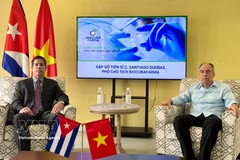
Dr. Santiago Dueñas Carrera (left), Vice President of Cuba’s BioCubaFarma group, and Cuban Ambassador to Vietnam Rogelio Polanco Fuentes at the press briefing in Hanoi on April 21 (Photo: VNA)

Biotechnology cooperation – new driver of Vietnam - Cuba relations

A representative from BioCubaFarma emphasised that the longstanding Vietnam – Cuba friendship provides a solid foundation for further advancing comprehensive cooperation, especially in science and technology – a key driver of socio-economic development and national healthcare sovereignty.

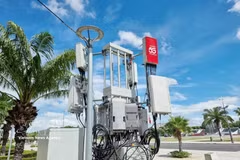
A Viettel 5G base station in Dong Hai ward, Khanh Hoa province (Photo: VNA)

Vietnam develops digital infrastructure aligned with demands of AI era

The data centre and cloud computing sector is entering a phase of redefinition. Infrastructure is no longer merely a backbone for data storage and processing, but is evolving into a foundational platform powering complex digital ecosystems—from AI and advanced analytics to real-time applications.

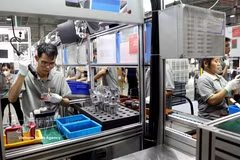
Workers manufacture products at Keystone Electrical Vietnam Co., Ltd. in the Lien Ha Thai industrial park. (Photo: VNA)

Vietnam turning ideas into value, aspirations into reality

Resolution No. 57 of the Politburo on breakthroughs in science-technology development, innovation, and national digital transformation is being vigorously implemented nationwide. Within this framework, innovation is increasingly recognised as a key engine for rapid and sustainable growth.

MK Smart achieves Common Criteria EAL5+ Certification, expanding opportunities in global digital identity

MK Smart achieves Common Criteria EAL5+ Certification, expanding opportunities in global digital identity

As countries accelerate the development of digital governments, electronic identification (eID) and electronic passports (ePassport) are becoming essential infrastructure. At the same time, security requirements are becoming increasingly stringent security requirements, particularly for systems that store sensitive data such as citizens’ identity and biometric information.