Education ministry demands sweeping tech curricula revamp in strategic fields

The education ministry demanded a complete review of existing curricula, covering goals, learning outcomes, structure, content, teaching and assessment methods, and how emerging technologies like AI, semiconductors, automation, data science, and cybersecurity are embedded.

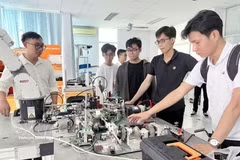
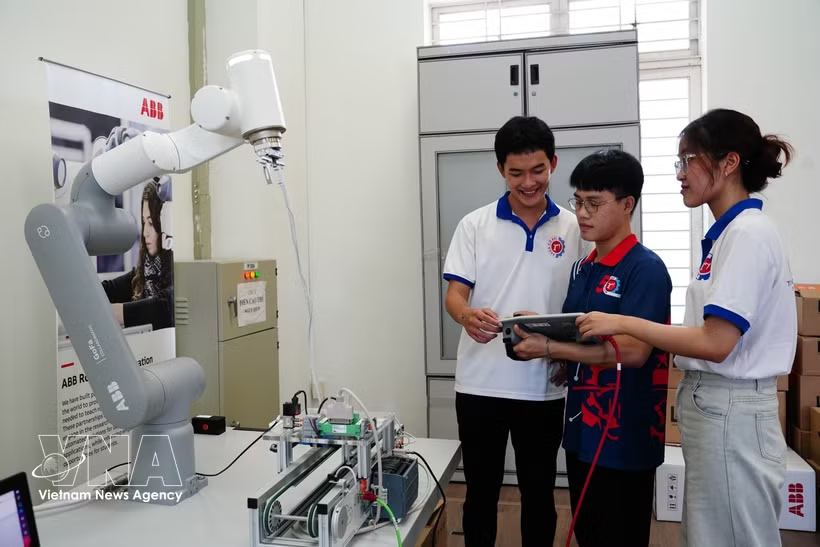
At national key laboratory of mechatronics and applications at the Da Nang University of Science and Technology (Photo: VNA)

Hanoi (VNA) - The Ministry of Education and Training (MoET) has issued a dispatch to universities, academies, higher education institutions and research institutes with doctoral courses, requesting a sweeping review and overhaul of curricula in strategic technology fields.

Accordingly, they must review, update, and scale up courses in STEM, semiconductor microchips, information technology, artificial intelligence (AI), big data, cybersecurity, core and strategic technologies, and other hi-tech sectors.

The ministry demanded a complete review of existing curricula, covering goals, learning outcomes, structure, content, teaching and assessment methods, and how emerging technologies like AI, semiconductors, automation, data science, and cybersecurity are embedded.

Curricula must be revised to boost interdisciplinary integration, add courses on new and core technologies, and expand practice sessions, projects, and industry-linked research. They should also involve major enterprises, foreign-invested firms, and tech companies in training and graduate assessment, and are encouraged to develop English-medium courses.

The ministry tasked them with creating new courses in semiconductor design and manufacturing, AI, data science, and cybersecurity, as well as in core technologies that support digital transformation and Industry 4.0. The list of priority fields extends to energy storage, space monitoring, marine technology, smart agriculture, next-generation communications, connected intelligent transport, digital creative industries, next-generation energy, green food, smart healthcare and home appliances, advanced materials, Earth system science, bioresponsive materials, and smart electric mobility.

They must also review and build up their faculty to meet quantity, structure, and qualification requirements, with priority to doctoral-level lecturers with research and international collaboration experience. They are encouraged to recruit experts from companies and research institutes and use incentive policies to draw domestic and foreign talent.

At the same time, they should review and invest in infrastructure, including laboratories, research centres, technology systems, digital learning resources, and equipment for hi-tech training.

On partnerships, the ministry ordered them to expand ties with tech enterprises, domestic and international corporations, research institutes, innovation centres, and key national technology projects.

Collaboration should take the form of co-developing and co-delivering courses, internships, commissioned training, jointly supervised research and product development, and the creation of leading expert groups and strong research teams that connect academia, industry, research institutes, key technology programmes, and international partners.

They were also told to tap national projects for integrated infrastructure, smart workshops, and digital simulation tools; set up open labs, and expand university-enterprise collaboration to build innovation hubs and student research centres that support product design, testing, and improvement, thus spurring innovation and entrepreneurship.

A tripartite network involving academia, industry, and government should be formed to jointly design courses, run internship semesters, and fund studies. Companies are expected to advise on science, help develop curricula, evaluate graduates, promote dual training and applied research, and offer internships and jobs tied to practical skills.

The ministry is pushing for a boost in workforce R&D, tighter links between training and scientific research, and the creation of research groups in strategic technology fields. It also wants expanded postgraduate education, especially STEM and hi-tech doctoral courses, and innovation centres that offer consultancy, technology transfer, and innovation services. The establishment of sci-tech and intellectual property management firms, and investment mechanisms for such enterprises is also encouraged.

Relevant results must be reported to the ministry by June 15./.
VNA

See more

Students engage in hands-on learning through the application of digital technology software. (Illustrative photo: VNA)

Resolution 57 delivers tangible gains in digital life of citizens

The resolution has generated not only strategic momentum but also practical impact, as digital technologies are increasingly embedded in daily activities, driving socio-economic development and laying a solid foundation for rapid and sustainable growth in the new phase.

The Duc Giang General Hospital and Vietnam Post Corporation jointly launch a model applying drones to medical transport services. (Photo: hanoimoi.vn)

Vietnam charts UAV strategy as Hanoi eyes low-altitude economy

Vietnam is accelerating a national strategy to develop unmanned aerial vehicles (UAVs) as a cornerstone of its emerging low-altitude economy, with Hanoi positioning itself to pilot new governance models, regulatory sandboxes and early-stage applications in controlled airspace.

Vietnamese Prime Minister Le Minh Hung and the Republic of Korea's President Lee Jae Myung attend an economic forum in Hanoi on April 23. (Photo: VNA)

SK Group partners to build AI ecosystem in Vietnam

SK Innovation and SK Telecom signed MoUs with Nghe An province and the National Innovation Centre of Vietnam to advance AI ecosystem development and support the country’s long-term growth strategy.

CMC signs an AI cooperation deal with Korean partner FuriosaAI (Photo: CMC)

CMC signs AI cooperation deal with Korean partner

Under the agreement, CMC Global - a member of CMC Corporation - and FuriosaAI will collaborate on developing AI application software, leveraging their respective technological strengths and customer ecosystems to roll out joint projects in the coming period.

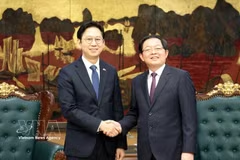
Vietnamese Deputy Prime Minister Ho Quoc Dung (R) and Deputy Prime Minister and Minister of Science and ICT of the Republic of Korea (RoK) Bae Kyung Hoon in Hanoi on April 22, 2026. (Photo: VNA)

Vietnam, RoK promote science, technology cooperation

Deputy Prime Minister Ho Quoc Dung encouraged Korean enterprises to scale up investment in Vietnam, particularly in priority sectors such as infrastructure development, high-tech electronics manufacturing, semiconductors, big data, biotechnology, and smart urban development.

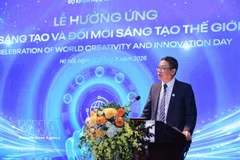
Deputy Minister of Science and Technology Le Xuan Dinh delivers opening remarks at the launching ceremony of the Scientific Innovation Competition 2026 on April 21. (Photo: VNA)

Scientific Innovation Competition opens to OVs, boosting global talent linkages

In response to World Creativity and Innovation Day 2026, the contest provides a platform for individuals and teams nationwide who are passionate about research, creativity, and practical application of science, while promoting a movement of scientific inquiry within the community, particularly among young people.

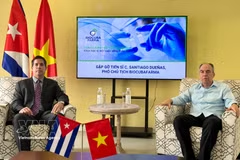
Dr. Santiago Dueñas Carrera (left), Vice President of Cuba’s BioCubaFarma group, and Cuban Ambassador to Vietnam Rogelio Polanco Fuentes at the press briefing in Hanoi on April 21 (Photo: VNA)

Biotechnology cooperation – new driver of Vietnam - Cuba relations

A representative from BioCubaFarma emphasised that the longstanding Vietnam – Cuba friendship provides a solid foundation for further advancing comprehensive cooperation, especially in science and technology – a key driver of socio-economic development and national healthcare sovereignty.

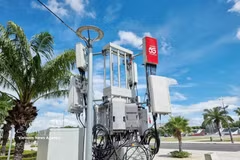
A Viettel 5G base station in Dong Hai ward, Khanh Hoa province (Photo: VNA)

Vietnam develops digital infrastructure aligned with demands of AI era

The data centre and cloud computing sector is entering a phase of redefinition. Infrastructure is no longer merely a backbone for data storage and processing, but is evolving into a foundational platform powering complex digital ecosystems—from AI and advanced analytics to real-time applications.

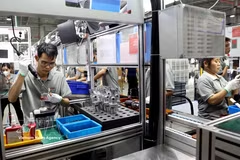
Workers manufacture products at Keystone Electrical Vietnam Co., Ltd. in the Lien Ha Thai industrial park. (Photo: VNA)

Vietnam turning ideas into value, aspirations into reality

Resolution No. 57 of the Politburo on breakthroughs in science-technology development, innovation, and national digital transformation is being vigorously implemented nationwide. Within this framework, innovation is increasingly recognised as a key engine for rapid and sustainable growth.

MK Smart achieves Common Criteria EAL5+ Certification, expanding opportunities in global digital identity

MK Smart achieves Common Criteria EAL5+ Certification, expanding opportunities in global digital identity

As countries accelerate the development of digital governments, electronic identification (eID) and electronic passports (ePassport) are becoming essential infrastructure. At the same time, security requirements are becoming increasingly stringent security requirements, particularly for systems that store sensitive data such as citizens’ identity and biometric information.

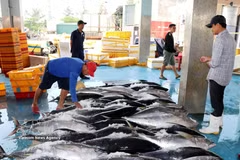
Sorting fish prior to transport for distribution. (Photo: VNA)

Fishermen keep pace with digital technology

Across central coastal provinces, authorities have introduced policies to restructure fleets, reduce vessel numbers, and support fishermen in transitioning to more sustainable livelihoods. Provinces such as Dak Lak and Gia Lai have earmarked nearly 1 trillion VND to support occupational changes and decommission inefficient vessels, while others including Nghe An, Quang Tri, Hue, and Quang Ngai are implementing roadmaps to phase out thousands of underqualified boats.

Phuc Loi ward in Hanoi has launched the “Digital Literacy for All” movement, forming support teams to help residents install applications such as iHanoi and eTax. (Photo: VNA)

Hanoi advances technological innovation in key economic sectors

The municipal People's Committee recently issued Plan No. 109/KH-UBND on technological innovation in key economic sectors through 2035, which serves as both a catalyst and a strategic move to systematise, elevate and reinforce the capital’s leading role in the digital era.