Digital technologies redraw jobs landscape

Vietnam’s labour market is entering an accelerated transition under digitalisation and AI. According to the International Labour Organization (ILO), about 11.5 million workers - one in five - are in jobs potentially affected by GenAI.

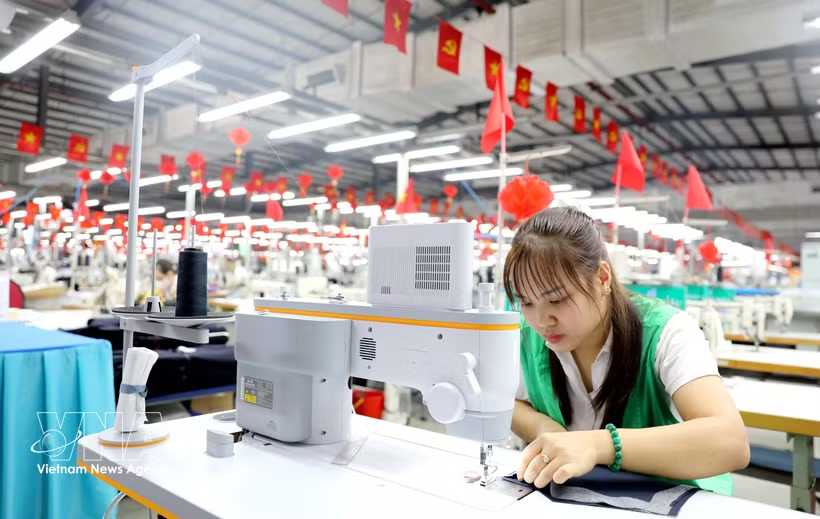
Hung Ha Veston Factory under May 10 Corporation has invested in sewing machines using AI technology to serve production (Photo: VNA)

Hanoi (VNA) - The rapid advance of digital technologies, particularly generative artificial intelligence (GenAI), is reshaping Vietnam’s employment structure. As millions face changes in job content, the labour market is undergoing sectoral shifts while demanding urgent upgrades in skills, job quality and policy adaptation.

Digital wave drives structural transformation

Vietnam’s labour market is entering an accelerated transition under digitalisation and AI. According to the International Labour Organization (ILO), about 11.5 million workers - one in five - are in jobs potentially affected by GenAI.

Rather than mass job losses, the dominant trend is job transformation. Routine tasks are increasingly automated, while workers move towards roles requiring higher cognitive, creative and interactive skills.

Only around one million workers (under 2%) are at risk of full automation, lower than in many regional peers, indicating a shift towards restructuring rather than displacement. Still, the scale of change underscores the urgency of reskilling and job transition.

Impacts vary across sectors. Finance and insurance, wholesale and retail, and information and communications are among the most affected, while administrative roles face particularly high exposure, with nearly two-thirds of positions at risk of partial automation.

Proactive governance to harness AI

Sinwon Park, Country Director of the ILO in Vietnam, noted that the country stands at a critical juncture to leverage generative AI as a driver of productivity and decent work. To ensure a positive transition, she stressed the need to strengthen AI governance in line with labour standards, invest in workforce skills, ensure workers’ participation in AI adoption, support responsible AI use among small and medium-sized enterprises, and establish safeguards to ensure an inclusive and equitable transformation.
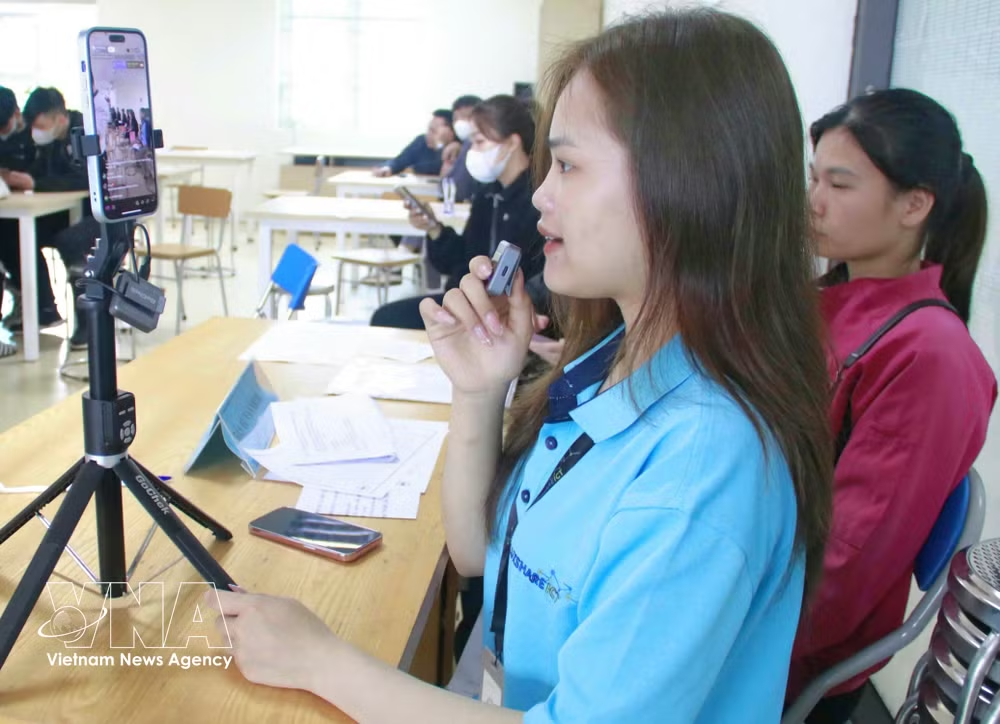
vnanet-potal-bac-ninh-ket-noi-cung-cau-lao-dong-qua-ung-dung-cong-nghe-so-8702814.jpg
Recruitment staff from various companies livestream on digital platforms to seek workers (Photo: VNA)

Geographically, major economic hubs such as Hanoi, Ho Chi Minh City and Da Nang are experiencing the most pronounced impacts. This reflects a key feature of the digital economy, where fast-growing service centres are also the earliest to feel the effects of technological change.

Gender disparities are notable, with women more exposed to affected roles (24.1% versus 17.8%), highlighting the need to integrate gender considerations into policy. At the same time, AI can enhance productivity and create new job models, particularly in sectors like retail.

Job quality challenges and policy response

Beyond technology, structural issues persist. The ILO’s World Employment and Social Outlook 2026 notes stable global unemployment at 4.9%, but stagnant job quality, with many workers in insecure or low-paid roles.

Informal employment remains a major concern, with 2.1 billion workers globally projected in this sector by 2026 - a challenge also relevant to Vietnam.

Youth face rising pressure, with global unemployment at 12.4% and 260 million not in employment, education or training. AI may intensify competition, especially for standardised high-skill roles.

Vietnam’s challenge is not just job creation, but ensuring quality, productivity and adaptability. Progress towards high-value sectors such as digital technology, green energy and the circular economy remains uneven.

A coordinated policy response is essential, including stronger investment in education, digital skills and lifelong learning, improved labour market data systems, and close monitoring of AI impacts.

Experts also emphasise responsible AI adoption, stronger workplace dialogue, and targeted protection for vulnerable groups such as women, youth and informal workers.

Vietnam’s labour market transformation is inevitable. While technology offers opportunities for growth and productivity, it also raises challenges around skills, job quality and inequality. How the country manages this transition will determine whether it drives inclusive development or widens existing gaps, requiring a proactive, people-centred approach./.
VNA

See more

Officers and soldiers of the Hai Phong Border Guard assist a Chinese fishing vessel in securing its moorings while awaiting favourable weather conditions for being towed into the harbour shelter. (Photo: VNA)

Vietnamese border guards rescue two foreign fishing vessels in distress at sea

The prompt and successive rescue of the two foreign vessels underscores the professionalism and responsibility of Vietnam’s Border Guard force in safeguarding maritime sovereignty and security. It also serves as a clear demonstration of Vietnam’s commitment to promoting a peaceful, friendly, and humanitarian maritime environment in line with international law and practices.

Construction site of Tu Lien bridge, along Nghi Tam Street (Photo: VNA)

Hanoi accelerates seven Red River bridge projects, many exceed 70% completion

ccording to the municipal Transport Construction Investment Project Management Board, the city is simultaneously implementing seven projects, namely Tu Lien, Ngoc Hoi, Tran Hung Dao, Thuong Cat, Van Phuc, Hong Ha and Me So bridges. Construction is being carried out on multiple fronts, focusing on bored piles, pile caps, piers and superstructure works.

Border guards of Dong Thap province present gifts and raise awareness on IUU fishing prevention for fishermen at Vam Lang fishing port, Gia Thuan commune, Dong Thap province. (Photo: VNA)

Dong Thap tightens fishing control to curb IUU fishing

The southern province has ensured 100% of fishing vessels are registered, licensed, and equipped with vessel monitoring systems (VMS). Authorities have strengthened inspections, particularly targeting vessels that lose tracking signals or fail to meet operational conditions.

Visitors tour Dien Bien Phu Victory Museum (Photo: VNA)

Dien Bien battlefield legacy powers tourism revival

Seventy-two years after the Dien Bien Phu Victory, its legacy still reverberates. The unity, self-reliance, and resilience forged in that historic triumph remain a powerful internal engine, now propelling Dien Bien toward fast and sustainable development.

Delegates cut the ribbon to inaugurate the Vietnam Pavilion at Foire de Paris. (Photo: VNA)

Vietnam space opens at Foire de Paris

The opening ceremony featured vibrant performances, including a traditional lion dance and musical showcases with the monochord (dan bau) and T’rung bamboo instrument, offering visitors an immersive introduction to Vietnamese culture. The festive atmosphere was further enhanced as lion dance troupes paraded through the Vietnamese exhibition area.

Vietnam’s fertility drops below replacement in recent years, from 2.11 children per woman in 2021 to 1.91 in 2024 and 1.93 in 2025, especially in major cities and more developed regions. (Photo: VNA)

Health ministry targets annual fertility rate of 2% by 2030

Vietnam’s fertility has dropped below replacement in recent years, from 2.11 children per woman in 2021 to 1.91 in 2024 and 1.93 in 2025, especially in major cities and more developed regions, prompting the need for coordinated measures to encourage childbirth.

The Hoa Binh 1 and 2 wind power plants in Vinh Hau commune, Ca Mau province generate around 400 million kWh annually, contributing to the country’s energy security (Photo: VNA)

Vietnam’s energy transition on track, poised to become regional power hub: Malaysian expert

Vietnam is entering the most challenging phase—from planning to execution—where financial, infrastructural and governance challenges are all surfacing at once. Yet this stage also clarifies opportunities. If the country can overcome systemic bottlenecks and balance security, transition and cost considerations, it has the potential to emerge as a key energy pillar in Southeast Asia.

The Vietnam Education Publishing House is working to supply textbooks to localities (Photo: VNA)

Vietnam picks one textbook set for all schools, targets free books by 2030

The Ministry of Education and Training has selected the “Ket noi tri thuc voi cuoc song” (Connecting Knowledge with Life) series, published by state-owned Vietnam Education Publishing House (VEPH), from among three existing sets. The education minister approved the choice on December 26, 2025, locking in enough time for preparation before the new school year.

Party General Secretary and State President To Lam speaks at a meeting with voters from ten wards in central Hanoi on May 4. (Photo: VNA)

New opportunities open for Hanoi to make stronger breakthrough: Top leader

Party General Secretary and State President To Lam told voters from ten central Hanoi wards on May 4 that while Hanoi faces significant challenges, it also has unprecedented opportunities for breakthrough development befitting its role as the capital, as he and members of the city’s delegation to the 16th National Assembly met with constituents to hear their views and brief them on the legislature’s first session.

A requiem ceremony for Nguyen Van Tu held ahead of the park naming event. (Photo: VNA)

Berlin names park after Vietnamese victim of neo-Nazi violence

Nguyen Van Tu, born in 1963, was murdered on April 24, 1992, at the age of 29 amid a surge of far-right violence targeting immigrants in post-reunification Germany. His death remains a stark reminder of a difficult period for Vietnamese and other foreign communities in the country.

National Assembly Chairman Tran Thanh Man lays flowers in commemoration of President Ho Chi Minh, heroes and martyrs at the memorial site of the Nam Ky Uprising in Hoc Mon commune, Ho Chi Minh City, on May 4. (Photo: VNA)

NA Chairman pays tribute at Hoc Mon historic site

Writing in the memorial book, Chairman Tran Thanh Man said he was deeply moved to visit the site, which witnessed the Nam Ky Uprising on November 23, 1940 and preserved important milestones in the long struggle of the army and people of the 18 hamlets of betel gardens.

The opening ceremony of the Hoa Binh - Xuan Mai clean water plant. (Photo hanoimoi.vn)

5 trillion VND clean water plant opened in Phu Tho

Cplant’s launch marked a key milestone in developing technical infrastructure in Phu Thọ and surrounding regions, helping meet rising demand for clean water in Hanoi while supporting urban, industrial and services growth.

“Google Digital Classroom”, a space that inspires passion and builds core digital skills for students. (Photo: VNA)

Hanoi scales up high-quality schools, raises standards

In addition to 23 accredited institutions, the city plans to establish 37 more, lifting the total to 60. The move signals a shift in approach rather than a mere technical adjustment, aligning with the Politburo’s Resolution 71-NQ/TW on education breakthroughs and Hanoi’s Action Programme 05-CTr/TU.

The exquisite mother-of-pearl inlaid cabinet that Lumban Sianipar meticulously brings back from Vietnam (Photo: VNA)

“Vietnam Museum” in the heart of Indonesia

The house of Lumban Sianipar, former Indonesian Defence Attaché in Vietnam, unfolds as a cultural journey through Vietnam, with walls adorned with mother-of-pearl inlay works, eggshell art, lacquer and oil paintings. Intricately crafted wooden cabinets, Bat Trang ceramics and various handicrafts are thoughtfully arranged, creating a space that is both elegant and warmly imbued with Vietnamese character.