Ho Chi Minh City (VNA) – A growing number of cooperatives in Ho Chi Minh City are proactively developing standardised raw material zones, not only meeting domestic demand but also steadily breaking into demanding international markets.
With production organised through tightly linked value chains and strict compliance with quality standards, farm produce is securing stable outlets while gaining higher value, opening up sustainable growth pathways for farmers.
Standardised production takes shape
After more than two decades cultivating cocoa, farmer Tran Nhu Phong in Binh Gia commune has shifted to organic farming across his 2-hectare plot, minimising chemical inputs.
As a member of Chau Duc Cocoa Cooperative, his produce now enjoys stable purchasing contracts and has reached high-end markets such as Japan and the Netherlands - clear evidence of the effectiveness of standardised raw material development.
From small, fragmented farms, farmers joining cooperatives are forming concentrated production zones with uniform processes and quality.
Chau Duc Cocoa Cooperative, for instance, has expanded from 11 members covering 60 hectares to 97 households with around 100 hectares, though output still falls short of demand, underscoring strong market appetite for certified products.
Businesses are also playing a pivotal role by investing beyond procurement into deep processing, producing higher-value items such as chocolate, cocoa powder and fermented beverages.
Companies such as OCA Vietnam–Japan Co., Ltd. are helping build closed-loop production and distribution chains. According to Nguyen Thi Thu, Director of the company, gaining access to demanding markets like Japan and Europe hinges on strict quality control from the raw material stage, alongside full compliance with stringent international standards.
Investment in processing products such as chocolate, cocoa powder and fermented beverages is not only diversifying output but also boosting added value, strengthening the competitiveness of Vietnamese agricultural products.
High-tech farming as a “passport” to exports
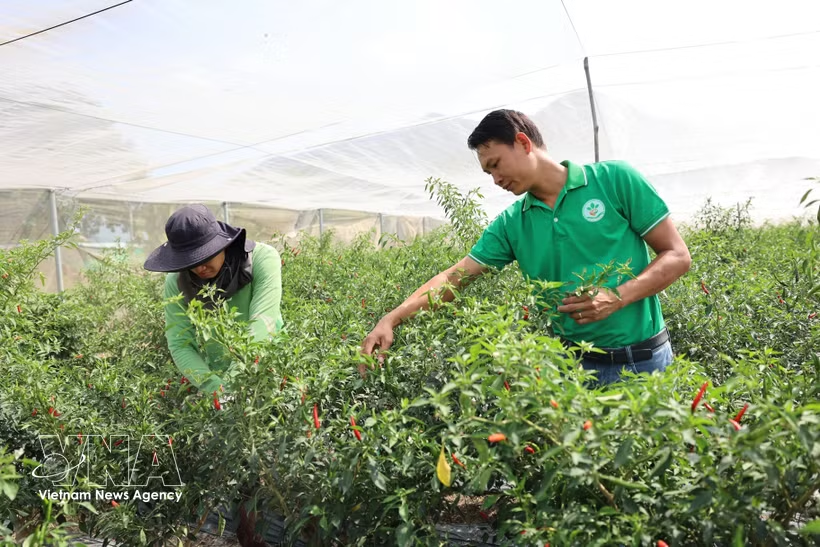
Alongside cocoa, herb cultivation in Chau Pha commune is emerging as another success model. The local agricultural cooperative manages 55 hectares of VietGAP-certified produce, including 20 hectares dedicated to exports to Europe. High-tech solutions -greenhouses, automated irrigation and digital management systems - ensure strict quality control and traceability, enabling weekly exports of around three tonnes.
Participation in standardised production is also reshaping farmers’ mindsets.
While stricter processes require greater effort, they bring stable prices and significantly higher incomes, encouraging more farmers to join cooperative-linked models.
According to the Ho Chi Minh City Department of Agriculture and Environment, the city currently has over 300 agricultural cooperatives with more than 7,000 members. Many are actively expanding standardised raw material zones through partnerships with farmers and businesses, aligning production with international standards.
The department is advising the municipal People’s Committee on a decision to approve a list of key sectors and products eligible for incentives and priority support in production and consumption linkages. The move is expected to provide a foundation for guiding the development of standardised raw material zones and improving the efficiency of agricultural value chains in the coming period.
With continued policy support and a stronger focus on value-chain linkages, high-tech adoption and quality enhancement, building standardised raw material zones is proving not just a short-term solution but a long-term strategy, positioning Vietnamese agricultural products to compete sustainably in global markets./.
VNA